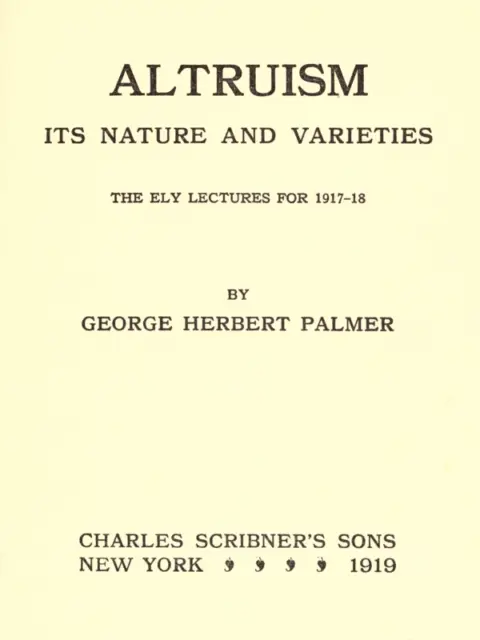
Altruism: Its Nature and Varieties
George Herbert Palmer
THE CLASSIC COLLECTION · 1908
"The Teacher: Essays and Addresses on Education" by George Herbert Palmer and Alice Freeman Palmer is a collection of insightful essays written in the early 20th century. The work delves into various philosophical aspects of education, examining the roles and ideals of teachers, the nature of ethical and moral instruction, and the broader implications of teaching within society. The authors address the significance of teaching as an art form that shapes character and influences the development of students. The opening of the book presents a preface that outlines the structure and core themes of the essays within. Palmer discusses the profound responsibility and influence teachers have over their students, emphasizing the importance of teaching as more than just a profession but an art intertwined with character development. He introduces the concept of "vicariousness" as a necessary quality for teachers, urging them to empathize deeply with their students' perspectives. Palmer's reflections establish the foundational ideas that the following essays will explore, setting the stage for a rich examination of education's role in shaping individuals and society at large.
Introduction adapted from the source catalogue; source summaries may be automatically generated.
Free to read · English · 91,433 words · No account needed
MAKE TIME FOR A GOOD BOOK
On by default. Untick to stop anonymous reading totals. Each page counts after 10 seconds in view. How this works.
Anonymous counting is on unless you have switched it off.
Fortunate it is, then, that self-cultivation in the use of English must chiefly come through speech; because we are always speaking, whatever else we do. In opportunities for acquiring a mastery of language the poorest and busiest are at no large disadvantage as compared with the leisured rich. It is true the strong impulse which comes from the suggestion and approval of society may in some cases be absent, but this can be compensated by the sturdy purpose of the learner. A recognition of the beauty of well-ordered words, a strong desire, patience under discouragements, and promptness in counting every occasion as of consequence,--these are the simple agencies which sweep one on to power. Watch your speech then. That is all which is needed. Only it is desirable to know what qualities of speech to watch for. I find three,--accuracy, audacity, and range,--and I will say a few words about each.
Obviously, good English is exact English. Our words should fit our thoughts like a glove and be neither too wide nor too tight. If too wide, they will include much vacuity beside the intended matter. If too tight, they will check the strong grasp. Of the two dangers, looseness is by far the greater. There are people who say what they mean with such a naked precision that nobody not familiar with the subject can quickly catch the sense. George Herbert and Emerson strain the attention of many. But niggardly and angular speakers are rare. Too frequently words signify nothing in particular. They are merely thrown out in a certain direction to report a vague and undetermined meaning or even a general emotion. The first business of every one who would train himself in language is to articulate his thought, to know definitely what he wishes to say, and then to pick those words which compel the hearer to think of this and only this. For such a purpose two words are often better than three. The fewer the words, the more pungent the impression. Brevity is the soul, not simply of a jest, but of wit in its finer sense where it is identical with wisdom. He who can put a great deal into a little is the master. Since firm texture is what is wanted, not embroidery or superposed ornament, beauty has been well defined as the purgation of superfluities. And certainly many a paragraph might have its beauty brightened by letting quiet words take the place of its loud words, omitting its "verys," and striking out its purple patches of fine writing. Here is Ben Jonson's description of Bacon's language: "There happened in my time one noble speaker who was full of gravity in his speech. No man ever spoke more neatly, more pressly, more weightily, or suffered less emptiness, less idleness, in what he uttered. No member of his speech but consisted of his own graces. His hearers could not cough or look aside without loss. He commanded when he spoke, and had his judges angry or pleased at his discretion." Such are the men who command, men who speak "neatly and pressly." But to gain such precision is toilsome business. While we are in training for it, no word must unpermittedly pass the portal of the teeth. Something like what we mean must never be counted equivalent to what we mean. And if we are not sure of our meaning or of our word, we must pause until we are sure. Accuracy does not come of itself. For persons who can use several languages, capital practice in acquiring it can be had by translating from one language to another and seeing that the entire sense is carried over. Those who have only their native speech will find it profitable often to attempt definitions of the common words they use. Inaccuracy will not stand up against the habit of definition. Dante boasted that no rhythmic exigency had ever made him say what he did not mean. We heedless and unintending speakers, under no exigency of rhyme or reason, say what we mean but seldom, and still more seldom mean what we say. To hold our thoughts and words in significant adjustment requires unceasing consciousness, a perpetual determination not to tell lies; for of course every inaccuracy is a bit of untruthfulness. We have something in mind, yet convey something else to our hearer. And no moral purpose will save us from this untruthfulness unless that purpose is sufficient to inspire the daily drill which brings the power to be true. Again and again we are shut up to evil because we have not acquired the ability of goodness.
Your reading position is saved on this browser. Take it to another device with a library code. Reading pages adapt to text, rather than matching a printed edition.
George Herbert Palmer
George Herbert Palmer
BEHIND THE BOOK
This eBook is for the use of anyone anywhere in the United States and most other parts of the world at no cost and with almost no restrictions whatsoever. You may copy it, give it away or re-use it under the terms of the Project Gutenberg License included with this eBook or online at www.gutenberg.org. If you are not located in the United States, you will have to check the laws of the country where you are located before using this eBook. Read the source licence.
The original source file, including credits and licence, is retained by this library. Request an original-format copy at no charge. Please include the book title and Project Gutenberg identifier #36774.
KEEP YOUR CURIOSITY GOING

David Patterson (Spirit) Hatch

David Patterson (Spirit) Hatch

David Patterson (Spirit) Hatch
Coulson Kernahan

Ralph Waldo Emerson

Maurice Baring