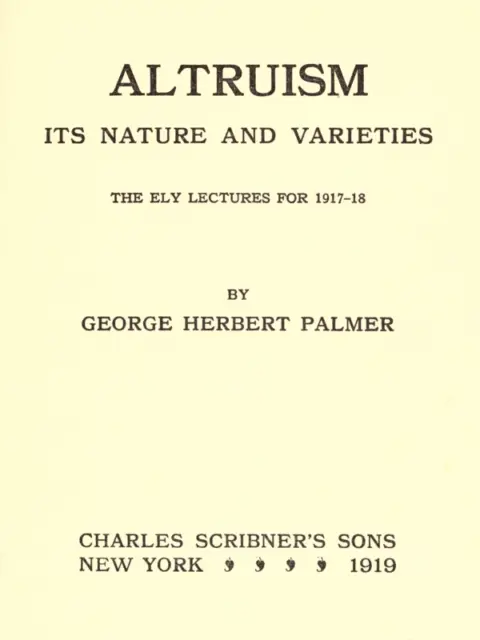
Altruism: Its Nature and Varieties
George Herbert Palmer
THE CLASSIC COLLECTION · 1908
"The Teacher: Essays and Addresses on Education" by George Herbert Palmer and Alice Freeman Palmer is a collection of insightful essays written in the early 20th century. The work delves into various philosophical aspects of education, examining the roles and ideals of teachers, the nature of ethical and moral instruction, and the broader implications of teaching within society. The authors address the significance of teaching as an art form that shapes character and influences the development of students. The opening of the book presents a preface that outlines the structure and core themes of the essays within. Palmer discusses the profound responsibility and influence teachers have over their students, emphasizing the importance of teaching as more than just a profession but an art intertwined with character development. He introduces the concept of "vicariousness" as a necessary quality for teachers, urging them to empathize deeply with their students' perspectives. Palmer's reflections establish the foundational ideas that the following essays will explore, setting the stage for a rich examination of education's role in shaping individuals and society at large.
Introduction adapted from the source catalogue; source summaries may be automatically generated.
Free to read · English · 91,433 words · No account needed
MAKE TIME FOR A GOOD BOOK
On by default. Untick to stop anonymous reading totals. Each page counts after 10 seconds in view. How this works.
Anonymous counting is on unless you have switched it off.
I insist, therefore, that under a pretty loose elective system boys are little disposed to intentionally vicious choices. My fears look in a different direction. I do not expect depravity, but I want to head off aimless trifling. I agree with the opponents of election in thinking that there is danger, especially during the early years of college life, that righteous intention may not be distinct and energetic. Boys drift. Inadequate influences induce their decisions. The inclinations of the clique in which a young man finds himself are, without much thought, accepted as his own. Heedlessness is the young man's bane. It should not be mistaken for vice; the two are different. A boy who will enter a dormitory at twelve o'clock at night, and go to the third story whistling and beating time on the banisters, certainly seems a brutish person; but he is ordinarily a kind enough fellow, capable of a good deal of self-sacrifice when brought face to face with need. He simply does not think. So it is in study: there, too, he does not think. Now in college a boy should learn perpetually to think; and an excellent way of helping him to learn is to ask him often what he is thinking about. The object of the questioning should not be to thwart the boy's aims, rather to insure that they are in reality his own. Essentially his to the last they should remain, even though intrinsically they may not be the best. Young persons, much more than their elders, require to talk over plans from time to time with an experienced critic, in order to learn by degrees the difficult art of planning. By such talk intentionality is fortified. There is much of this talk already; talk of younger students with older, talk with wise persons at home, and more and more every year with the teachers of the courses left and the courses entered. All this is good. Haphazard modes breed an astonishing average of choices that possess a meaning. The waste of a laissez-faire system comes nowhere near the waste of a prescribed. But what is good when compared with a bad thing may be poor when compared with excellence itself. We must go on. A college, like a man, should always be saying, "Never was I so good as to-day, and never again will I be so bad." We must welcome criticisms more than praises, and seek after our weak points as after hid treasures. The elective system seems to me weak at present through lacking organized means of bringing the student and his intentions face to face. Intentions grow by being looked at. At the English universities a young man on entering a college is put in charge of a special tutor, without whose consent he can do little either in the way of study or of personal management.[9] Dependence so extreme is perhaps better suited to an infant school than to an American college; and even in England, where respectful subservience on the part of the young has been cultivated for generations, the system is losing ground. Since the tutors were allowed to marry and to leave the college home, tutorial influence has been changing. In most American colleges twenty-five years ago there were officers known as class tutors, to whom, in case of need, a student might turn. Petty permissions were received from these men, instead of from a mechanical central office. So far as this plan set personal supervision in the place of routine it was, in my eyes, good. But the relation of a class tutor to his boys was usually one of more awe than friendship. At the Johns Hopkins University there is a board of advisers, to some member of which each student is assigned at entrance. The adviser stands in loco parentis to his charges. The value of such adjustments depends on the nature of the parental tie. If the relation is worked so as to stimulate the student's independence, it is good; if so as to discharge him from responsibility, it unfits for the life that follows. At Harvard special students not candidates for a degree have recently been put in charge of a committee, to whom they are obliged to report their previous history and their plans of study for each succeeding year. The committee must know at all times what their charges are doing. Something of this sort, I am convinced, will be demanded at no distant day, as a means of steadying all students in elective colleges. Large personal supervision need not mean diminution of freedom. A young man may possess his freedom more solidly if he recognizes an obligation to state and defend the reasons which induce his choice. For myself, I should be willing to make the functions of such advisory committees somewhat broad. As a college grows, the old ways of bringing about acquaintance between officers and students become impracticable. But the need of personal acquaintance, unhappily, does not cease. New ways should be provided. A boy dropped into the middle of a large college must not be lost to sight; he must be looked after. To allow the teacher's work of instruction to become divorced from his pastoral, his priestly, function is to cheapen and externalize education. I would have every student in college supplied with somebody who might serve as a discretionary friend; and I should not think it a disadvantage that such an expectation of friendship would be as apt to better the instructor as the student.
Your reading position is saved on this browser. Take it to another device with a library code. Reading pages adapt to text, rather than matching a printed edition.
George Herbert Palmer
George Herbert Palmer
BEHIND THE BOOK
This eBook is for the use of anyone anywhere in the United States and most other parts of the world at no cost and with almost no restrictions whatsoever. You may copy it, give it away or re-use it under the terms of the Project Gutenberg License included with this eBook or online at www.gutenberg.org. If you are not located in the United States, you will have to check the laws of the country where you are located before using this eBook. Read the source licence.
The original source file, including credits and licence, is retained by this library. Request an original-format copy at no charge. Please include the book title and Project Gutenberg identifier #36774.
KEEP YOUR CURIOSITY GOING

David Patterson (Spirit) Hatch

David Patterson (Spirit) Hatch

David Patterson (Spirit) Hatch
Coulson Kernahan

Ralph Waldo Emerson

Maurice Baring