Madame Roland: A Biographical Study
Ida M. (Ida Minerva) Tarbell
THE CLASSIC COLLECTION · 1906
"The Tariff in Our Times" by Ida M. Tarbell is a historical account written in the early 20th century. The book explores the evolution of tariff policies in the United States, particularly focusing on how public opinion has often been sidelined in favor of special interests. Tarbell aims to narrate the story of the popular will regarding tariff laws, examining the impacts of protectionism and how American industries have navigated these changes over the decades. At the start of the work, the author presents a historical analysis of tariff legislation leading up to and during the Civil War. She discusses how public sentiment and established policies shifted due to economic crises and political pressures, culminating in a burgeoning advocacy for protectionist measures. Key figures such as Justin S. Morrill emerge in this narrative, as their actions reflect the complexities and challenges faced in maintaining a balance between revenue generation and industrial protection. Through the opening chapters, Tarbell sets the stage for a deeper investigation into how tariffs have shaped the economic landscape of the United States and the continual tension between protectionism and free trade.
Introduction adapted from the source catalogue; source summaries may be automatically generated.
Free to read · English · 122,618 words · No account needed
MAKE TIME FOR A GOOD BOOK
On by default. Untick to stop anonymous reading totals. Each page counts after 10 seconds in view. How this works.
Anonymous counting is on unless you have switched it off.
The violent attack upon this duty and the very plausible reasons for believing that the industry could never be selfsupporting, led to the adopting of an ingenious provision, limiting the time that manufacturers might have to establish the business. Tin plate was to be admitted free of duty after October 1, 1897, unless in some one of the years between 1891 (when the duty was to go into effect) and 1897, one-third as much tin plate was produced here as was imported in any one of the other six years. This clever device originated with Senator Spooner of Wisconsin.
The Tin Plate and Iron and Steel Associations practically wrote their own schedules in the McKinley Bill. The wool growers and woollen manufacturers did the same. A series of poor years in wool occurred in the ’80’s. There were legitimate causes outside of the tariff for the depression, but a large and influential part of the industry believed or professed to believe the trouble to come solely from reductions in duties made in 1883. These reductions had disturbed the “harmony” in wool which they claimed the growers and manufacturers had established in 1867, and which they now loudly affirmed must be restored if the two branches of the industry were again to be prosperous. There were long petitions presented by manufacturers asking for free wool, arguing that the industry could never hope to compete until it was on an equal footing with other nations in the matter of raw materials; but this point of view was not supported by the National Association of Wool Manufacturers, which by this time had become one of the most powerful political organizations in American industry. It held that the manufacturer must support the duty on wool if he did not wish to set the growers against the duty on woollens. It had been established in 1867 “almost as economic law,” Mr. Whitman, the president of the organization claimed, that the wool-grower was to have his duty, and that the wool manufacturer was to be given two kinds of duties, one which would compensate him fully for the tariffs on his raw materials, not only wool but dyestuffs, and that after that, he was to have the same measure of protection that other industries received. Mr. Whitman claimed that the lowering of the compensating duty in 1883 had particularly disturbed the “economic law.” As we have seen, this duty had been dropped from 50 to 35 cents. In making this drop the Committee had decided that it was a mistake to count 4 pounds of grease wool to one pound of cloth as had been done in 1867, since 4 pounds were rarely used. It had said that 3½ pounds was a generous allowance—as it was. Mr. Whitman remonstrated against this decreased compensation. He wanted the duty based on the 4 pounds and he wanted other upward revisions. The program proposed by the Association was practically adopted. It contained one curious provision new to the wool schedule and important in the later history of the tariff; that was a duty on tops and all wools and hair advanced beyond a washed condition. Tops are wool in one of the early stages on the way to yarn. Mr. Whitman, asked how the cost of making tops compared with that of making yarn, said it was about one-half. In the same examination Mr. Whitman also said the principle which he wished applied in the fixing of the duties was that there should be a higher duty on cloth than yarn, on clothing than cloth, and he suggested that the relative per cent of the three should be 40 per cent for yarn, 50 per cent for cloth, and 60 per cent for clothing. As to tops, which could be made according to Mr. Whitman at one-half the expense of yarn, he suggested for them a duty not lower, as one would expect from the “principle” he had himself laid down, nor indeed did he fix a direct duty. Mr. Whitman suggested that the rate on tops be that fixed for the basket or catch-all clause of the schedule. Turning to that clause we find it to be not less than the rate on yarn, but considerably more. The suggestion was embodied in the McKinley Bill apparently without anybody except Mr. Whitman understanding its motive. Other suggestions of the manufacturers were also adopted, resulting in increased protection on those classes of goods where there was any amount of importation. Generally speaking, the efforts of the manufacturers was to secure advances in both the wool and cotton schedules where competition still persisted.
Your reading position is saved on this browser. Take it to another device with a library code. Reading pages adapt to text, rather than matching a printed edition.
Ida M. (Ida Minerva) Tarbell
Ida M. (Ida Minerva) Tarbell
Ida M. (Ida Minerva) Tarbell
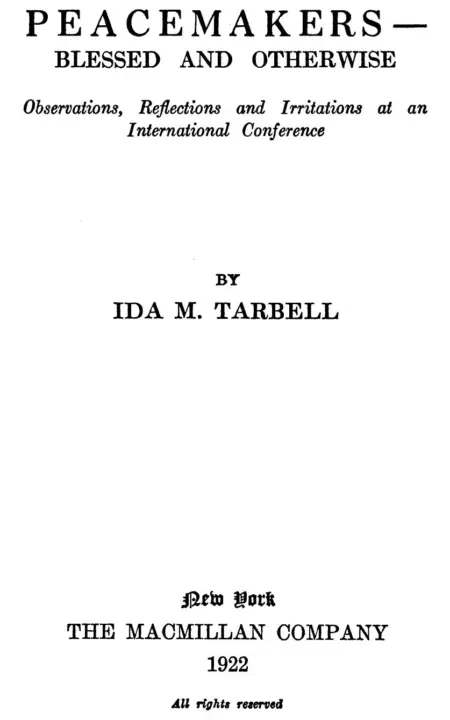
Ida M. (Ida Minerva) Tarbell
BEHIND THE BOOK
This eBook is for the use of anyone anywhere in the United States and most other parts of the world at no cost and with almost no restrictions whatsoever. You may copy it, give it away or re-use it under the terms of the Project Gutenberg License included with this eBook or online at www.gutenberg.org. If you are not located in the United States, you will have to check the laws of the country where you are located before using this eBook. Read the source licence.
The original source file, including credits and licence, is retained by this library. Request an original-format copy at no charge. Please include the book title and Project Gutenberg identifier #59763.
KEEP YOUR CURIOSITY GOING
Cécile Tormay

Moritz Busch
John L. Ransom
Frances Wright
Cécile Tormay

Mabel Potter Daggett