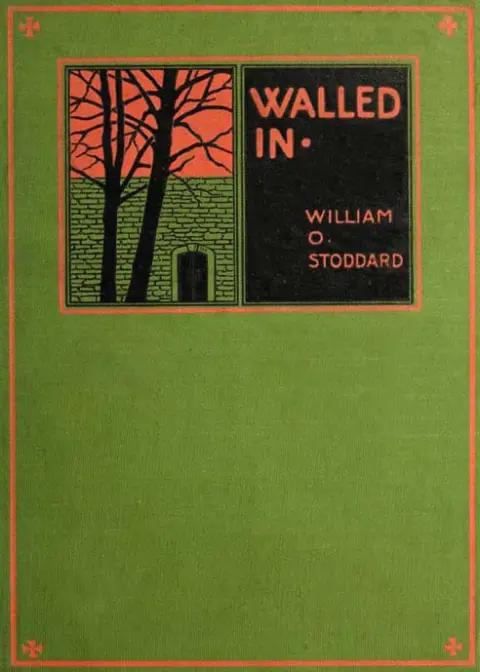
Walled In: A True Story of Randall’s Island
William O. Stoddard
THE CLASSIC COLLECTION · 1882
"The Talking Leaves: An Indian Story" by William O. Stoddard is a historical novel written in the late 19th century. Set against the backdrop of Native American life and the encroachment of white settlers, it focuses on characters like Ni-ha-be, the daughter of an Apache chief, and her adopted sister Rita, who explore themes of cultural identity and the impact of outside influences on indigenous communities. At the start of the story, we are introduced to Ni-ha-be and Rita as they witness a gathering of Apache warriors while on a ride in the mountains. The excitement builds when they discover “talking leaves” (magazines) left behind by a group of white soldiers, igniting Rita’s curiosity and stirring entrenched feelings regarding their identities. The girls must navigate the complexities of their connection with both the Apache culture and their white origins, which sets the stage for their unfolding adventure amid the tensions between the two worlds. As they present the talking leaves to Ni-ha-be’s father, Many Bears, their discovery hints at larger conflicts and cultural intersections that are central to the narrative.
Introduction adapted from the source catalogue; source summaries may be automatically generated.
Free to read · English · 66,194 words · No account needed
MAKE TIME FOR A GOOD BOOK
On by default. Untick to stop anonymous reading totals. Each page counts after 10 seconds in view. How this works.
Anonymous counting is on unless you have switched it off.
"Look!" said Red Wolf at the same instant. "Drop baby."
Not her pappoose, for it was safe under her blanket, but her three-year-old girl had slipped from behind her, and the river was sweeping it down stream.
"It will be drowned!" exclaimed Steve, in some excitement.
"No. Apache baby never sink. Swim a heap. Look!"
Steve looked, and there was no question but what the queer little thing was paddling bravely, and not even showing fear. To be sure, the current was carrying it away, but Steve now saw that three or four older boys and girls were swimming around it and were ready to give it all the help needed.
For all that, the wrath and anxiety of Too Many Toes exhibited itself in a torrent of long words.
Steve had learned among the Lipans that the red men have a great deal of fun in their compositions, but he was almost surprised to hear Red Wolf say, "Squaw talk big rain. Fall in river. Have freshet then. Lipans can't follow Apaches."
If talk could have raised the river, the chatter of nearly two hundred squaws of all ages, added to the scolding of Too Many Toes, would have made a torrent of it.
And yet a number of the squaws, wives and daughters of men of character and station attended to the business of fording the stream with the silence and gravity of the most dignified white matrons.
Dolores would have scorned putting herself on a level with such a squaw as Too Many Toes, even in the use of her tongue; and as for Ni-ha-be and Rita, they never forgot for a moment whose family they belonged to.
"Rita," said Ni-ha-be, as they rode down to the river, "your blanket is loose. Red Wolf and Knotted Cord are watching us."
"Send Warning is not there."
"No, of course not. He is with the chiefs. Don't let them see we are
looking at them."
"I'm not looking at them."
"Neither am I. I don't care for Red Wolf either."
"And I don't care whether Knotted Cord sees me or not. I wish I could
talk with Send Warning."
"What for?"
"To ask about the talking leaves."
"Knotted Cord could tell you. He is a pale-face."
"He is a mere boy. Send Warning's head is very white."
"Look out, Rita. Your horse's feet are slipping."
Ni-ha-be had better have been attending to the feet of her own pretty mustang. The ford was not very wide just there, and the two girls were compelled to get a little out of the way of the two mules loaded with lodge-poles.
Alas for the vanity of the chiefs self-confident daughter!
Your reading position is saved on this browser. Take it to another device with a library code. Reading pages adapt to text, rather than matching a printed edition.
William O. Stoddard
William O. Stoddard
William O. Stoddard
William O. Stoddard
BEHIND THE BOOK
This eBook is for the use of anyone anywhere in the United States and most other parts of the world at no cost and with almost no restrictions whatsoever. You may copy it, give it away or re-use it under the terms of the Project Gutenberg License included with this eBook or online at www.gutenberg.org. If you are not located in the United States, you will have to check the laws of the country where you are located before using this eBook. Read the source licence.
The original source file, including credits and licence, is retained by this library. Request an original-format copy at no charge. Please include the book title and Project Gutenberg identifier #21913.
KEEP YOUR CURIOSITY GOING
Cécile Tormay

Moritz Busch
Coulson Kernahan
John L. Ransom

Maurice Baring
Frances Wright