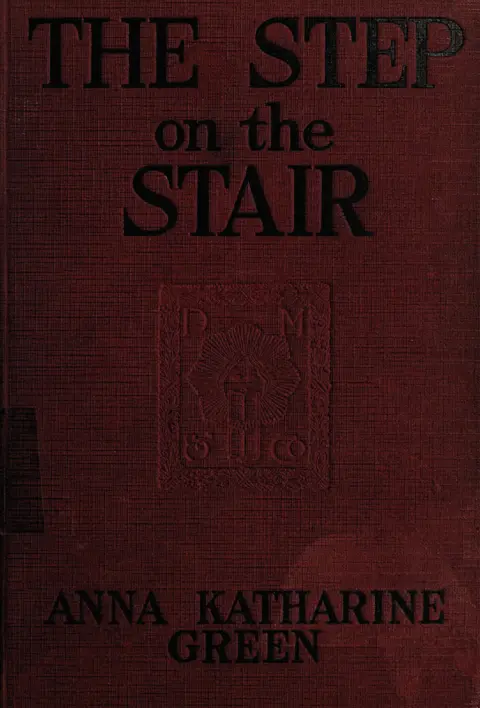
The step on the stair
Anna Katharine Green

THE CLASSIC COLLECTION · 1881
"The Sword of Damocles: A Story of New York Life" by Anna Katharine Green is a novel written in the late 19th century. The story is set in New York and explores themes of love, ambition, and social class through the experiences of its main character, Bertram Mandeville, a talented pianist navigating the complexities of his profession and aspirations for wealth and status to win the affection of Miss Preston, a young heiress. The opening of the narrative introduces a bleak New York City night filled with a bitter wind, establishing the story's tone. It then shifts to a somber young woman standing outside a cathedral, reflecting themes of despair and disillusionment. The narrative quickly transitions to the discussion between Mandeville and his uncle, who expresses concern over the risks of pursuing wealth through Wall Street compared to maintaining a successful musical career. Mandeville’s determination to pursue speculative investments stems from his love for a young woman above his social class. The chapter closes with Mandeville revealing his recent encounter with a mysterious old woman who delivered a note from a girl named Paula, hinting at a deeper connection that interweaves love and intrigue into the struggles of the characters.
Introduction adapted from the source catalogue; source summaries may be automatically generated.
Free to read · English · 141,665 words · No account needed
MAKE TIME FOR A GOOD BOOK
On by default. Untick to stop anonymous reading totals. Each page counts after 10 seconds in view. How this works.
Anonymous counting is on unless you have switched it off.
Mr. Gryce at once took up his hat. “If the charge implied in my opinion strikes you, gentlemen, as serious, you must at least acknowledge that your own judgment does not greatly differ from mine, or why such unnecessary agitation in regard to a loss so petty, by a gentleman worth as we are told his millions.” And with this passing shot, to which neither of his auditors responded, he made his final obeisance and calmly left the room.
Mr. Sylvester and Mr. Stuyvesant slowly confronted one another.
“The man speaks the truth,” said the former. “You at least suspect some one in the bank, Mr. Stuyvesant?”
“I have no wish to,” hastily returned the other, “but facts—”
“Would facts of this nature have any weight with you against the unspotted character of a man never known by you to meditate, much less commit a dishonest action?”
“No; yet facts are facts, and if it is proved that some one in our employ has perpetrated a theft, the mind will unconsciously ask who, and remain uneasy till it is satisfied.”
“And if it never is?”
“It will always ask who, I suppose.”
Mr. Sylvester drew back. “The matter shall be pushed,” said he; “you shall be satisfied. Surveillance over each man employed in this institution ought sooner or later to elicit the truth. The police shall take it in charge.”
Mr. Stuyvesant looked uneasy. “I suppose it is only justice,” murmured he, “but it is a scandal I would have been glad to avoid.”
“And I, but circumstances admit of no other course. The innocent must not suffer for the guilty, even so far as an unfounded suspicion would lead.”
“No, no, of course not.” And the director bustled about after his
overcoat and hat.
Mr. Sylvester watched him with growing sadness. “Mr. Stuyvesant,” said he, as the latter stood before him ready for the street, “we have always been on terms of friendship, and nothing but the most pleasant relations have ever existed between us. Will you pardon me if I ask you to give me your hand in good-day?”
The director paused, looked a trifle astonished, but held out his hand not only with cordiality but very evident affection.
“Good day,” cried he, “good-day.”
Mr. Sylvester pressed that hand, and then with a dignified bow, allowed the director to depart. It was his last effort at composure. When the door closed, his head sank on his hands, and life with all its hopes and honors, love and happiness, seemed to die within him.
He was interrupted at length by Bertram. “Well, uncle?” asked the young man with unrestrained emotion.
Your reading position is saved on this browser. Take it to another device with a library code. Reading pages adapt to text, rather than matching a printed edition.
Anna Katharine Green

Anna Katharine Green
Anna Katharine Green
Anna Katharine Green
BEHIND THE BOOK
This eBook is for the use of anyone anywhere in the United States and most other parts of the world at no cost and with almost no restrictions whatsoever. You may copy it, give it away or re-use it under the terms of the Project Gutenberg License included with this eBook or online at www.gutenberg.org. If you are not located in the United States, you will have to check the laws of the country where you are located before using this eBook. Read the source licence.
The original source file, including credits and licence, is retained by this library. Request an original-format copy at no charge. Please include the book title and Project Gutenberg identifier #33301.
KEEP YOUR CURIOSITY GOING
Coulson Kernahan

Maurice Baring
Frances Wright
Cécile Tormay

Frederic Jesup Stimson

W. H. P. (William Henry Pope) Jarvis