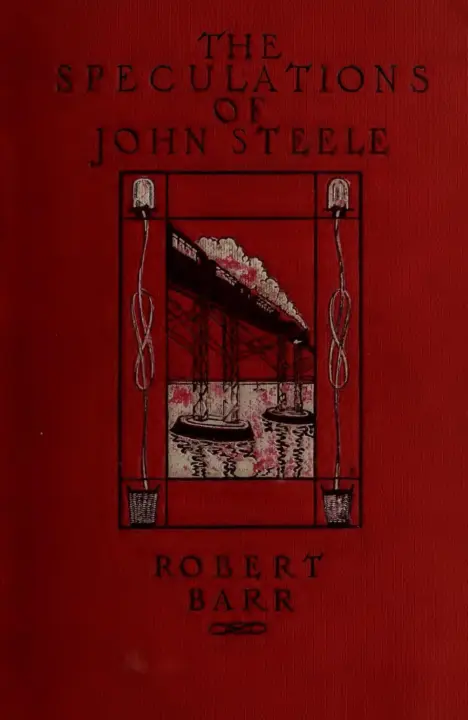
The Speculations of John Steele
Robert Barr
THE CLASSIC COLLECTION · 1910
"The Sword Maker" by Robert Barr is a historical novel likely written in the early 20th century. The story unfolds in the turbulent settings of Frankfort, a city ripe with social unrest and economic decay, where merchants struggle against the oppressive rule of nobility and brigands. The protagonist, Roland, is a young prince who aspires to become a master swordsman and harbinger of change, navigating the harsh realities of his society in his quest for freedom and justice. The opening of the novel establishes a setting of chaos and despair, with a population on the brink of rioting against a lethargic emperor and his corrupt nobles. Amidst the turmoil, a group of craftsmen, primarily metal-workers, gather in a tavern to scheme their escape from destitution. Roland, who possesses extraordinary swordsmanship skills, becomes their unexpected leader after vanishing for a time but returning with plans to rescue their city from ruin. His interactions with the merchants highlight the growing strife in Frankfort, and Roland's determination to reclaim prosperity sets the stage for a gripping tale of rebellion, camaraderie, and the quest for rightful authority.
Introduction adapted from the source catalogue; source summaries may be automatically generated.
Free to read · English · 112,192 words · No account needed
MAKE TIME FOR A GOOD BOOK
On by default. Untick to stop anonymous reading totals. Each page counts after 10 seconds in view. How this works.
Anonymous counting is on unless you have switched it off.
"Yes; although to this determination my guardian is opposed."
"Alas," said Roland, with a sigh, "I confess myself in agreement with him so far as your taking the veil is concerned. Still, imprisonment seems an unduly harsh alternative."
The girl's seriousness fled, and she smiled at him.
"As you have had some experience of my obstinacy, and proposed an even harsher remedy than that--"
"Ah, you forget," interrupted Roland, "that I apologized for my lack of manners. I hope during our journey to Nonnenwerth I may earn complete forgiveness."
"Oh, you are forgiven already, which is magnanimous of me, when you recollect that the fault was wholly my own. I will join you in the courtyard at once if I may."
"Very well. I shall be down there after I have given final instructions
to my men."
Roland arrived at the north window, and saw that the flotilla had already departed. He could discern Ebearhard standing with his hand on the prow of the remaining boat, so pulled up the rope, untied it from the ring to which it was fastened, and threw it down to his lieutenant.
"A rope is always useful," he whispered, "and we will puzzle the good Pfalzgraf regarding our exit."
In the courtyard he found the three women awaiting him. Quietly he drew back the heavy bolts, and undid the stout chains. Holding the door slightly ajar, he peered out at the scene on the landing, brightly illuminated by numerous torches which the servants held aloft.
The men-at-arms were enjoying themselves hugely, and the great heap of bales already on the rocks showed that they resolved not to leave even one package on the barge. The fact that they stood in the light prevented their seeing the exit of the quartette from the Castle, even had any been on the outlook.
Roland swung the door wide, placed the ladder in exactly the same position it had formerly occupied, assisted the three women to the ground, and then led them round the western side of the Castle through the darkness to Ebearhard and his skiff. Dipping their paddles with great caution, they kept well out of the torchlight radius.
As they left the shadow of the Castle, and came within sight of the party on the landing, they were somewhat startled by a lusty cheer.
"Ah," said Ebearhard, "they have discovered our barrels of gold."
"'Tis very likely," replied Roland.
"Still," added Ebearhard consolingly, "I think we have made a good exchange. There appears to be more money in Stahleck's bags than in our two barrels."
Your reading position is saved on this browser. Take it to another device with a library code. Reading pages adapt to text, rather than matching a printed edition.
Robert Barr
Robert Barr
Robert Barr
Robert Barr
BEHIND THE BOOK
This eBook is for the use of anyone anywhere in the United States and most other parts of the world at no cost and with almost no restrictions whatsoever. You may copy it, give it away or re-use it under the terms of the Project Gutenberg License included with this eBook or online at www.gutenberg.org. If you are not located in the United States, you will have to check the laws of the country where you are located before using this eBook. Read the source licence.
The original source file, including credits and licence, is retained by this library. Request an original-format copy at no charge. Please include the book title and Project Gutenberg identifier #14656.
KEEP YOUR CURIOSITY GOING
Cécile Tormay

Moritz Busch
Coulson Kernahan
John L. Ransom

Maurice Baring
Frances Wright