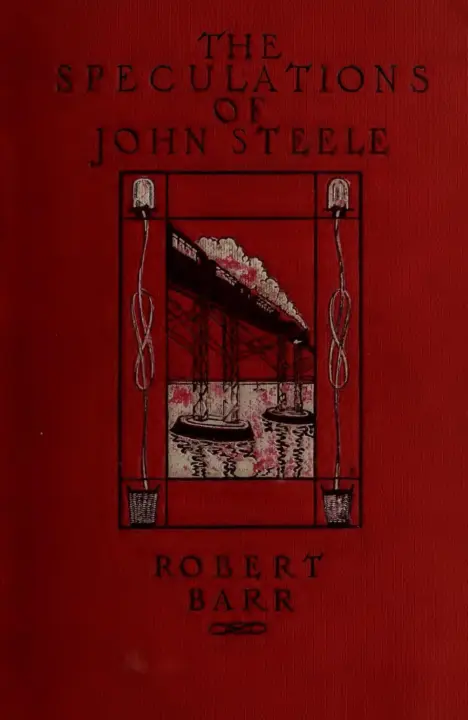
The Speculations of John Steele
Robert Barr
THE CLASSIC COLLECTION · 1910
"The Sword Maker" by Robert Barr is a historical novel likely written in the early 20th century. The story unfolds in the turbulent settings of Frankfort, a city ripe with social unrest and economic decay, where merchants struggle against the oppressive rule of nobility and brigands. The protagonist, Roland, is a young prince who aspires to become a master swordsman and harbinger of change, navigating the harsh realities of his society in his quest for freedom and justice. The opening of the novel establishes a setting of chaos and despair, with a population on the brink of rioting against a lethargic emperor and his corrupt nobles. Amidst the turmoil, a group of craftsmen, primarily metal-workers, gather in a tavern to scheme their escape from destitution. Roland, who possesses extraordinary swordsmanship skills, becomes their unexpected leader after vanishing for a time but returning with plans to rescue their city from ruin. His interactions with the merchants highlight the growing strife in Frankfort, and Roland's determination to reclaim prosperity sets the stage for a gripping tale of rebellion, camaraderie, and the quest for rightful authority.
Introduction adapted from the source catalogue; source summaries may be automatically generated.
Free to read · English · 112,192 words · No account needed
MAKE TIME FOR A GOOD BOOK
On by default. Untick to stop anonymous reading totals. Each page counts after 10 seconds in view. How this works.
Anonymous counting is on unless you have switched it off.
"Are you sure you have already done it on all occasions?" asked the
Archbishop severely.
The man's face became ghastly in its pallor.
"I don't know what you mean, my Lord."
"Then I will quickly tell you what I mean. It is rumored that Prince Roland has been seen on the streets of Frankfort."
"How--how could that be, my Lord?"
"That is exactly what I wish to know. I believe the Prince is not in
your custody."
"I assure you, my Lord," said the now thoroughly frightened man, "that his Highness is in his room."
"Very well; then conduct this lady thither. Although she does not know the Prince, a relative of hers who does asserts that he met his Highness in Frankfort. I said this was impossible if you had done that duty you prate so much about. The lady merely wishes to ask him for some explanation of this affair, so make your choice. Shall she go up with you now, or must I send for the other two Archbishops?"
There was but one comforting phrase in this remark, namely, that the lady did not know the Prince. Still, it was a dreadful risk, yet the custodian hesitated no longer. He took down a bunch of keys, and asked the Countess to follow him. Ascending the stair, he unlocked the door, and stood aside for the Countess to pass through.
Some one with wildly tousled hair sat sprawling in a chair; arms on the table, and head sunk forward down upon them. A full tankard of wine within his reach, and a flagon had been overset, sluicing the table with its contents, which still fell drip, drip, drip, to the floor.
The young man raised his head, aroused by the harsh unlocking of the door, and with the crash it made as his father flung it hard against the stone wall for the purpose of giving him warning, but the youth was in no condition to profit by this thoughtfulness, nor to understand the signals his father made from behind the frightened girl. He clutched wildly at the overturned flagon, and with an oath cried:
"Bring me more wine, you old--"
Staggering to his feet, he threw the flagon wide, then slipped on the
spilled wine and fell heavily to the floor, roaring defiance at the
world.
The panic-stricken girl shrank back, crying to the jailer:
"Let me out! Close the door quickly, and lock it!" an order obeyed with
alacrity.
When Hildegunde emerged to the court her guardian asked no question. The horror in her face told all.
"I am sorry, my Lord," said the cringing custodian, "but his Highness is
drunk."
"Does this--does this happen often?"
Your reading position is saved on this browser. Take it to another device with a library code. Reading pages adapt to text, rather than matching a printed edition.
Robert Barr
Robert Barr
Robert Barr
Robert Barr
BEHIND THE BOOK
This eBook is for the use of anyone anywhere in the United States and most other parts of the world at no cost and with almost no restrictions whatsoever. You may copy it, give it away or re-use it under the terms of the Project Gutenberg License included with this eBook or online at www.gutenberg.org. If you are not located in the United States, you will have to check the laws of the country where you are located before using this eBook. Read the source licence.
The original source file, including credits and licence, is retained by this library. Request an original-format copy at no charge. Please include the book title and Project Gutenberg identifier #14656.
KEEP YOUR CURIOSITY GOING
Cécile Tormay

Moritz Busch
Coulson Kernahan
John L. Ransom

Maurice Baring
Frances Wright