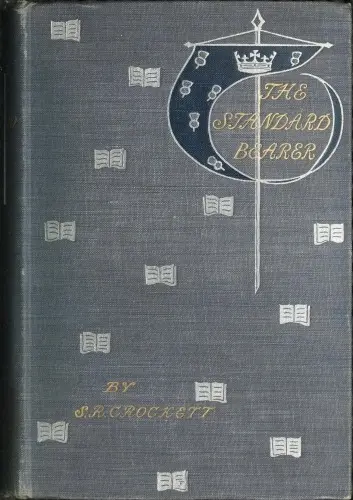
The Standard Bearer
S. R. (Samuel Rutherford) Crockett
THE CLASSIC COLLECTION · 1897
"The Surprising Adventures of Sir Toady Lion with Those of General Napoleon Smith" by S. R. Crockett is a children's adventure novel written in the late 19th century. The story follows young General Napoleon Smith and his imaginative sibling Priscilla, alongside their companion Sir Toady Lion, as they navigate childhood escapades that intertwine fantastical elements with the everyday challenges of boyhood mischief. The blend of humor, whimsy, and sibling dynamics hints at a broader exploration of courage, creativity, and the nature of childhood. At the start of this tale, we are introduced to Hugh John, who secretly identifies as General Napoleon Smith, an ambitious and imaginative young boy grappling with the weight of his illustrious name. Accompanied by his adventurous sister, Priscilla, and their comically inept friend, Sir Toady Lion, they unwittingly find themselves embroiled in mischief and mayhem, exploring their father's farm and the mysterious castle nearby. Their banter and play illustrate not just their childhood innocence but also their budding individual identities, setting the stage for further adventures as they devise plans to rescue a pet lamb and confront rival boys—an exciting journey blending loyalty, bravery, and a hefty dose of sibling rivalry.
Introduction adapted from the source catalogue; source summaries may be automatically generated.
Free to read · English · 66,164 words · No account needed
MAKE TIME FOR A GOOD BOOK
On by default. Untick to stop anonymous reading totals. Each page counts after 10 seconds in view. How this works.
Anonymous counting is on unless you have switched it off.
"All right, then, I will listen to your old stuff if you will say you are sorry, and promise to be my horse, and let me lick you for an hour afterwards--besides giving me a penny."
It was thus that Priscilla, to whom in after times great lights of criticism listened with approval, was compelled to stoop to artifice and bribery in order to secure and hold her first audience. Whereupon the authoress took paper from her pocket, and as she did so, held the manuscript with its back to Napoleon Smith, in order to conceal the suspicious shortness of the lines. But that great soldier instantly detected the subterfuge.
"It's a penny more for listening to poetry!" he said, with sudden
alacrity.
"I know it is," replied Prissy sadly, "but you might be nice about it just this once. I'm dreadfully, dreadfully poor this week, Hugh John!"
"So am I," retorted Napoleon Smith sternly; "if I wasn't, do you think I would listen at all to your beastly old poetry? Drive on!"
Thus encouraged, Priscilla meekly began--
"My love he is a soldier bold,
And my love is a knight;
He girds him in a coat of mail,
When he goes forth to fight."
"That's not quite so bad as usual," said Napoleon condescendingly, toying meanwhile with the lash of an old dog-whip he had just "boned" out of the harness-room. Priscilla beamed gratefully upon her critic, and proceeded--
"He rides him forth across the sand----"
"Who rides whom?" cried Napoleon. "Didn't the fool ride a horse?"
"It means himself," said Priscilla meekly.
"Then why doesn't it say so?" cried the critic triumphantly, tapping his boot with the "boned" dog-whip just like any ordinary lord of creation in presence of his inferiors.
"It's poetry," explained Priscilla timidly.
"It's silly!" retorted Napoleon, judicially and finally.
Priscilla resumed her reading in a lower and more hurried tone. She knew that she was skating over thin ice.
"He rides him forth across the sand,
Upon a stealthy steed."
"You mean 'stately,' you know," interrupted Napoleon--somewhat rudely, Priscilla thought. Yet he was quite within his rights, for Priscilla had not yet learned that a critic always knows what you mean to say much better than you do yourself.
"No, I don't mean 'stately,'" said Priscilla, "I mean 'stealthy,' the way a horse goes on sand. You go and gallop on the sea-shore and you'll find out."
"I shan't. I haven't got any sea-shore," said Napoleon. "But do hurry. I've listened quite a pennyworth now."
"He rides him forth across the sand,
Upon a stealthy steed,
And when he sails upon the sea,
He plays upon a reed!"
Your reading position is saved on this browser. Take it to another device with a library code. Reading pages adapt to text, rather than matching a printed edition.
S. R. (Samuel Rutherford) Crockett
S. R. (Samuel Rutherford) Crockett
S. R. (Samuel Rutherford) Crockett
S. R. (Samuel Rutherford) Crockett
BEHIND THE BOOK
This eBook is for the use of anyone anywhere in the United States and most other parts of the world at no cost and with almost no restrictions whatsoever. You may copy it, give it away or re-use it under the terms of the Project Gutenberg License included with this eBook or online at www.gutenberg.org. If you are not located in the United States, you will have to check the laws of the country where you are located before using this eBook. Read the source licence.
The original source file, including credits and licence, is retained by this library. Request an original-format copy at no charge. Please include the book title and Project Gutenberg identifier #39340.
KEEP YOUR CURIOSITY GOING
Coulson Kernahan

Maurice Baring
Frances Wright
Cécile Tormay
Francis Greenleaf Allinson & Anne C. E. (Anne Crosby Emery) Allinson

Frederic Jesup Stimson