THE CLASSIC COLLECTION✦The Catholic Church and conversionCLASSIC FREE BOOKS
The Catholic Church and conversion
G. K. (Gilbert Keith) Chesterton
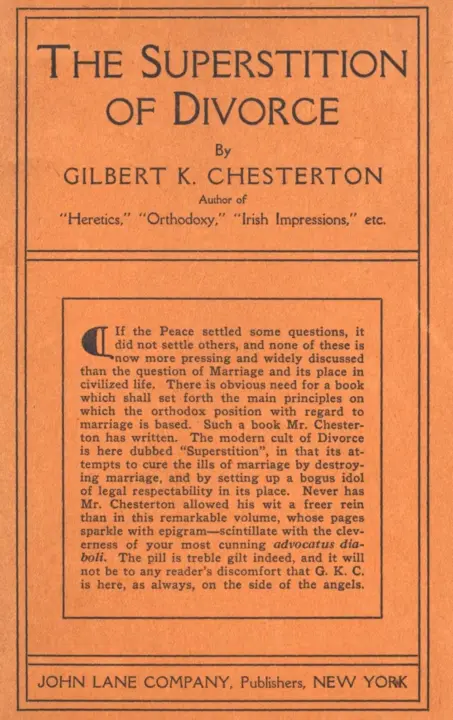
THE CLASSIC COLLECTION · 1920
"The Superstition of Divorce" by G. K. Chesterton is a philosophical examination of the social and moral implications of divorce, written in the early 20th century. The text argues that divorce is treated as a form of liberation in modern society but critiques this notion by asserting that it undermines the sanctity of marriage, which is fundamentally a promise or vow. Through a series of essays, Chesterton explores the historical significance of marital vows and the societal consequences of viewing marriage merely as a legal contract. At the start of the work, the author introduces the idea that contemporary discussions around divorce often neglect to adequately consider the meaning and implications of marriage itself. He emphasizes a need to understand what a marriage vow represents, positioning it as an act of commitment rather than a casual choice. Chesterton critiques the opportunistic attitudes of reformers who advocate for easier divorce laws without reflecting on the foundational aspects of marriage itself. He thus sets the stage for a nuanced debate about not only the nature of divorce but also the broader implications for family and society, challenging readers to reconsider their perspectives on these issues.
Introduction adapted from the source catalogue; source summaries may be automatically generated.
Free to read · English · 24,327 words · No account needed
MAKE TIME FOR A GOOD BOOK
On by default. Untick to stop anonymous reading totals. Each page counts after 10 seconds in view. How this works.
Anonymous counting is on unless you have switched it off.
Such is, in a curt and crude outline, this obvious thing for those to whom it is not obvious. Now I know there are thinking men among those who would tamper with it; and I shall expect some of these to reply to my questions. But for the moment I only ask this question: whether the parliamentary and journalistic divorce movement shows even a shadowy trace of these fundamental truths, regarded as tests. Does it even discuss the nature of a vow, the limits and objects of loyalty, the survival of the family as a small and free state? The writers are content to say that Mr. Brown is uncomfortable with Mrs. Brown, and the last emancipation, for separated couples, seems only to mean that he is still uncomfortable without Mrs. Brown. These are not days in which being uncomfortable is felt as the final test of public action. For the rest, the reformers show statistically that families are in fact so scattered in our industrial anarchy, that they may as well abandon hope of finding their way home again. I am acquainted with that argument for making bad worse and I see it everywhere leading to slavery. Because London Bridge is broken down, we must assume that bridges are not meant to bridge. Because London commercialism and capitalism have copied hell, we are to continue to copy them. Anyhow, some will retain the conviction that the ancient bridge built between the two towers of sex is the worthiest of the great works of the earth.
It is exceedingly characteristic of the dreary decades before the War that the forms of freedom in which they seemed to specialise were suicide and divorce. I am not at the moment pronouncing on the moral problem of either; I am merely noting, as signs of those times, those two true or false counsels of despair; the end of life and the end of love. Other forms of freedom were being increasingly curtailed. Freedom indeed was the one thing that progressives and conservatives alike contemned. Socialists were largely concerned to prevent strikes, by State arbitration; that is, by adding another rich man to give the casting vote between rich and poor. Even in claiming what they called the right to work they tacitly surrendered the right to leave off working. Tories were preaching conscription, not so much to defend the independence of England as to destroy the independence of Englishmen. Liberals, of course, were chiefly interested in eliminating liberty, especially touching beer and betting. It was wicked to fight, and unsafe even to argue; for citing any certain and contemporary fact might land one in a libel action. As all these doors were successfully shut in our faces along the chilly and cheerless corridor of progress (with its glazed tiles) the doors of death and divorce alone stood open, or rather opened wider and wider. I do not expect the exponents of divorce to admit any similarity in the two things; yet the passing parallel is not irrelevant. It may enable them to realise the limits within which our moral instincts can, even for the sake of argument, treat this desperate remedy as a normal object of desire. Divorce is for us at best a failure, of which we are more concerned to find and cure the cause than to complete the effects; and we regard a system that produces many divorces as we do a system that drives men to drown and shoot themselves. For instance, it is perhaps the commonest complaint against the existing law that the poor cannot afford to avail themselves of it. It is an argument to which normally I should listen with special sympathy. But while I should condemn the law being a luxury, my first thought will naturally be that divorce and death are only luxuries in a rather rare sense. I should not primarily condole with the poor man on the high price of prussic acid; or on the fact that all precipices of suitable suicidal height were the private property of the landlords. There are other high prices and high precipices I should attack first. I should admit in the abstract that what is sauce for the goose is sauce for the gander; that what is good for the rich is good for the poor; but my first and strongest impression would be that prussic acid sauce is not good for anybody. I fear I should, on the impulse of the moment, pull a poor clerk or artisan back by the coat-tails, if he were jumping over Shakespeare’s Cliff, even if Dover sands were strewn with the remains of the dukes and bankers who had already taken the plunge.
Your reading position is saved on this browser. Take it to another device with a library code. Reading pages adapt to text, rather than matching a printed edition.
G. K. (Gilbert Keith) Chesterton
G. K. (Gilbert Keith) Chesterton
G. K. (Gilbert Keith) Chesterton
G. K. (Gilbert Keith) Chesterton
BEHIND THE BOOK
This eBook is for the use of anyone anywhere in the United States and most other parts of the world at no cost and with almost no restrictions whatsoever. You may copy it, give it away or re-use it under the terms of the Project Gutenberg License included with this eBook or online at www.gutenberg.org. If you are not located in the United States, you will have to check the laws of the country where you are located before using this eBook. Read the source licence.
The original source file, including credits and licence, is retained by this library. Request an original-format copy at no charge. Please include the book title and Project Gutenberg identifier #62680.
KEEP YOUR CURIOSITY GOING

David Patterson (Spirit) Hatch

David Patterson (Spirit) Hatch

David Patterson (Spirit) Hatch
Coulson Kernahan

Ralph Waldo Emerson

Maurice Baring