THE CLASSIC COLLECTION✦The Catholic Church and conversionCLASSIC FREE BOOKS
The Catholic Church and conversion
G. K. (Gilbert Keith) Chesterton
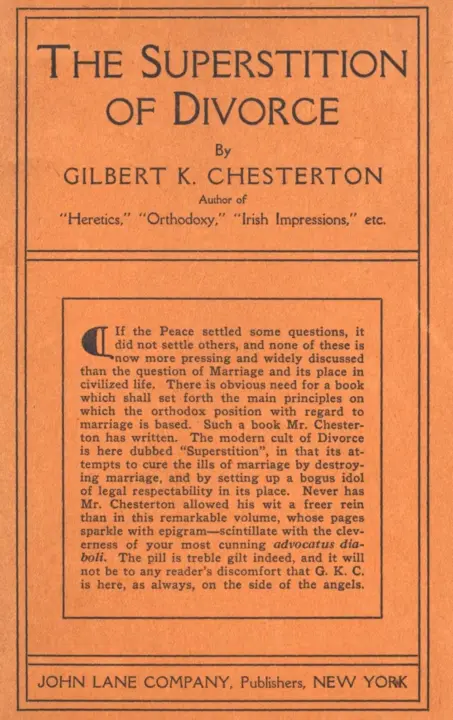
THE CLASSIC COLLECTION · 1920
"The Superstition of Divorce" by G. K. Chesterton is a philosophical examination of the social and moral implications of divorce, written in the early 20th century. The text argues that divorce is treated as a form of liberation in modern society but critiques this notion by asserting that it undermines the sanctity of marriage, which is fundamentally a promise or vow. Through a series of essays, Chesterton explores the historical significance of marital vows and the societal consequences of viewing marriage merely as a legal contract. At the start of the work, the author introduces the idea that contemporary discussions around divorce often neglect to adequately consider the meaning and implications of marriage itself. He emphasizes a need to understand what a marriage vow represents, positioning it as an act of commitment rather than a casual choice. Chesterton critiques the opportunistic attitudes of reformers who advocate for easier divorce laws without reflecting on the foundational aspects of marriage itself. He thus sets the stage for a nuanced debate about not only the nature of divorce but also the broader implications for family and society, challenging readers to reconsider their perspectives on these issues.
Introduction adapted from the source catalogue; source summaries may be automatically generated.
Free to read · English · 24,327 words · No account needed
MAKE TIME FOR A GOOD BOOK
On by default. Untick to stop anonymous reading totals. Each page counts after 10 seconds in view. How this works.
Anonymous counting is on unless you have switched it off.
A short time ago, as I am well aware, it would have sounded very strange to represent the old religious and peasant communities either as a model or a menace. It was counted a queer thing to say, in the days when my friends and I first said it; in the days of my youth when the republic of France and the religion of Ireland were regarded as alike ridiculous and decadent. But many things have happened since then; and it will not now be so easy to persuade even newspaper readers that Foch is a fool, either because he is a Frenchman or because he is a Catholic. The older tradition, even in the most unfashionable forms, has found champions in the most unexpected quarters. Only the other day Dr. Saleeby, a distinguished scientific critic who had made himself the special advocate of all the instruction and organisation that is called social science, startled his friends and foes alike by saying that the peasant families in the West of Ireland were far more satisfactory and successful than those brooded over by all the benevolent sociology of Bradford. He gave his testimony from an entirely rationalistic and even materialistic point of view; indeed, he carried rationalism so far as to give the preference to Roscommon because the women are still mammals. To a mind of the more traditional type it might seem sufficient to say they are still mothers. To a memory that lingers over the legends and lyrical movements of mankind, it might seem no great improvement to imagine a song that ran “My mammal bids me bind my hair,” or “I’m to be Queen of the May, mammal, I’m to be Queen of the May.” But indeed the truth to which he testified is all the more arresting, because for him it was materialistic and not mystical. The brute biological advantage, as well as other advantages, was with those for whom that truth was a truth; and it was all the more instinctive and automatic where that truth was a tradition. The sort of place where mothers are still something more than mammals is the only sort of place where they still are mammals. There the people are still healthy animals; healthy enough to hit you if you call them animals. I also have, on this merely controversial occasion, used throughout the rationalistic and not the religious appeal. But it is not unreasonable to note that the materialistic advantages are really found among those who most repudiate materialism. This one stray testimony is but a type of a thousand things of the same kind, which will convince any one with the sense of social atmospheres that the day of the peasantries is not passing, but rather arriving. It is the more complex types of society that are now entangled in their own complexities. Those who tell us, with a monotonous metaphor, that we cannot put the clock back, seem to be curiously unconscious of the fact that their own clock has stopped. And there is nothing so hopeless as clockwork when it stops. A machine cannot mend itself; it requires a man to mend it; and the future lies with those who can make living laws for men and not merely dead laws for machinery. Those living laws are not to be found in the scatter-brained scepticism which is busy in the great cities, dissolving what it cannot analyse. The primary laws of man are to be found in the permanent life of man; in those things that have been common to it in every time and land, though in the highest civilisation they have reached an enrichment like that of the divine romance of Cana in Galilee. We know that many critics of such a story say that its elements are not permanent; but indeed it is the critics who are not permanent. A hundred mad dogs of heresy have worried man from the beginning; but it was always the dog that died. We know there is a school of prigs who disapprove of the wine; and there may now be a school of prigs who disapprove of the wedding. For in such a case as the story of Cana, it may be remarked that the pedants are prejudiced against the earthly elements as much as, or more than, the heavenly elements. It is not the supernatural that disgusts them, so much as the natural. And those of us who have seen all the normal rules and relations of humanity uprooted by random speculators, as if they were abnormal abuses and almost accidents, will understand why men have sought for something divine if they wished to preserve anything human. They will know why common sense, cast out from some academy of fads and fashions conducted on the lines of a luxurious madhouse, has age after age sought refuge in the high sanity of a sacrament.
Your reading position is saved on this browser. Take it to another device with a library code. Reading pages adapt to text, rather than matching a printed edition.
G. K. (Gilbert Keith) Chesterton
G. K. (Gilbert Keith) Chesterton
G. K. (Gilbert Keith) Chesterton
G. K. (Gilbert Keith) Chesterton
BEHIND THE BOOK
This eBook is for the use of anyone anywhere in the United States and most other parts of the world at no cost and with almost no restrictions whatsoever. You may copy it, give it away or re-use it under the terms of the Project Gutenberg License included with this eBook or online at www.gutenberg.org. If you are not located in the United States, you will have to check the laws of the country where you are located before using this eBook. Read the source licence.
The original source file, including credits and licence, is retained by this library. Request an original-format copy at no charge. Please include the book title and Project Gutenberg identifier #62680.
KEEP YOUR CURIOSITY GOING

David Patterson (Spirit) Hatch

David Patterson (Spirit) Hatch

David Patterson (Spirit) Hatch
Coulson Kernahan

Ralph Waldo Emerson

Maurice Baring