THE CLASSIC COLLECTION✦The Catholic Church and conversionCLASSIC FREE BOOKS
The Catholic Church and conversion
G. K. (Gilbert Keith) Chesterton
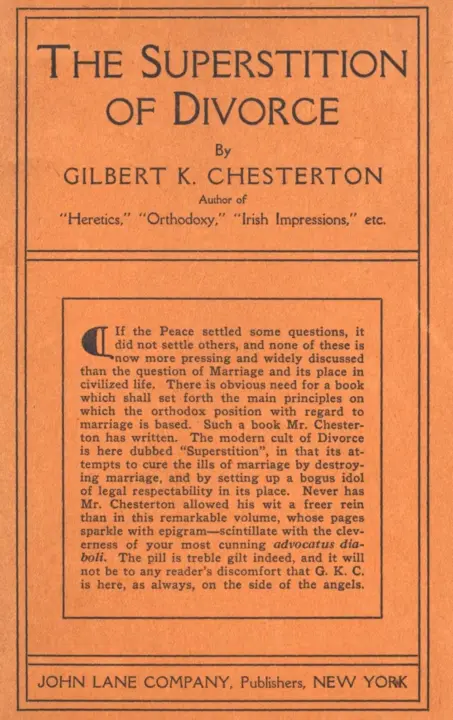
THE CLASSIC COLLECTION · 1920
"The Superstition of Divorce" by G. K. Chesterton is a philosophical examination of the social and moral implications of divorce, written in the early 20th century. The text argues that divorce is treated as a form of liberation in modern society but critiques this notion by asserting that it undermines the sanctity of marriage, which is fundamentally a promise or vow. Through a series of essays, Chesterton explores the historical significance of marital vows and the societal consequences of viewing marriage merely as a legal contract. At the start of the work, the author introduces the idea that contemporary discussions around divorce often neglect to adequately consider the meaning and implications of marriage itself. He emphasizes a need to understand what a marriage vow represents, positioning it as an act of commitment rather than a casual choice. Chesterton critiques the opportunistic attitudes of reformers who advocate for easier divorce laws without reflecting on the foundational aspects of marriage itself. He thus sets the stage for a nuanced debate about not only the nature of divorce but also the broader implications for family and society, challenging readers to reconsider their perspectives on these issues.
Introduction adapted from the source catalogue; source summaries may be automatically generated.
Free to read · English · 24,327 words · No account needed
MAKE TIME FOR A GOOD BOOK
On by default. Untick to stop anonymous reading totals. Each page counts after 10 seconds in view. How this works.
Anonymous counting is on unless you have switched it off.
And with that we can only return to the point of honour which I have compared here to a point of patriotism; since it is both the smallest and the greatest kind of patriotism. Men have died in torments during the last five years for points of patriotism far more dubious and fugitive. Men like the Poles or the Serbians, through long periods of their history, may be said rather to have lived in torments. I will never admit that the vital need of the freedom of the family, as I have tried to sketch it here, is not a cause as valuable as the freedom of any frontier. But I do willingly admit that the cause would be a dark and terrible one, if it really asked these men to suffer torments. As I have stated it, on its most extreme terms, it only asks them to suffer abnegations. And those negative sufferings I do think they may honourably be called upon to bear, for the glory of their own oath and the great things by which the nations live. In relation to their own nation most normal men will feel that this distinction between release and “re-lease” is neither fanciful nor harsh, but very rational and human. A patriot may be an exile in another country; but he will not be a patriot of another country. He will be as cheerful as he can in an abnormal position; he may or may not sing his country’s songs in a strange land; but he will not sing the strange songs as his own. And such may fairly be also the attitude of the citizen who has gone into exile from the oldest of earthly cities.
VIII.--The Vista of Divorce
The case for divorce combines all the advantages of having it both ways; and of drawing the same deduction from right or left, and from black or white. Whichever way the programme works in practice, it can still be justified in theory. If there are few examples of divorce, it shows how little divorce need be dreaded; if there are many, it shows how much it is required. The rarity of divorce is an argument in favour of divorce; and the multiplicity of divorce is an argument against marriage. Now, in truth, if we were confined to considering this alternative in a speculative manner, if there were no concrete facts but only abstract probabilities, we should have no difficulty in arguing our case. The abstract liberty allowed by the reformers is as near as possible to anarchy, and gives no logical or legal guarantee worth discussing. The advantages of their reform do not accrue to the innocent party, but to the guilty party; especially if he be sufficiently guilty. A man has only to commit the crime of desertion to obtain the reward of divorce. And if they are entitled to take as typical the most horrible hypothetical cases of the abuse of the marriage laws, surely we are entitled to take equally extreme possibilities in the abuse of their own divorce laws. If they, when looking about for a husband, so often hit upon a homicidal maniac, surely we may politely introduce them to the far more human figure of the gentleman who marries as many women as he likes and gets rid of them as often as he pleases. But in fact there is no necessity for us to argue thus in the abstract; for the amiable gentleman in question undoubtedly exists in the concrete. Of course, he is no new figure; he is a very recurrent type of rascal; his name has been Lothario or Don Juan; and he has often been represented as a rather romantic rascal. The point of divorce reform, it cannot be too often repeated, is that the rascal should not only be regarded as romantic, but regarded as respectable. He is not to sow his wild oats and settle down; he is merely to settle down to sowing his wild oats. They are to be regarded as tame and inoffensive oats; almost, if one may say so, as Quaker oats. But there is no need, as I say, to speculate about whether the looser view of divorce might prevail; for it is already prevailing. The newspapers are full of an astonishing hilarity about the rapidity with which hundreds or thousands of human families are being broken up by the lawyers; and about the undisguised haste of the “hustling judges” who carry on the work. It is a form of hilarity which would seem to recall the gaiety of a grave-digger in a city swept by a pestilence. But a few details occasionally flash by in the happy dance; from time to time the court is moved by a momentary curiosity about the causes of the general violation of oaths and promises; as if there might, here and there, be a hint of some sort of reason for ruining the fundamental institution of society. And nobody who notes those details, or considers those faint hints of reason, can doubt for a moment that masses of these men and women are now simply using divorce in the spirit of free-love. They are very seldom the sort of people who have once fallen tragically into the wrong place, and have now found their way triumphantly to the right place. They are almost always people who are obviously wandering from one place to another, and will probably leave their last shelter exactly as they have left their first. But it seems to amuse them to make again, if possible in a church, a promise they have already broken in practice and almost avowedly disbelieve in principle.
Your reading position is saved on this browser. Take it to another device with a library code. Reading pages adapt to text, rather than matching a printed edition.
G. K. (Gilbert Keith) Chesterton
G. K. (Gilbert Keith) Chesterton
G. K. (Gilbert Keith) Chesterton
G. K. (Gilbert Keith) Chesterton
BEHIND THE BOOK
This eBook is for the use of anyone anywhere in the United States and most other parts of the world at no cost and with almost no restrictions whatsoever. You may copy it, give it away or re-use it under the terms of the Project Gutenberg License included with this eBook or online at www.gutenberg.org. If you are not located in the United States, you will have to check the laws of the country where you are located before using this eBook. Read the source licence.
The original source file, including credits and licence, is retained by this library. Request an original-format copy at no charge. Please include the book title and Project Gutenberg identifier #62680.
KEEP YOUR CURIOSITY GOING

David Patterson (Spirit) Hatch

David Patterson (Spirit) Hatch

David Patterson (Spirit) Hatch
Coulson Kernahan

Ralph Waldo Emerson

Maurice Baring