THE CLASSIC COLLECTION✦The Catholic Church and conversionCLASSIC FREE BOOKS
The Catholic Church and conversion
G. K. (Gilbert Keith) Chesterton
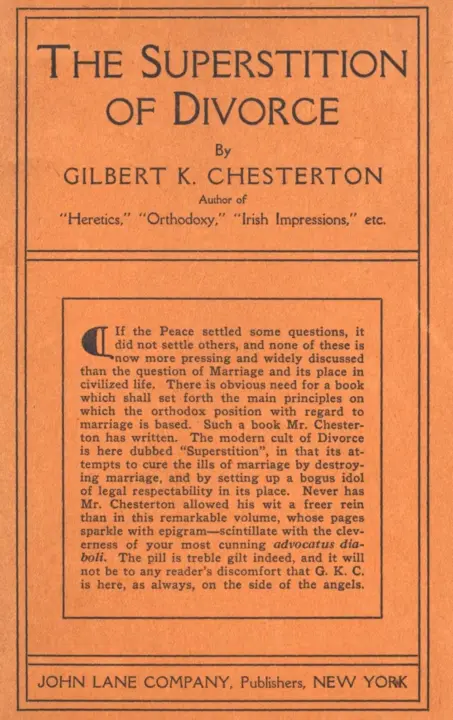
THE CLASSIC COLLECTION · 1920
"The Superstition of Divorce" by G. K. Chesterton is a philosophical examination of the social and moral implications of divorce, written in the early 20th century. The text argues that divorce is treated as a form of liberation in modern society but critiques this notion by asserting that it undermines the sanctity of marriage, which is fundamentally a promise or vow. Through a series of essays, Chesterton explores the historical significance of marital vows and the societal consequences of viewing marriage merely as a legal contract. At the start of the work, the author introduces the idea that contemporary discussions around divorce often neglect to adequately consider the meaning and implications of marriage itself. He emphasizes a need to understand what a marriage vow represents, positioning it as an act of commitment rather than a casual choice. Chesterton critiques the opportunistic attitudes of reformers who advocate for easier divorce laws without reflecting on the foundational aspects of marriage itself. He thus sets the stage for a nuanced debate about not only the nature of divorce but also the broader implications for family and society, challenging readers to reconsider their perspectives on these issues.
Introduction adapted from the source catalogue; source summaries may be automatically generated.
Free to read · English · 24,327 words · No account needed
MAKE TIME FOR A GOOD BOOK
On by default. Untick to stop anonymous reading totals. Each page counts after 10 seconds in view. How this works.
Anonymous counting is on unless you have switched it off.
From its first days in the forest this human group had to fight against wild monsters; and so it is now fighting against these wild machines. It only managed to survive then, and it will only manage to survive now, by a strong internal sanctity; a tacit oath or dedication deeper than that of the city or the tribe. But though this silent promise was always present, it took at a certain turning point of our history a special form which I shall try to sketch in the next chapter. That turning point was the creation of Christendom by the religion which created it. Nothing will destroy the sacred triangle; and even the Christian faith, the most amazing revolution that ever took place in the mind, served only in a sense to turn that triangle upside down. It held up a mystical mirror in which the order of the three things was reversed; and added a holy family of child, mother and father to the human family of father, mother and child.
VI.--The Story of the Vow
Charles Lamb, with his fine fantastic instinct for combinations that are also contrasts, has noted somewhere a contrast between St. Valentine and valentines. There seems a comic incongruity in such lively and frivolous flirtations still depending on the date and title of an ascetic and celibate bishop of the Dark Ages. The paradox lends itself to his treatment, and there is a truth in his view of it. Perhaps it may seem even more of a paradox to say there is no paradox. In such cases unification appears more provocative than division; and it may seem idly contradictory to deny the contradiction. And yet in truth there is no contradiction. In the deepest sense there is a very real similarity, which puts St. Valentine and his valentines on one side, and most of the modern world on the other. I should hesitate to ask even a German professor to collect, collate and study carefully all the valentines in the world, with the object of tracing a philosophical principle running through them. But if he did, I have no doubt about the philosophic principle he would find. However trivial, however imbecile, however vulgar or vapid or stereotyped the imagery of such things might be, it would always involve one idea, the same idea that makes lovers laboriously chip their initials on a tree or a rock, in a sort of monogram of monogamy. It may be a cockney trick to tie one’s love on a tree; though Orlando did it, and would now doubtless be arrested by the police for breaking the bye-laws of the Forest of Arden. I am not here concerned especially to commend the habit of cutting one’s own name and private address in large letters on the front of the Parthenon, across the face of the Sphinx, or in any other nook or corner where it may chance to arrest the sentimental interest of posterity. But like many other popular things, of the sort that can generally be found in Shakespeare, there is a meaning in it that would probably be missed by a less popular poet, like Shelley. There is a very permanent truth in the fact that two free persons deliberately tie themselves to a log of wood. And it is the idea of tying oneself to something that runs through all this old amorous allegory like a pattern of fetters. There is always the notion of hearts chained together, or skewered together, or in some manner secured; there is a security that can only be called captivity. That it frequently fails to secure itself has nothing to do with the present point. The point is that every philosophy of sex must fail, which does not account for its ambition of fixity, as well as for its experience of failure. There is nothing to make Orlando commit himself on the sworn evidence of the nearest tree. He is not bound to be bound; he is under constraint, but nobody constrains him to be under constraint. In short, Orlando took a vow to marry precisely as Valentine took a vow not to marry. Nor could any ascetic, without being a heretic, have asserted in the wildest reactions of asceticism, that the vow of Orlando was not lawful as well as the vow of Valentine. But it is a notable fact that even when it was not lawful, it was still a vow. Through all that mediæval culture, which has left us the legend of romance, there ran this pattern of a chain, which was felt as binding even where it ought not to bind. The lawless loves of mediæval legends all have their own law, and especially their own loyalty, as in the tales of Tristram or Lancelot. In this sense we might say that mediæval profligacy was more fixed than modern marriage. I am not here discussing either modern or mediæval ethics, in the matter of what they did say or ought to say of such things. I am only noting as a historical fact the insistence of the mediæval imagination, even at its wildest, upon one particular idea. That idea is the idea of the vow. It might be the vow which St. Valentine took; it might be a lesser vow which he regarded as lawful; it might be a wild vow which he regarded as quite lawless. But the whole society which made such festivals and bequeathed to us such traditions was full of the idea of vows; and we must recognise this notion, even if we think it nonsensical, as the note of the whole civilisation. And Valentine and the valentine both express it for us; even more if we feel them both as exaggerated, or even as exaggerating opposites. Those extremes meet; and they meet in the same place. Their trysting place is by the tree on which the lover hung his love-letters. And even if the lover hung himself on the tree, instead of his literary compositions, even that act had about it also an indefinable flavour of finality.
Your reading position is saved on this browser. Take it to another device with a library code. Reading pages adapt to text, rather than matching a printed edition.
G. K. (Gilbert Keith) Chesterton
G. K. (Gilbert Keith) Chesterton
G. K. (Gilbert Keith) Chesterton
G. K. (Gilbert Keith) Chesterton
BEHIND THE BOOK
This eBook is for the use of anyone anywhere in the United States and most other parts of the world at no cost and with almost no restrictions whatsoever. You may copy it, give it away or re-use it under the terms of the Project Gutenberg License included with this eBook or online at www.gutenberg.org. If you are not located in the United States, you will have to check the laws of the country where you are located before using this eBook. Read the source licence.
The original source file, including credits and licence, is retained by this library. Request an original-format copy at no charge. Please include the book title and Project Gutenberg identifier #62680.
KEEP YOUR CURIOSITY GOING

David Patterson (Spirit) Hatch

David Patterson (Spirit) Hatch

David Patterson (Spirit) Hatch
Coulson Kernahan

Ralph Waldo Emerson

Maurice Baring