
Last letters from the living dead man
David Patterson (Spirit) Hatch
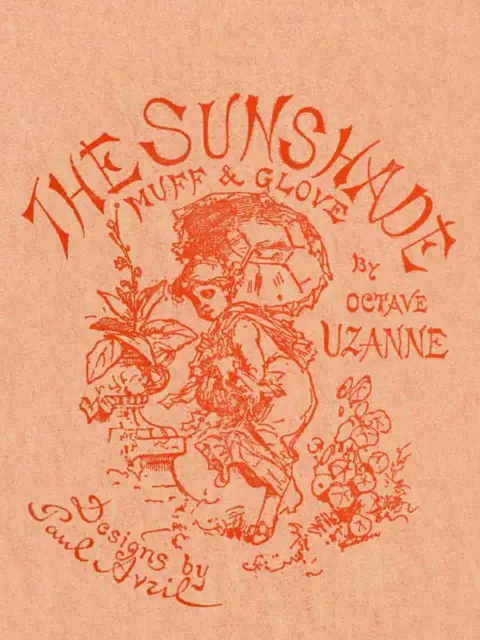
THE CLASSIC COLLECTION · 1883
"The Sunshade, the Glove, the Muff" by Octave Uzanne is a collection of essays on the history and cultural significance of these feminine ornamental accessories, written in the late 19th century. The text serves as an exploration of the evolution and functionality of these items, demonstrating Uzanne's interest in the blend of art, fashion, and social commentary present in women’s adornments. The narrative indicates that the book will delve deeply into various historical contexts, highlighting their uses across different cultures and time periods, and possibly reflects on the role of women in society concerning fashion. The opening of the work features a preface by Uzanne, who explains the motivation behind this exploration following the success of his previous volume on "The Fan." He begins by discussing the historical roots of the sunshade, tracing its use back to ancient civilizations and its symbolic representation across cultures. Uzanne references various literary and historical sources to illustrate how these items were more than mere accessories but significant cultural artifacts representing beauty, femininity, and social class. He humorously hints at the challenges of undertaking such a comprehensive topic, reflecting a blend of seriousness and levity as he prepares to embark on an enriching literary journey regarding these fashionable items.
Introduction adapted from the source catalogue; source summaries may be automatically generated.
Free to read · English · 30,801 words · No account needed
MAKE TIME FOR A GOOD BOOK
On by default. Untick to stop anonymous reading totals. Each page counts after 10 seconds in view. How this works.
Anonymous counting is on unless you have switched it off.
A friend of mine, new, true, and rare,
And all unlike the common form;
Who leaves me when my sky is fair,
And reappears in days of storm.
This almost equals that other quatrain, more ancient still, signed by
the good abbé Delille--
This precious, supple instrument, confect Of the whale's bone, and of the silkworm's grave, With outstretched wing, my brow will oft protect From the wet onslaught of the pluvial wave.
Have we not here Academic verse well made for the Umbrellas of the
Academicians!
To come to extremes: among the popular songs, we hear the song of /the Umbrella/, "a ditty found in a whale"--
The good Umbrella may be sung
In many airs and ways;
The Umbrella, be we old or young,
Will serve us all our days.
It keeps true love from getting wet,
And catching cold at night;
It hides the thief, to business set,
From the policeman's sight.
Umbrella!
Then buy yourself, for fear of rain,
A solid, useful, good, and plain
Umbrella!
In fact, for rain we cannot sell a
Much better thing than our Umbrella!
This funny song is well worth the tiresome verse sung at present--
He has not an Umbrella, well
It is no matter, while it's fine;
But when the rain comes down pell-mell,
Why, then he's wetted to the spine! . . . .
Certainly one ought to write a physiological monograph of these black mushrooms, which to-day protect humanity, just as one ought to rhyme a poem of the dainty Sunshade, that pretty rosy cupola, which is one of the most charming coquetries of a Frenchwoman.
We write this /one ought/ with a vague sadness, with the discouragement which makes us wish for the future, what we should have been so glad to bury in the past. In beginning our work, we experienced a careless joy, we thought the end was near on our very entry into the field, and that we should quickly attain it, with the satisfaction of having created a little work, both complete and altogether graceful; but once on our way, ferreting without relaxation in all the literary thickets where some Parasol might lie buried, in the fold of a phrase, in the middle of a story, of an anecdote, or of a dissertation, of some fact, we have gathered so ample a harvest, our sheaf has become so large, so very large, that it was impossible for us to bind our arms about it, after having co-ordinated its various parts. It is but a few poor strays then which lie stranded here, the flotsam and jetsam of our hope, sole vestiges of a project which, like all projects, became Homeric as it grew great in the workshop of the imagination.
Your reading position is saved on this browser. Take it to another device with a library code. Reading pages adapt to text, rather than matching a printed edition.
BEHIND THE BOOK
This eBook is for the use of anyone anywhere in the United States and most other parts of the world at no cost and with almost no restrictions whatsoever. You may copy it, give it away or re-use it under the terms of the Project Gutenberg License included with this eBook or online at www.gutenberg.org. If you are not located in the United States, you will have to check the laws of the country where you are located before using this eBook. Read the source licence.
The original source file, including credits and licence, is retained by this library. Request an original-format copy at no charge. Please include the book title and Project Gutenberg identifier #44570.
KEEP YOUR CURIOSITY GOING
David Patterson (Spirit) Hatch

David Patterson (Spirit) Hatch

David Patterson (Spirit) Hatch
Cécile Tormay

Moritz Busch
John L. Ransom