THE CLASSIC COLLECTION✦A dead man’s diaryCLASSIC FREE BOOKS
A dead man’s diary
Coulson Kernahan
THE CLASSIC COLLECTION · 1911
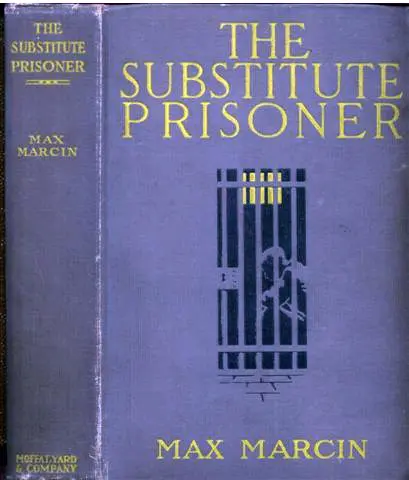
"The Substitute Prisoner" by Max Marcin is a novel written in the early 20th century. The story centers around Herbert Whitmore, a wealthy businessman entangled in a web of deceit, jealousy, and potential murder, as he navigates complex relationships with a woman named Julia Strong and the estranged husband George Collins. The narrative unfolds with suspense as various character motivations and tangled connections are revealed, suggesting themes of betrayal and retribution. At the start of the novel, the reader is introduced to Herbert Whitmore, who is surprised by an unexpected visit from Julia Strong at his home late at night. Julia warns Whitmore about the volatile situation with her lover, George Collins, who is furious about Whitmore’s interest in his wife. As the plot thickens, it becomes apparent that Collins may be a threat to Whitmore, creating a tense atmosphere filled with uncertainty. The narrative quickly establishes the stakes as Whitmore is drawn into a dangerous game of manipulation and confrontation, setting the foundation for a gripping tale of love, vengeance, and ultimately, murder.
Introduction adapted from the source catalogue; source summaries may be automatically generated.
Free to read · English · 54,944 words · No account needed
MAKE TIME FOR A GOOD BOOK
On by default. Untick to stop anonymous reading totals. Each page counts after 10 seconds in view. How this works.
Anonymous counting is on unless you have switched it off.
"I shall be on hand," Beard promised.
"Then you are at liberty to go," the coroner told him.
If Britz expected to witness a hysterical scene between Beard and the girl, he was doomed to disappointment. He had stage-managed Beard's release, and he also had arranged for the presence of Miss Burden and Ward. He had hoped to produce a happy climax, with Ward present as a conflicting factor, to be carried by jealousy into some foolish act that would result in open hostility between him and Beard.
The happy climax, Britz succeeded in producing. But it was a most dignified, genteel, quiet climax. No emotional outburst occurred, no storm of happiness swept the girl or Beard. The joy they felt was not of the wild, unharnessed kind. It was like an internal bath of sunshine, peaceful, radiant, diffusing a quiet happiness about them.
Nor did Ward give any outward sign of being torn by violent emotions. He held his passions in complete subjugation. If he was consumed by jealousy, his conduct did not betray it. Not a word did he utter as the girl linked her arm in Beard's, and, with a flash of gratitude at the coroner, left the office.
"Did you bring me down to witness this?" Ward turned toward Britz.
"Yes," acknowledged the detective.
"Why?" demanded the banker.
"Because I wanted to ascertain whether I was justified in eliminating Mr. Beard as the possible assassin of his employer."
"And have you eliminated him?"
"I have."
"Because of what occurred just now?" inquired Ward.
"Because of what did NOT occur," Britz informed him.
"I don't understand." Ward looked his amazement.
"You'll understand to-morrow," said the detective. "You may go, Mr. Ward," he added. "Your sister undoubtedly has been arraigned in court by now and probably is at the Tombs. The coroner will give you permission to visit her."
Britz walked out of the office and proceeded slowly to Police Headquarters. In the lobby he encountered Greig.
"Come into my office," said Britz. "And ask the chief to come also."
Greig summoned Manning, and the two followed Britz into the room
occupied by the detective.
"Sit down and make yourselves comfortable," said Britz, producing a box of cigars and offering it to the visitors. Britz summoned the doorman.
"Don't permit anyone to disturb us!" he said to the attendant.
Lighting a fresh cigar, Britz disposed himself at his desk, and, turning toward Manning and Greig, said:
"I shall now begin to enlighten you with regard to the Whitmore case."
Your reading position is saved on this browser. Take it to another device with a library code. Reading pages adapt to text, rather than matching a printed edition.
BEHIND THE BOOK
This eBook is for the use of anyone anywhere in the United States and most other parts of the world at no cost and with almost no restrictions whatsoever. You may copy it, give it away or re-use it under the terms of the Project Gutenberg License included with this eBook or online at www.gutenberg.org. If you are not located in the United States, you will have to check the laws of the country where you are located before using this eBook. Read the source licence.
The original source file, including credits and licence, is retained by this library. Request an original-format copy at no charge. Please include the book title and Project Gutenberg identifier #18965.
KEEP YOUR CURIOSITY GOING
Coulson Kernahan

Maurice Baring
Frances Wright
Cécile Tormay

Frederic Jesup Stimson

W. H. P. (William Henry Pope) Jarvis