THE CLASSIC COLLECTION✦A dead man’s diaryCLASSIC FREE BOOKS
A dead man’s diary
Coulson Kernahan
THE CLASSIC COLLECTION · 1911
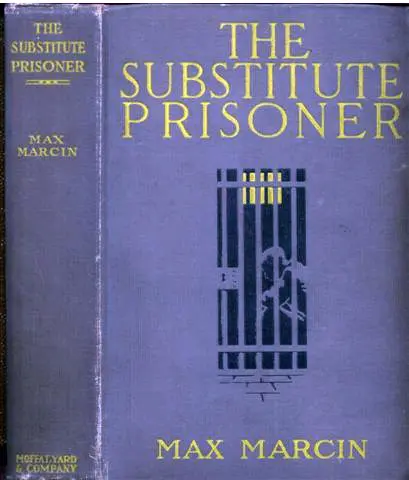
"The Substitute Prisoner" by Max Marcin is a novel written in the early 20th century. The story centers around Herbert Whitmore, a wealthy businessman entangled in a web of deceit, jealousy, and potential murder, as he navigates complex relationships with a woman named Julia Strong and the estranged husband George Collins. The narrative unfolds with suspense as various character motivations and tangled connections are revealed, suggesting themes of betrayal and retribution. At the start of the novel, the reader is introduced to Herbert Whitmore, who is surprised by an unexpected visit from Julia Strong at his home late at night. Julia warns Whitmore about the volatile situation with her lover, George Collins, who is furious about Whitmore’s interest in his wife. As the plot thickens, it becomes apparent that Collins may be a threat to Whitmore, creating a tense atmosphere filled with uncertainty. The narrative quickly establishes the stakes as Whitmore is drawn into a dangerous game of manipulation and confrontation, setting the foundation for a gripping tale of love, vengeance, and ultimately, murder.
Introduction adapted from the source catalogue; source summaries may be automatically generated.
Free to read · English · 54,944 words · No account needed
MAKE TIME FOR A GOOD BOOK
On by default. Untick to stop anonymous reading totals. Each page counts after 10 seconds in view. How this works.
Anonymous counting is on unless you have switched it off.
The pitiless baiting to which Collins was being subjected was beginning to tell on him. He turned his poor, befuddled head to one side, then to the other. His eyes shot mute appeals for help, but no answering gleam of compassion came from the others. They regarded him with cold, stolid faces, expressionless as death masks.
"Why can't you leave me alone?" pleaded Collins. "I didn't kill
Whitmore."
The denial was uttered in the tone of a fervent plea, but it made no visible impression on the detective.
"If you didn't do it, why don't you establish your innocence?" Britz
pursued relentlessly.
"You haven't proved me guilty!" Collins fired back. Evidently something which Luckstone had told him flashed across his mind, for he seemed to come out of his bewildered state, and again he adopted an air of resolute opposition. "I won't say another word."
Britz met this altered attitude of Collins with a swift transformation of his own. His face contracted until every line seemed to harden into an expression of stern determination.
"Do you know why Julia Strong killed herself?" he snapped.
"Yes," said Collins weakly.
"Why?"
"She threatened to do it a dozen times. She wanted me to permit my wife to obtain a divorce so I could marry her."
Collins had been taken off his guard and Britz found it easy to follow
up his advantage.
"You promised to marry her?" he inquired.
"I never told her so."
"But you led her to believe you would?"
"I wasn't responsible for what she believed."
"Now I'll tell you something," pursued the detective in a firm, subdued voice. "An hour before Julia Strong committed suicide she was in my office at Police Headquarters."
Collins started as if jarred by a hateful sound.
"I--I--don't believe it," he faltered.
"She was there," said Britz, ignoring the other's remark. "Moreover, she accused you of having killed Whitmore. She did it in the presence of a witness, and, although she was unaware of it, her statement was taken down by a hidden stenographer."
"Then why did she commit suicide?" blurted Collins, as if her death contradicted the detective's statement.
"She betrayed you because you had betrayed her. She thought you and your wife had become reconciled. Then, when she received your note--the one that Beard brought her--she believed you meant, after all, to marry her. In a fit of remorse at having betrayed you, she killed herself."
"Why do you tell me this?" asked Collins suspiciously.
"To show you what an overwhelming mass of evidence we have against you. And to give you a last opportunity to explain."
Your reading position is saved on this browser. Take it to another device with a library code. Reading pages adapt to text, rather than matching a printed edition.
BEHIND THE BOOK
This eBook is for the use of anyone anywhere in the United States and most other parts of the world at no cost and with almost no restrictions whatsoever. You may copy it, give it away or re-use it under the terms of the Project Gutenberg License included with this eBook or online at www.gutenberg.org. If you are not located in the United States, you will have to check the laws of the country where you are located before using this eBook. Read the source licence.
The original source file, including credits and licence, is retained by this library. Request an original-format copy at no charge. Please include the book title and Project Gutenberg identifier #18965.
KEEP YOUR CURIOSITY GOING
Coulson Kernahan

Maurice Baring
Frances Wright
Cécile Tormay

Frederic Jesup Stimson

W. H. P. (William Henry Pope) Jarvis