THE CLASSIC COLLECTION✦A dead man’s diaryCLASSIC FREE BOOKS
A dead man’s diary
Coulson Kernahan
THE CLASSIC COLLECTION · 1924
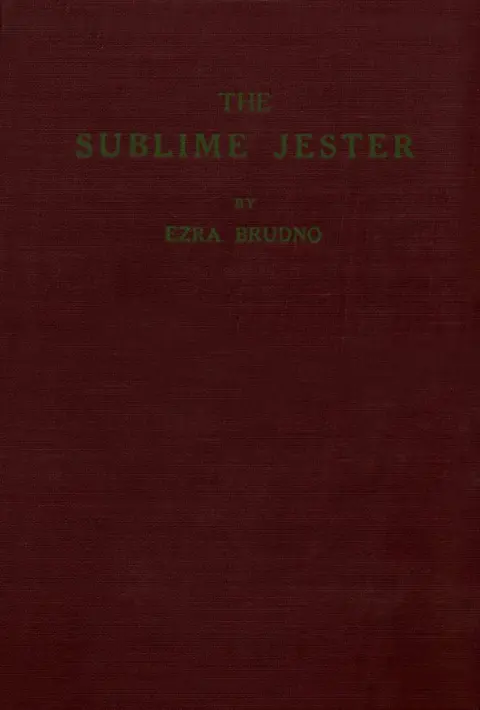
"The Sublime Jester" by Ezra S. Brudno is a novel written in the early 20th century. This work follows the life of Albert Zorn, a young boy navigating the challenges of his identity and societal prejudices in a small town. The themes of heritage, dreams of inheritance, and the struggles against mockery and misunderstanding are central to the story. The opening of the story introduces Albert as he reflects on a trivial but impactful incident from his childhood while dreaming of a newfound fortune. Set against the backdrop of his quaint hometown, his daydreams of wealth are abruptly interrupted by the cruel taunts from classmates regarding his Jewish heritage. As Albert grapples with these insults, he is supported by his friend Christian, indicating the importance of companionship in his life. Through a series of dramatic exchanges in the classroom, the tension between the boy's aspirations and the harsh realities of prejudice begins to unfold, setting the stage for Albert's emotional journey and his eventual quest for meaning and purpose beyond the confines of societal expectations.
Introduction adapted from the source catalogue; source summaries may be automatically generated.
Free to read · English · 91,804 words · No account needed
MAKE TIME FOR A GOOD BOOK
On by default. Untick to stop anonymous reading totals. Each page counts after 10 seconds in view. How this works.
Anonymous counting is on unless you have switched it off.
A little man, with a large head and an ugly sharp face, was laughing blandly, as an echo to von Ense’s remark.
“I see you are sceptical about new poetic geniuses, Pastor Schleiermacher,” resumed von Ense.
“No,” said the little man, still laughing, “but I thought that with Herr von Goethe still alive Frau Varnhagen would admit of no other poetic genius.”
Rahel, who was giving her attention to one of Hegel’s discourses—Hegel was always delivering discourses, even in drawingrooms—caught the gist of Schleiermacher’s ironic remark and her smiling eyes seemed to say, “Wait until Professor Hegel gets through with his monologue and you shall get your deserts.”
However, the opportunity had not yet come. Professor Hegel was still laboring to complete his sentence in his strong Swabian accent, speaking haltingly, with jerking gestures, and, swaying his body awkwardly, he continued:
“As I was saying, when I think a thought, for instance, I am not thinking my own thought but only part of the universal thought of all human intelligence, and while the thought strikes me as my own it is only the thought of the universe I am thinking, and when I think of God, or rather of the absolute, the idea of the consciousness of one, I am only thinking as part of the whole which is God—in other words, my consciousness of this thought and the opposite of this very thought are one and the same thing, both being the same consciousness of an integral whole——”
Rahel welcomed the guests while giving part of her mind to Hegel, who was laboring through the labyrinth of his thoughts, seeking a way out. Fortunately Hegel minded no intrusions nor interruptions, and with his shoulders stooped, his prematurely aged, wrinkled countenance undergoing the visible contortions of a twitching pair, proceeded:
“In other words, though directed an sich, concerning and pertaining to one’s self as an incomplete and imperfect existence—such thought, as I have clearly demonstrated, is different and yet identical, all forming complementary parts of a whole, as segments make up a circle, and yet without a circle there can be no segments——”
“Clearly so,” struck in the hostess.
“Yes, Pastor Schleiermacher,” she turned her keen eyes upon the little savant, “I have discovered a new poetic genius. Venus may shine even though the greater lustre is that of Jupiter.”
She wished him to know that she had overheard his pleasantly about the
bard of Weimar.
“Who is this new genius—a Berliner?”
Several other faces turned upon the hostess.
“No, a recent arrival. He hails originally from the Rhineland but he has just come from Goettingen, a student of Jurisprudence——”
Your reading position is saved on this browser. Take it to another device with a library code. Reading pages adapt to text, rather than matching a printed edition.
BEHIND THE BOOK
This eBook is for the use of anyone anywhere in the United States and most other parts of the world at no cost and with almost no restrictions whatsoever. You may copy it, give it away or re-use it under the terms of the Project Gutenberg License included with this eBook or online at www.gutenberg.org. If you are not located in the United States, you will have to check the laws of the country where you are located before using this eBook. Read the source licence.
The original source file, including credits and licence, is retained by this library. Request an original-format copy at no charge. Please include the book title and Project Gutenberg identifier #65313.
KEEP YOUR CURIOSITY GOING
Coulson Kernahan

Maurice Baring
Frances Wright
Cécile Tormay

Frederic Jesup Stimson

W. H. P. (William Henry Pope) Jarvis