
Last letters from the living dead man
David Patterson (Spirit) Hatch
THE CLASSIC COLLECTION · 1917
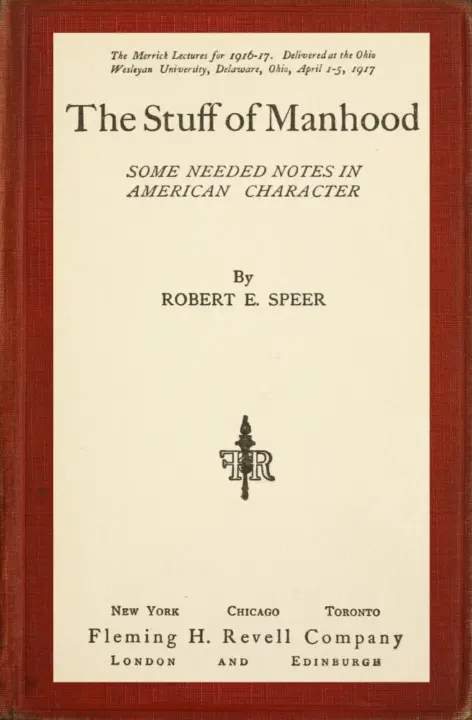
"The Stuff of Manhood: Some Needed Notes in American Character" by Robert E. Speer is a series of lectures exploring the moral and character elements essential for individuals and the nation, written in the early 20th century. The text delves into the ideals of character, self-discipline, and social responsibility, emphasizing the notion that individual virtue contributes to societal health. It aims to inspire readers to strive for personal excellence and communal welfare, focusing on what it means to embody true manhood in American society. The opening of the work introduces Speer’s perspective on the importance of self-discipline and moral responsibility through the lens of individual and national character. He discusses how modern theories of upbringing—and life more broadly—often lean toward indulgence and lack the necessary framework of discipline, emphasizing that true strength arises from facing challenges and fulfilling one's duties. Drawing on biblical figures and contemporary examples, Speer articulates the concept that self-restraint and striving toward moral ideals not only enrich individual character but also enhance the collective character of society, urging readers to embrace the hard path of discipline for personal growth and the betterment of the nation.
Introduction adapted from the source catalogue; source summaries may be automatically generated.
Free to read · English · 47,388 words · No account needed
MAKE TIME FOR A GOOD BOOK
On by default. Untick to stop anonymous reading totals. Each page counts after 10 seconds in view. How this works.
Anonymous counting is on unless you have switched it off.
By the gift of the late Rev. Frederick Merrick, M. D., D. D., LL. D., for fifty-one years a member of the Faculty, and for thirteen of those years President of Ohio Wesleyan University, a fund was established providing an annual income for the purpose of securing lectures within the general field of Experimental and Practical Religion. The following courses have previously been given on this foundation:
Daniel Curry, D. D.――“Christian Education.”
President James McCosh, D. D., LL. D.――“Tests of the Various Kinds of
Truth.”
Bishop Randolph S. Foster, D. D., LL. D.――“The Philosophy of Christian
Experience.”
Professor James Stalker, D. D.――“The Preacher and His Models.”
John W. Butler, D. D.――“Mission Work in Mexico.”
Professor George Adam Smith, D. D., LL. D.――“Christ in the Old
Testament.”
Bishop James W. Bashford, Ph. D., D. D., LL. D.――“The Science of
Religion.”
James M. Buckley, D. D., LL. D.――“The Natural and Spiritual Orders and
Their Relations.”
John R. Mott, M. A., F. R. G. S.――“The Pastor and Modern Missions.”
Bishop Elijah E. Hoss, D. D., LL. D.; Professor Doremus A. Hayes, Ph. D., S. T. D., LL. D.; Charles E. Jefferson, D. D., LL. D.; Bishop William F. McDowell, D. D., LL. D.; President Edwin H. Hughes, D. D.――“The New Age and Its Creed.”
Robert E. Speer, M. A.――“The Marks of a Man, or The Essentials of
Christian Character.”
Rev. Charles Stelzle, Miss Jane Addams, Commissioner of Labor Charles P. Neill, Ph. D., Professor Graham Taylor, and Rev. George P. Eckman, D. D.――“The Social Application of Religion.”
Rev. George Jackson, M. A.――“Some Old Testament Problems.”
Professor Walter Rauschenbusch, D. D.――“Christianizing the Social
Order.”
Professor G. A. Johnston Ross, M. A.――“One Avenue of Faith.”
Introduction
The moral elements of individual character are inevitably social. And the social obligation immensely strengthens the sanctions which enjoin them. When a man “has trained himself,” to use the words of Lord Morley in dealing with Voltaire’s religion, “to look upon every wrong in thought, every duty omitted from act, each infringement of the inner spiritual law which humanity is constantly perfecting for its own guidance and advantage ... as an ungrateful infection, weakening and corrupting the future of his brothers,” he views each struggle within his own soul against evil and each firm aspiration after purity not as a mere incident in his own spiritual biography but as a fight for social good and for the perfecting of the nation and of humanity. And the struggle for social good and the perfecting of human life is fundamentally a struggle for the triumph of ideals in personal wills. God can take hold of men only in man. He revealed Himself and wrought redemption less by a social process than by a personal incarnation. And the only way of which we know to uplift the life of the nation and to fit it for its mission and its ministry is to reform our own and other men’s characters, and ourselves to be what manner of man among men we would have the nation be among nations. It is of some of the elements of character of which men stand specially in need to-day that we are to speak in these lectures. What is good in our lives as individuals and in our life as a nation is not in need of discussion here. And there is no nobility in analyzing and deriding our weaknesses. Our purpose is to urge our keeping if we have not lost them, and our regaining if we feel them slipping from us, some of the elemental moral qualities and spiritual resources which are vital to the capacity for duty and to the living of a full and efficient life.
Your reading position is saved on this browser. Take it to another device with a library code. Reading pages adapt to text, rather than matching a printed edition.
BEHIND THE BOOK
This eBook is for the use of anyone anywhere in the United States and most other parts of the world at no cost and with almost no restrictions whatsoever. You may copy it, give it away or re-use it under the terms of the Project Gutenberg License included with this eBook or online at www.gutenberg.org. If you are not located in the United States, you will have to check the laws of the country where you are located before using this eBook. Read the source licence.
The original source file, including credits and licence, is retained by this library. Request an original-format copy at no charge. Please include the book title and Project Gutenberg identifier #67403.
KEEP YOUR CURIOSITY GOING
David Patterson (Spirit) Hatch

David Patterson (Spirit) Hatch

David Patterson (Spirit) Hatch
Coulson Kernahan

Ralph Waldo Emerson

Maurice Baring