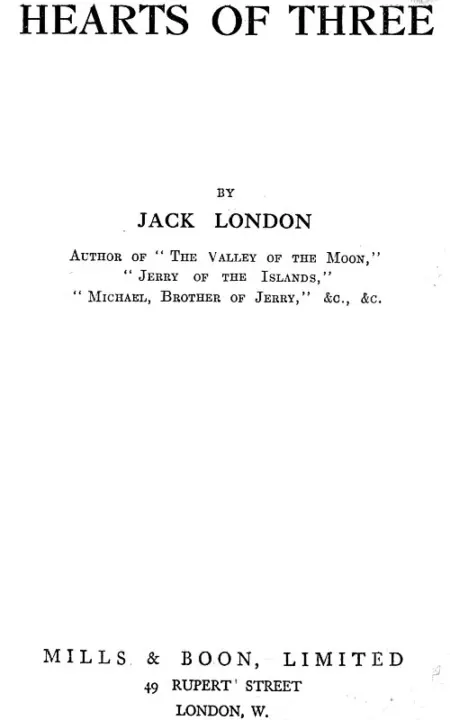
Hearts of three
Jack London
THE CLASSIC COLLECTION · 1911
"The Strength of the Strong" by Jack London is a collection of stories written in the early 20th century. The book begins with a parable that dives into themes of strength, community, and development from primitive social structures to more complex ones, and depicts early human struggles and social dynamics. The narrative is engaging and features characters such as Old Long-Beard and his grandsons, who reflect on past experiences that shape their understanding of strength and survival in a primitive environment. At the start of the narrative, Old Long-Beard recounts tales of his ancestors living in fear and isolation, caught in a cycle of individualism that leaves them vulnerable to stronger adversaries. The three grandsons, Deer-Runner, Yellow-Head, and Afraid-of-the-Dark, listen intently as Long-Beard explains how their people once operated as isolated units, but after facing dire threats from the "Meat-Eaters," they formed their first tribe to combine their strengths. This initiates a societal evolution driven by the realizations about collaboration and the necessity of laws to maintain unity and strength. The opening section highlights the contrast between chaos and cohesion, setting the stage for a deeper exploration of human society's development through cooperation and shared strength.
Introduction adapted from the source catalogue; source summaries may be automatically generated.
Free to read · English · 47,372 words · No account needed
MAKE TIME FOR A GOOD BOOK
On by default. Untick to stop anonymous reading totals. Each page counts after 10 seconds in view. How this works.
Anonymous counting is on unless you have switched it off.
“But you are an old woman to be doing this man’s work, and a strong man’s work at that,” I insisted.
Again she seemed to immerse herself in that atmosphere of contemplative eternity, and so strangely did it affect me that I should not have been surprised to have awaked a century or so later and found her just beginning to enunciate her reply—
“The work hoz tull be done, an’ I am beholden tull no one.”
“But have you no children, no family, relations?”
“Oh, aye, a-plenty o’ them, but they no see fut tull be helpun’ me.”
She drew out her pipe for a moment, then added, with a nod of her head toward the house, “I luv’ wuth meself.”
I glanced at the house, straw-thatched and commodious, at the large
stable, and at the large array of fields I knew must belong with the
place.
“It is a big bit of land for you to farm by yourself.”
“Oh, aye, a bug but, suvunty acres. Ut kept me old mon buzzy, along wuth a son an’ a hired mon, tull say naught o’ extra honds un the harvest an’ a maid-servant un the house.”
She clambered into the cart, gathered the reins in her hands, and quizzed me with her keen, shrewd eyes.
“Belike ye hail from over the watter—Ameruky, I’m meanun’?”
“Yes, I’m a Yankee,” I answered.
“Ye wull no be findun’ mony Island McGill folk stoppun’ un Ameruky?”
“No; I don’t remember ever meeting one, in the States.”
She nodded her head.
“They are home-luvun’ bodies, though I wull no be sayin’ they are no fair-travelled. Yet they come home ot the last, them oz are no lost ot sea or kult by fevers an’ such-like un foreign parts.”
“Then your sons will have gone to sea and come home again?” I queried.
“Oh, aye, all savun’ Samuel oz was drownded.”
At the mention of Samuel I could have sworn to a strange light in her eyes, and it seemed to me, as by some telepathic flash, that I divined in her a tremendous wistfulness, an immense yearning. It seemed to me that here was the key to her inscrutableness, the clue that if followed properly would make all her strangeness plain. It came to me that here was a contact and that for the moment I was glimpsing into the soul of her. The question was tickling on my tongue, but she forestalled me.
She tchk’d to the horse, and with a “Guid day tull you, sir,” drove
off.
Your reading position is saved on this browser. Take it to another device with a library code. Reading pages adapt to text, rather than matching a printed edition.
Jack London
Jack London
Jack London
Jack London
BEHIND THE BOOK
This eBook is for the use of anyone anywhere in the United States and most other parts of the world at no cost and with almost no restrictions whatsoever. You may copy it, give it away or re-use it under the terms of the Project Gutenberg License included with this eBook or online at www.gutenberg.org. If you are not located in the United States, you will have to check the laws of the country where you are located before using this eBook. Read the source licence.
The original source file, including credits and licence, is retained by this library. Request an original-format copy at no charge. Please include the book title and Project Gutenberg identifier #1075.
KEEP YOUR CURIOSITY GOING
Coulson Kernahan

Maurice Baring
Frances Wright
Cécile Tormay

Frederic Jesup Stimson

W. H. P. (William Henry Pope) Jarvis