THE CLASSIC COLLECTION✦The Hampstead mystery: a novel. Volume 3 (of 3)CLASSIC FREE BOOKS
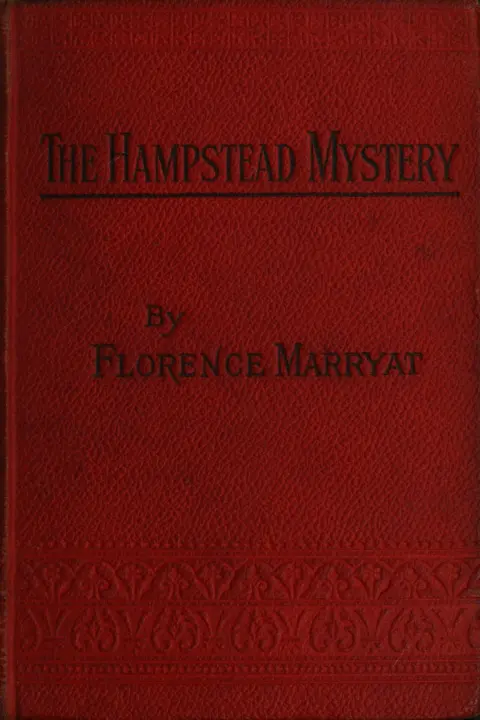
The Hampstead mystery: a novel. Volume 3 (of 3)
Florence Marryat
THE CLASSIC COLLECTION · 1896
"The strange transfiguration of Hannah Stubbs" by Florence Marryat is a novel written in the late 19th century. It blends domestic realism with occult intrigue, following an exiled Italian aristocrat in London, a pragmatic young doctor, and a country maid whose uncanny mediumship draws them into séances and supernatural tests. Expect a tale of jealousy, guilt, and the thirst for answers beyond the veil, with the title character’s latent powers promising unsettling transformations. The opening of the novel introduces Signor Ricardo, a reserved Italian language teacher in a Soho lodging-house, secretly using a black-draped room for occult experiments. Visited by Dr. Karl Steinberg, he confesses he is Paolo, Marchese di Sorrento, who killed his wife Leonora in a jealous rage and now longs to learn if she was guilty or innocent by summoning her spirit. After an unnerving séance that spooks Steinberg, the men discover their landlady’s new maid, Hannah Stubbs, an ingenuous village girl whose presence triggers poltergeist-like activity. They strike a deal to “treat” her, hold sittings, and hear a controlling voice called James speak through her, promising guidance and hinting that Leonora is near; soon Hannah herself reports seeing a veiled, black-eyed lady on the stairs and by her bed, setting the stage for deeper—and riskier—experiments.
Introduction adapted from the source catalogue; source summaries may be automatically generated.
Free to read · English · 80,052 words · No account needed
MAKE TIME FOR A GOOD BOOK
On by default. Untick to stop anonymous reading totals. Each page counts after 10 seconds in view. How this works.
Anonymous counting is on unless you have switched it off.
When she had left the room, Hannah put sugar and lemon and whiskey and
hot water into the tumbler--but then she seemed to hesitate for a
moment.
“Folly!” she said to herself, “che sarà, sarà! I must be free!”
She dashed a small quantity of white powder into the glass, as she thought thus, and a moment later Charlotte appeared with the tray.
“Take that up to the Markiss,” she said; “and if he don’t answer you, say you’ve a message for him from the Baron, and when he opens the door tell him the Baron ordered me to send him up that the last thing. Do you understand?”
“Yes! Mum--my lady!”
“Now, don’t forget. Say first--‘Please, Markiss, the Baron has sent you a message’--and when he opens the door, hand him the tray and say, ‘The Baron begged as you would drink this,’ and leave it there.”
“Yes! Mum--my lady!” repeated the child.
The ruse succeeded. Ricardo at first refused to unlock his door, declaring he wanted nothing more that night, but when he heard that Von Steinberg had a message for him, he left his bed to hear what it was.
When Charlotte, faithful to her orders, thrust the tray and tumbler into his hands, and repeated the message, Hannah heard him grumble,
“What did you disturb me for such nonsense for? Here! put the tray down, and don’t you dare to come near me again to-night, or I’ll send you home to your mother. Do you understand?”
“Yes! Markiss--yes! my lord!” stammered the child, as she scuttled down the stairs again, and ran into the kitchen.
All was silent in the Professor’s room, and Hannah went back to her needlework. It was the time that she usually went to bed, but she did not feel as if she could sleep that night. At ten o’clock her little maid crept into the parlour, white and trembling.
“Please, Mum--my lady----” she commenced, half crying, “there’s sich a rum noise going on upstairs--like a dog moaning. Please, do you think it can be the Markiss!”
“The Markiss, child!” said Hannah, who had also suddenly gone unaccountably white, “why! what do you mean? Why should the Markiss make a noise? It’s most likely the wind you hear through the trees!”
“O! no! Mum--my lady--please! there’s no wind to-night, and I’m afraid to go up to bed,” continued Charlotte, weeping.
“What nonsense!” exclaimed her mistress, “I’ll go with you, then, but what you have to look so scared for, I can’t imagine!”
Your reading position is saved on this browser. Take it to another device with a library code. Reading pages adapt to text, rather than matching a printed edition.
Florence Marryat
Florence Marryat
Florence Marryat
Florence Marryat
BEHIND THE BOOK
This eBook is for the use of anyone anywhere in the United States and most other parts of the world at no cost and with almost no restrictions whatsoever. You may copy it, give it away or re-use it under the terms of the Project Gutenberg License included with this eBook or online at www.gutenberg.org. If you are not located in the United States, you will have to check the laws of the country where you are located before using this eBook. Read the source licence.
The original source file, including credits and licence, is retained by this library. Request an original-format copy at no charge. Please include the book title and Project Gutenberg identifier #76579.
KEEP YOUR CURIOSITY GOING
Coulson Kernahan

Maurice Baring
Frances Wright
Cécile Tormay
Francis Greenleaf Allinson & Anne C. E. (Anne Crosby Emery) Allinson

Frederic Jesup Stimson