THE CLASSIC COLLECTION✦An outlaw’s diary: the CommuneCLASSIC FREE BOOKS
An outlaw’s diary: the Commune
Cécile Tormay
THE CLASSIC COLLECTION · 1916
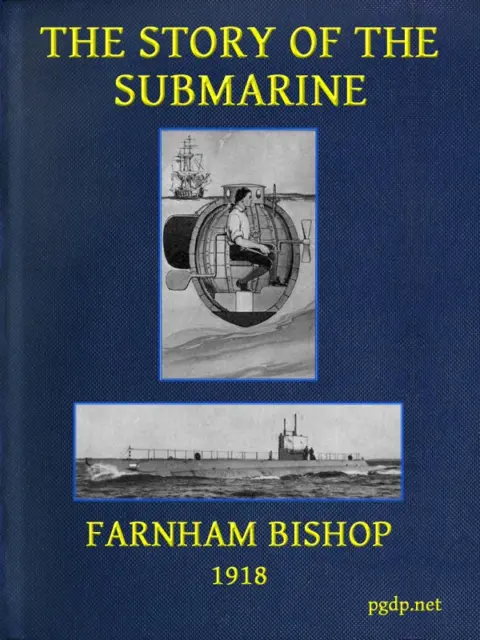
"The Story of the Submarine" by Farnham Bishop is a historical account written in the early 20th century. This work aims to educate non-technical readers about the evolution of submarines, prominently featuring notable inventors like David Bushnell and Robert Fulton. The book explores various stages of submarine development, invoking a sense of both wonder and historical significance around these remarkable inventions. The opening of the book provides a fascinating introduction to the concept of submarines, tracing the history back to early ideas and experiments from the 14th century onwards. It details the first attempts at underwater navigation, including Cornelius Van Drebel's ingenious wooden rowboats that ventured beneath the Thames in the early 17th century. Additionally, the text sets the stage for more advanced designs and concepts that would evolve over the centuries, highlighting the ingenuity and challenges faced by these pioneers in submarine technology. The author mixes historical anecdotes with an engaging narrative that promises to delve into the role of submarines in warfare and their impact on naval strategy.
Introduction adapted from the source catalogue; source summaries may be automatically generated.
Free to read · English · 46,472 words · No account needed
MAKE TIME FOR A GOOD BOOK
On by default. Untick to stop anonymous reading totals. Each page counts after 10 seconds in view. How this works.
Anonymous counting is on unless you have switched it off.
Like the settlement of the Arabic case, this was hailed as a great diplomatic victory for the United States. Unlike it, there was no question of sharing the credit with the anti-submarine activities of the Allies, whose merchant ships in the Mediterranean were being torpedoed with startling frequency. On December 21st, the new 12,000 ton Japanese liner Yasaka Maru was sunk without warning, near Port Said. Thanks to the splendid discipline of her crew, no lives were lost. There was an alleged American on board, but there was some irregularity about his citizenship papers. Nor were there any Americans aboard the French passenger ship Ville de la Ciotat, torpedoed on Christmas Eve, with the loss of seventy lives. There was nothing to mar the smug satisfaction of the American people on New Year’s Day.
Then came the news of the sinking of the Peninsular and Oriental liner Persia, on December 30th, off the Island of Crete.
“I was in the dining room of the Persia at 1.05 P.M.,” declares Mr. Charles Grant of Boston, who was one of the two Americans on board. “I had just finished my soup, and the steward was asking me what I would take for my second course, when a terrific explosion occurred.
“The saloon became filled with smoke, broken glass and steam from the boiler, which appeared to have burst. There was no panic on board. We went on deck as though we were at drill, and reported at the lifeboats on the starboard side, as the vessel had listed to port....
“The last I saw of the Persia, she had her bow in the air, five minutes after the explosion....
“Robert McNeely, American Consul at Aden, sat at the same table with me on the voyage. He was not seen, probably because his cabin was on the port side.
“It was a horrible scene. The water was black as ink. Some passengers were screaming, others were calling out good-by. Those in one boat sang hymns.”
The Persia was apparently torpedoed, without warning. Like the Hesperian, she was armed with a 4.7 gun. One of the ship’s officers saw the white wake of the torpedo. But no one saw the submarine.
The commander of that submarine evidently believed, like Captain
Sirius, in striking first and letting the lawyers talk about it
afterwards.
Aboukir, 160, 169.
Accidents, 124.
Aeroplanes, 17, 71, 172.
Air-chamber, 47.
Alabama, 70.
Albemarle, 43, 166.
Alert, 136.
Alkmaar, 4.
Alstitt’s submarine, 75.
Ancona, 202.
Anglo-Californian, 187.
Apostoloff’s submarine, 66.
Arabic, 198, 205.
Argo, 92.
Argonaut, 85, 92, 98.
Argonaut Jr., 85.
Argus, 34.
Asia, 12.
Aube, Admiral, 59.
Audacious, 161, 169.
Awash condition, 127.
Badger, 168.
Baker’s submarine, 82.
Balance-chamber, 44, 48.
Ballast-tanks, 16, 38, 57, 82, 111, 138.
Baralong case, 164, note.
Barber, Lieutenant F. M., 16.
Barlow, Joel, 26, 34.
Bates, Jr., Lindon, 194.
“Battle of the Kegs,” 23.
Bauer, Wilhelm, 56, 65, 120, note.
Your reading position is saved on this browser. Take it to another device with a library code. Reading pages adapt to text, rather than matching a printed edition.
BEHIND THE BOOK
This eBook is for the use of anyone anywhere in the United States and most other parts of the world at no cost and with almost no restrictions whatsoever. You may copy it, give it away or re-use it under the terms of the Project Gutenberg License included with this eBook or online at www.gutenberg.org. If you are not located in the United States, you will have to check the laws of the country where you are located before using this eBook. Read the source licence.
The original source file, including credits and licence, is retained by this library. Request an original-format copy at no charge. Please include the book title and Project Gutenberg identifier #50582.
KEEP YOUR CURIOSITY GOING
Cécile Tormay

Moritz Busch
John L. Ransom
Frances Wright
Cécile Tormay

Mabel Potter Daggett