THE CLASSIC COLLECTION✦Greenwich VillageCLASSIC FREE BOOKS
Greenwich Village
Anna Alice Chapin
THE CLASSIC COLLECTION · 1897
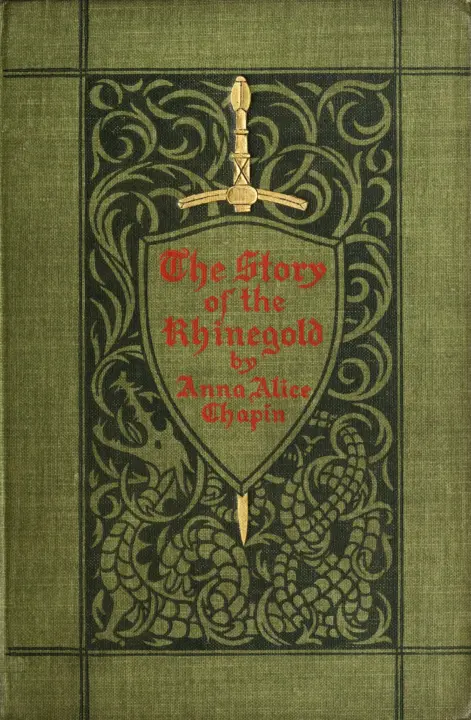
"The Story of the Rhinegold (Der Ring des Nibelungen) Told for Young People" by Anna Alice Chapin is a retelling of Richard Wagner's operatic cycle written in the late 19th century. This work seeks to present the epic narratives of Teutonic mythology in a form accessible to children, emphasizing themes of love, power, and the consequences of greed. The story introduces various legendary characters, including Wotan, the king of the gods, and Alberich, the greedy dwarf, as they interact with magical treasures and face the repercussions of their actions. The opening of the tale sets the stage for an enchanting but foreboding world, focusing on the Rhine maidens who guard a precious gold that grants immense power. As the narrative unfolds, the character of Alberich emerges, driven by his lust for the Rhinegold, which he steals after renouncing love. This act triggers a curse that shadows the subsequent characters and events, leading to conflicts involving gods and other mythical beings. The prelude establishes a rich atmosphere of myth, highlighting the intertwined fates of the characters and hinting at the tragic consequences that will follow their quests for power.
Introduction adapted from the source catalogue; source summaries may be automatically generated.
Free to read · English · 24,799 words · No account needed
MAKE TIME FOR A GOOD BOOK
On by default. Untick to stop anonymous reading totals. Each page counts after 10 seconds in view. How this works.
Anonymous counting is on unless you have switched it off.
A step lower than the gods, yet gifted with supernatural power and far removed from the characteristics of human beings, were the dwarfs and the giants. The giants, we are told, were creatures belonging properly to the Age of Stone, which explains the fact that there were left but two representatives of the race at the time of the Golden Age. The dwarfs come under the head of elves. They were gifted with the utmost cleverness and skill. The giants were stupid and clumsy, and, save for their superhuman strength and size, entirely inferior to the small, sly dwarfs.
The world was strangely peopled in those days; many of the heroes were demi-gods, that is, descended from some god or goddess, and witches, dwarfs, and sorcerers mingled with human beings.
Many mortals, also, had magic power then. Otter, the son of Rodmar, changed himself into the animal for which he was named, and while in the shape of the otter he was caught and killed by three of the gods who were wandering over the earth in disguise. Rodmar demanded weregild,[A] and Loki, with a net, caught Andvari, a rich and malignant dwarf, and commanded him to pay a ransom of gold and gems, enough to cover the skin of the otter; for such was the weregild demanded by Rodmar. Andvari, of necessity, gave the gold for his own release, even adding a wonderful wealth-breeding Ring to cover up a single hair in the skin which the rest of the treasures had left unconcealed. The dwarf cursed the Ring, and the curse attended it through all its manifold ways of magic, to the end of the story.
[Footnote A: Weregild is almost untranslatable. It may mean payment,
tax, forfeit, or ransom.]
Rodmar’s remaining sons, Fafnir and Regin, killed their father and fought for the treasure. Fafnir obtained it, and, turning himself into a monster-worm, went to Glistenheath (sometimes called Glittering Hearth) to guard his wealth. Regin called upon Sigurd, a young hero, to aid him, and, being a master-smith, forged for him a sharp sword named Gram. Some versions give the forging of the sword to Sigurd, but there are many sides to the story. The sword was sometimes called Gram, and oftener Baldung, until Wagner gave it the more expressive name of Nothung, or Needful. Prompted by Regin, Sigurd slew the Dragon at Glistenheath, and, after tasting the blood by accident, was able to understand the language of birds, and was told by two of Odin’s ravens that Regin was treacherous. After slaying Regin, Sigurd rode away with two bundles of the treasures slung across his horse’s back. He found and awakened Brynhildr, a beautiful woman asleep in a house on a hill. (She is known in the different tales in which she has figured as Brynhildr, Brunhild, Brunehault, and Brünnhilde.) The next part of the tale is most clearly set forth in the “Nibelungenlied,” an epic poem in Middle High German dialect, containing a story—or, more correctly, a series of stories—which originally belonged to the entire Teutonic people. These have been found in multitudinous poems and sagas, from those written by the ancient Norsemen, and most primitive in form, to the modern books, essays, and poems of writers who have been impressed with the interesting and picturesque aspects of the strange, complicated old story. The “Nibelungenlied” itself deals rather with the period of Christianity—with the knights and ladies of the time of chivalry—than with the primeval gods and heroes of the Golden Age. The substance of its contents may be found in the “Edda” and in the “Thidrekssaga” (thirteenth century), and the original manuscripts of the “Nibelungenlied” itself date from the thirteenth to the sixteenth century.
Your reading position is saved on this browser. Take it to another device with a library code. Reading pages adapt to text, rather than matching a printed edition.
BEHIND THE BOOK
This eBook is for the use of anyone anywhere in the United States and most other parts of the world at no cost and with almost no restrictions whatsoever. You may copy it, give it away or re-use it under the terms of the Project Gutenberg License included with this eBook or online at www.gutenberg.org. If you are not located in the United States, you will have to check the laws of the country where you are located before using this eBook. Read the source licence.
The original source file, including credits and licence, is retained by this library. Request an original-format copy at no charge. Please include the book title and Project Gutenberg identifier #73548.
KEEP YOUR CURIOSITY GOING

Maurice Baring
Francis Greenleaf Allinson & Anne C. E. (Anne Crosby Emery) Allinson

Abby Morton Diaz
Helen Hunt Jackson
Mary Frances Blaisdell
Stuart Dodgson Collingwood