THE CLASSIC COLLECTION✦An outlaw’s diary: the CommuneCLASSIC FREE BOOKS
An outlaw’s diary: the Commune
Cécile Tormay
THE CLASSIC COLLECTION · 1915
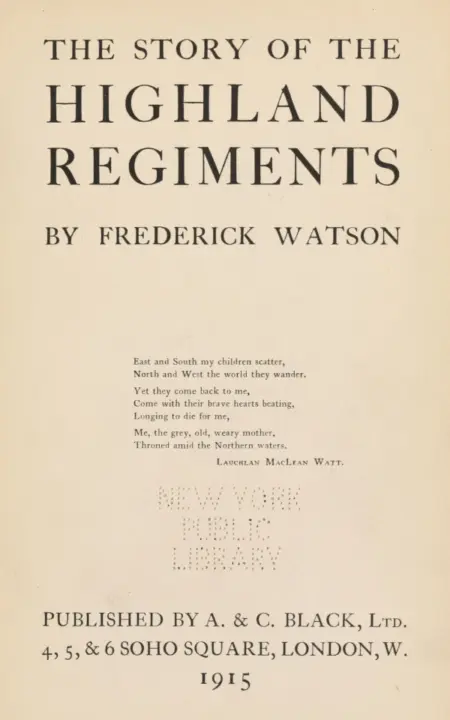
"The Story of the Highland Regiments" by Frederick Watson is a historical account written in the early 20th century. This book delves into the rich history and contributions of the Highland regiments of Scotland, tracing their valor and experiences over nearly two hundred years of military service. Watson sets the tone by promising a narrative that goes beyond mere history, highlighting themes of heroism, loyalty, and the spirit of adventure that characterized these regiments. At the start of the narrative, Watson lays the groundwork for understanding the clans' significance in Scottish history, particularly in military contexts, mentioning their loyalty during the Jacobite rebellions and the formation of the Black Watch. He emphasizes the Highlanders' martial ethos, their transition from clan warriors to disciplined soldiers serving the British Crown. The introduction frames the Highland regiments not only as military units but as emblematic of a broader Scottish identity infused with pride, sacrifice, and a deep connection to their homeland. This sets the stage for the detailed campaigns and battles that the Highlanders would later participate in, promising an engaging exploration of both individual exploits and collective struggles.
Introduction adapted from the source catalogue; source summaries may be automatically generated.
Free to read · English · 76,633 words · No account needed
MAKE TIME FOR A GOOD BOOK
On by default. Untick to stop anonymous reading totals. Each page counts after 10 seconds in view. How this works.
Anonymous counting is on unless you have switched it off.
The battle of the Alma was thus the first and last engagement in which the Highland Brigade fought together during the Crimean War. For two miserable winters they, with the other regiments of the British and French forces, were to endure privation and hardship such as had probably never before been experienced in a British campaign. The bitter cold, the lack of food, the absence of all hospital arrangements made the siege of Sevastopol one of the most ghastly tragedies in English history. Cholera, dysentery, with every other form of illness consequent on exposure and lack of sanitation, proved a more deadly antagonist than the Russian guns. Whatever the sufferings our soldiers had to endure in the trenches during the winter campaign of 1914-15, they were provided with good food, expert medical attendance, and, so far as was possible, with the relief and exchange of fatigue duty. In the Crimea no army was ever in a worse plight for the merest necessaries of life, and until Florence Nightingale was inspired to leave England for the hospital field there was very little hope of recovery from sickness. But then as now the various British regiments took their part in the trench work without complaint and in good heart—and when possible with the greatest distinction.
The 93rd Sutherland Highlanders were raised in 1799, and sailed for the Cape of Good Hope in 1806. After that they saw little active service of any distinction until the Crimea, though their sister regiment the Argyllshire Highlanders, raised in 1794, took part in the Peninsular War, but not in Waterloo. The two regiments became the 91st and 93rd Argyll and Sutherland Highlanders in 1881.
The Sutherland Highlanders took up their position before Balaclava with the knowledge that it was of first-rate importance to the safety of the whole army. The outer line of defences was held by some 5000 Turks; between the outer line and the inner line were 1500 cavalry, while the 93rd lay in front of the village of Kadikoi. The importance of Balaclava lay in its position. Lying upon the sea coast, it was not merely in communication with the outer world, but the only channel by which the Allies could receive their ammunition and stores. Were the Russians to take possession of Balaclava they would cut the British lines of communication at one swoop. It was therefore practically certain that sooner or later an attack would be made, and on the night of the 24th Sir Colin was informed by the Turks that the Russian advance was imminent. It came with the breaking of dawn, when the grey hordes of the enemy were seen flocking like ghosts down the hill-side, moving forward toward the Turkish redoubts. Compared with the little force defending Balaclava, the number of the enemy was infinitely superior, comprising 25 battalions of infantry, 34 squadrons of cavalry, and 78 guns. Presently their artillery found the range of the troops in the first redoubt, and in a very short time the Turks were in flight. Once this line of fortifications was taken it was hopeless to hold the corresponding flanks. The whole first line was beaten within a few minutes. The Sutherlands, drawn up under Sir Colin Campbell, stood at attention watching the fleeing columns of the Turks heading directly towards them. Perceiving that the Highlanders were perfectly at their ease, the Turks made a feeble rally and formed on either flank. The Russian advance was continued without halt, and their guns soon opened on the 93rd. To prevent unnecessary loss, Sir Colin drew back the regiment behind the slope of the hill, and from there awaited the next move. Presently the enemy’s cavalry, leaving the main body, galloped straight for his position. The moment of trial had come. Instantly he drew up the Highlanders in a line only two deep, shouting to them, “Now, men, remember there is no retreat from here. You must die where you stand!” at which there was a low murmur, “Ay, ay, Sir Colin; an need be, we’ll do that!” The whole line was advanced to the top of the hill, a movement that so excited the men that they nearly charged the Russians. But that was not Sir Colin’s intention, and halting them he calmly awaited the onslaught of the Russian cavalry, merely giving the order for the Sutherlands to stand in line. The noise of the thundering hoofs grew ever louder. It echoed in the ears of the Turks, and as dense masses of horses bounded in all their picturesque strength towards them, they broke on the instant and ran in a frenzy of terror to the rear, extending their hands to the vessels riding at anchor, and shouting in their panic, “Ship! ship!” To the Eastern mind it seemed the merest folly to await such a crash of cavalry.
Your reading position is saved on this browser. Take it to another device with a library code. Reading pages adapt to text, rather than matching a printed edition.
BEHIND THE BOOK
This eBook is for the use of anyone anywhere in the United States and most other parts of the world at no cost and with almost no restrictions whatsoever. You may copy it, give it away or re-use it under the terms of the Project Gutenberg License included with this eBook or online at www.gutenberg.org. If you are not located in the United States, you will have to check the laws of the country where you are located before using this eBook. Read the source licence.
The original source file, including credits and licence, is retained by this library. Request an original-format copy at no charge. Please include the book title and Project Gutenberg identifier #57897.
KEEP YOUR CURIOSITY GOING
Cécile Tormay

Moritz Busch
John L. Ransom
Frances Wright
Cécile Tormay

Mabel Potter Daggett