THE CLASSIC COLLECTION✦An outlaw’s diary: the CommuneCLASSIC FREE BOOKS
An outlaw’s diary: the Commune
Cécile Tormay
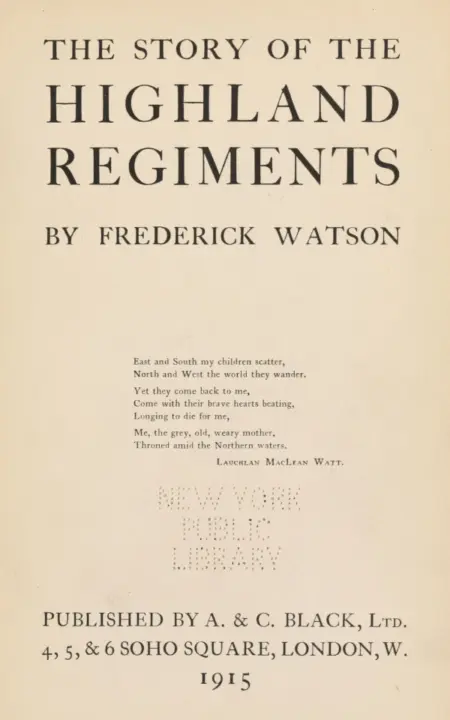
THE CLASSIC COLLECTION · 1915
"The Story of the Highland Regiments" by Frederick Watson is a historical account written in the early 20th century. This book delves into the rich history and contributions of the Highland regiments of Scotland, tracing their valor and experiences over nearly two hundred years of military service. Watson sets the tone by promising a narrative that goes beyond mere history, highlighting themes of heroism, loyalty, and the spirit of adventure that characterized these regiments. At the start of the narrative, Watson lays the groundwork for understanding the clans' significance in Scottish history, particularly in military contexts, mentioning their loyalty during the Jacobite rebellions and the formation of the Black Watch. He emphasizes the Highlanders' martial ethos, their transition from clan warriors to disciplined soldiers serving the British Crown. The introduction frames the Highland regiments not only as military units but as emblematic of a broader Scottish identity infused with pride, sacrifice, and a deep connection to their homeland. This sets the stage for the detailed campaigns and battles that the Highlanders would later participate in, promising an engaging exploration of both individual exploits and collective struggles.
Introduction adapted from the source catalogue; source summaries may be automatically generated.
Free to read · English · 76,633 words · No account needed
MAKE TIME FOR A GOOD BOOK
On by default. Untick to stop anonymous reading totals. Each page counts after 10 seconds in view. How this works.
Anonymous counting is on unless you have switched it off.
Nothing could be more forlorn, more Celtic in tragedy than the tale of the 4th Cameron Highlanders, whose night attack was checked by a deep ditch full of water. Some swam across, many sank never to rise again, but the battalion passed on. In the black darkness they struggled on, undaunted. A desolating fire raked their ranks. One company was annihilated, another was hopelessly lost, a third took a German trench. But the battalion was cut off. No machine guns could cross the stream to their support, and in the grey dawn the situation for the Gaelic remnant grew intolerable. The company in the German trench were forced to retire under a heavy fire. Colonel Fraser and twelve other officers had fallen. But that single company of Camerons were unbroken. Sergeant-Major Ross it was who gathered the remnants to him and brought them safely across the zone of fire. Never has a more hopeless withdrawal faced a British force. Never has a finer fortitude awaited it.
Again, in the British advance a detachment of the Scots Guards lost touch with the main body, and were surrounded. Admirably has Mr. John Buchan spoken of their end. “For them,” he says, “as for the steel circle around the King at Flodden, there could be no retreat. When, some days later, we took the place we found the Guards lying on the field of honour with swaths of the enemy’s dead around them. The history of war can show no more noble ending.”
It is with such pictures as these that I would close this chapter, pictures of courage and self-sacrifice unsurpassed in the story of our regiments. Whatever the future may hold, one thing is certain—victory must always greet men inspired by a cause that is at once noble and just.
For while the tired waves, vainly breaking, Seem here no painful inch to gain, Far back, through creeks and inlets making, Comes silent, flooding in, the main.
And not by eastern windows only, When daylight comes, comes in the light; In front the sun climbs slow, how slowly! But westward, look the land is bright.
Footnote 13:
Behind the Scenes at the Front (Chatto & Windus), by George Adams.
Abercrombie, General Sir James, 17, 20, 22, 25
Abercromby, General Sir Ralph, 66, 72, 74
Aboukir, 71, 213
Abraham, Plains of, 28, 31
Abu Hamid, 226
Acre, 71
Aisne, battle of the, 295, 297, 298
Alexandria, 73, 78
Alison, General Sir Archibald, 44, 180, 182, 184, 214
Allan, Captain, 284
Alliance, La Belle, 123
Alma, battle of the, 133.
See Chapter XIV.
Almeida, fortress of, 93
Alost, 66
Alumbagh, the, 167
Amherst, General, 25, 28, 31
Amiens, Peace of, 79
Angus, Lance-Corporal William, 309
Anson, General, 146
Arabi Bey, 212, 216
Arcot, 57
Assaye, 61
Atbara, River, 229, 231
Austerlitz, 82
Austrian Succession, War of, 10
Badajoz, 95
Baines, Major-General, 111
Baird, Sir David, 84, 88
Baird, Major-General, 59
Baker, General, 195, 196, 198, 222
Baker, Sir Samuel, 218
Balaclava, 137
Bareilly, 175, 176
Barnard, General, 146
Your reading position is saved on this browser. Take it to another device with a library code. Reading pages adapt to text, rather than matching a printed edition.
BEHIND THE BOOK
This eBook is for the use of anyone anywhere in the United States and most other parts of the world at no cost and with almost no restrictions whatsoever. You may copy it, give it away or re-use it under the terms of the Project Gutenberg License included with this eBook or online at www.gutenberg.org. If you are not located in the United States, you will have to check the laws of the country where you are located before using this eBook. Read the source licence.
The original source file, including credits and licence, is retained by this library. Request an original-format copy at no charge. Please include the book title and Project Gutenberg identifier #57897.
KEEP YOUR CURIOSITY GOING
Cécile Tormay

Moritz Busch
John L. Ransom
Frances Wright
Cécile Tormay

Mabel Potter Daggett