THE CLASSIC COLLECTION✦An outlaw’s diary: the CommuneCLASSIC FREE BOOKS
An outlaw’s diary: the Commune
Cécile Tormay
THE CLASSIC COLLECTION · 1915
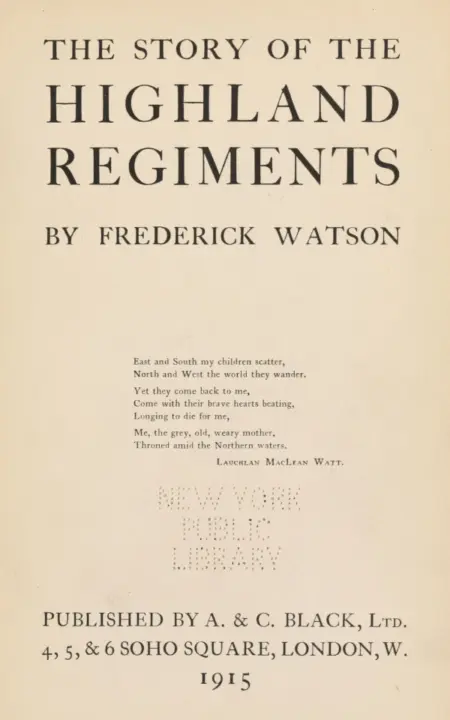
"The Story of the Highland Regiments" by Frederick Watson is a historical account written in the early 20th century. This book delves into the rich history and contributions of the Highland regiments of Scotland, tracing their valor and experiences over nearly two hundred years of military service. Watson sets the tone by promising a narrative that goes beyond mere history, highlighting themes of heroism, loyalty, and the spirit of adventure that characterized these regiments. At the start of the narrative, Watson lays the groundwork for understanding the clans' significance in Scottish history, particularly in military contexts, mentioning their loyalty during the Jacobite rebellions and the formation of the Black Watch. He emphasizes the Highlanders' martial ethos, their transition from clan warriors to disciplined soldiers serving the British Crown. The introduction frames the Highland regiments not only as military units but as emblematic of a broader Scottish identity infused with pride, sacrifice, and a deep connection to their homeland. This sets the stage for the detailed campaigns and battles that the Highlanders would later participate in, promising an engaging exploration of both individual exploits and collective struggles.
Introduction adapted from the source catalogue; source summaries may be automatically generated.
Free to read · English · 76,633 words · No account needed
MAKE TIME FOR A GOOD BOOK
On by default. Untick to stop anonymous reading totals. Each page counts after 10 seconds in view. How this works.
Anonymous counting is on unless you have switched it off.
It would not be fitting to conclude a chapter on the Indian Mutiny without recalling the name of Sir Colin Campbell. Broken in health through the toils and anxieties of the campaign, he was compelled to return to England, where he was raised to the Peerage as Baron Clyde. The remaining years of his life were spent in the quiet enjoyment of the honours that were showered upon him by a grateful country, and on August 14, 1863, the great Scottish soldier passed away, and was buried in Westminster Abbey.
Cape of Good Hope, 1806; Rolica, Vimiera, Corunna, Pyrenees, Nivelle, Nive, Orthez, Toulouse, Peninsula, Alma, Balaclava, Sevastopol, Lucknow; South Africa, 1846-1847, 1851-1852-1853, 1879; South Africa, 1899-1902; Modder River, Paardeberg.
The 1st Battalion was raised in 1794 and called the 91st Argyllshire
Highlanders.
The 2nd Battalion was raised in 1799 and known as the 93rd Sutherland
Highlanders.
The two regiments became the 1st and 2nd Battalions of the Argyll and Sutherland Highlanders in 1881.
CHAPTER XVIII
WOLSELEY AND THE BLACK WATCH IN ASHANTI
(1873-1874)
The Campbells are comin’, O ho, O ho! The Campbells are comin’, O ho! The Campbells are comin’ to bonnie Lochleven, The Campbells are comin’, O ho, O ho!
Regimental March.
After the Mutiny we say farewell, as it were, to the Old Guard of the Crimea and India, and hear a great deal about the younger men, Wolseley, Roberts, and White, all of whom had been through the Mutiny, two of them being destined to attain to the highest distinction that the British Army can bestow.
Garnet Wolseley was born in Dublin on June 4, 1833. He lost the use of one eye in the Crimea, served in India during the Mutiny, and in the Chinese War of 1860. In 1861 he crossed to Canada, and in 1870 conquered Louis Riel, the half-breed. In 1873 he led an expedition to Ashanti. There have been many places of horror and oppression in the histories of savage peoples, but it is doubtful whether there was ever a town so foul and brutal as Coomassie, the capital of Ashanti. The shedding of blood was the daily delight and pastime of the king, while murder upon a prodigal scale was to him and to his people a kind of rite. His subjects, instead of rebelling against these practices, delighted in such spectacles, and encouraged Koffi Calcalli, the king, to further outrages and orgies. It was, as some one has called it, ‘a metropolis of murder.’ So far, however, Britain had not seen her way to interfere, and had she done so, simply on the ground of common humanity, it is probable that other nations would have suspected her of conspiring to take over the country. At last King Koffi, craving for something new, decided that he would attack the English at Cape Coast Castle. Fortunately he was not able to achieve very much, but on the other hand the English were not strong enough to retaliate. This position was rendered all the more dangerous by the policy of toleration, which from the year 1824, when the Ashantis defeated Sir Charles M’Carthy, to the year 1863, when a West Indian regiment failed most signally, had given the natives a poor opinion of the English arms. It was therefore necessary for the safety of the English settlers that an Expeditionary Force should leave for Ashanti. It sailed under the command of Sir Garnet Wolseley, with whom were the Black Watch under Sir John Macleod.
Your reading position is saved on this browser. Take it to another device with a library code. Reading pages adapt to text, rather than matching a printed edition.
BEHIND THE BOOK
This eBook is for the use of anyone anywhere in the United States and most other parts of the world at no cost and with almost no restrictions whatsoever. You may copy it, give it away or re-use it under the terms of the Project Gutenberg License included with this eBook or online at www.gutenberg.org. If you are not located in the United States, you will have to check the laws of the country where you are located before using this eBook. Read the source licence.
The original source file, including credits and licence, is retained by this library. Request an original-format copy at no charge. Please include the book title and Project Gutenberg identifier #57897.
KEEP YOUR CURIOSITY GOING
Cécile Tormay

Moritz Busch
John L. Ransom
Frances Wright
Cécile Tormay

Mabel Potter Daggett