Letters to a Friend, Written to Mrs. Ezra S. Carr, 1866-1879
John Muir
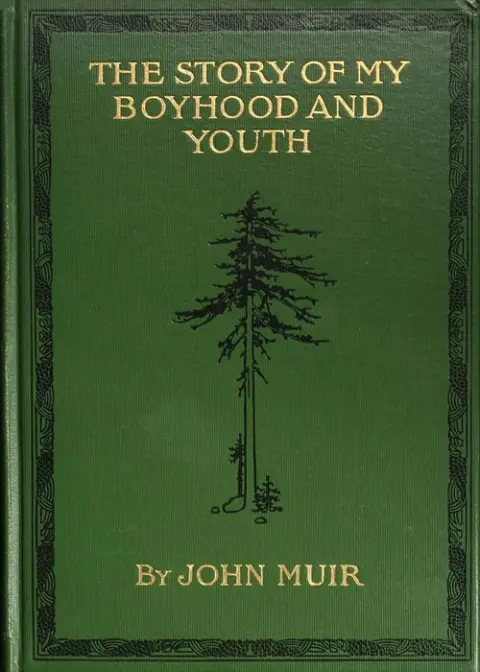
THE CLASSIC COLLECTION · 1912
"The Story of My Boyhood and Youth" by John Muir is an autobiographical memoir written in the early 20th century. The narrative recounts Muir's early experiences growing up in Scotland, focusing on his deep affinity with nature and adventure. It offers a vivid exploration of his childhood, emphasizing his wild pursuits, education, and the formative moments that shaped his love for the natural world. The opening of the memoir delves into Muir's early life in Dunbar, Scotland, where he shares vivid recollections of his explorations with friends and the thrill of discovering the wild surroundings. Muir reminisces about his school days filled with frightful legends, such as the "Dandy Doctor," and the joys of simple childhood games and adventures in nature. Through charming anecdotes and reflective observations, he sketches a portrait of a spirited boy whose experiences in the fields and by the sea began to cultivate a lasting passion for the environment that would characterize his later life as a naturalist and conservationist.
Introduction adapted from the source catalogue; source summaries may be automatically generated.
Free to read · English · 53,670 words · No account needed
MAKE TIME FOR A GOOD BOOK
On by default. Untick to stop anonymous reading totals. Each page counts after 10 seconds in view. How this works.
Anonymous counting is on unless you have switched it off.
One of our near neighbors, a stone mason and miner by the name of William Duncan, came to see me, and after hearing the particulars of the accident he solemnly said: “Weel, Johnnie, it’s God’s mercy that you’re alive. Many a companion of mine have I seen dead with choke-damp, but none that I ever saw or heard of was so near to death in it as you were and escaped without help.” Mr. Duncan taught father to throw water down the shaft to absorb the gas, and also to drop a bundle of brush or hay attached to a light rope, dropping it again and again to carry down pure air and stir up the poison. When, after a day or two, I had recovered from the shock, father lowered me again to my work, after taking the precaution to test the air with a candle and stir it up well with a brush-and-hay bundle. The weary hammer-and-chisel-chipping went on as before, only more slowly, until ninety feet down, when at last I struck a fine, hearty gush of water. Constant dropping wears away stone. So does constant chipping, while at the same time wearing away the chipper. Father never spent an hour in that well. He trusted me to sink it straight and plumb, and I did, and built a fine covered top over it, and swung two iron-bound buckets in it from which we all drank for many a day.
The honey-bee arrived in America long before we boys did, but several years passed ere we noticed any on our farm. The introduction of the honey-bee into flowery America formed a grand epoch in bee history. This sweet humming creature, companion and friend of the flowers, is now distributed over the greater part of the continent, filling countless hollows in rocks and trees with honey as well as the millions of hives prepared for them by honey-farmers, who keep and tend their flocks of sweet winged cattle, as shepherds keep sheep,—a charming employment, “like directing sunbeams,” as Thoreau says. The Indians call the honey-bee the white man’s fly; and though they had long been acquainted with several species of bumblebees that yielded more or less honey, how gladly surprised they must have been when they discovered that, in the hollow trees where before they had found only coons or squirrels, they found swarms of brown flies with fifty or even a hundred pounds of honey sealed up in beautiful cells. With their keen hunting senses they of course were not slow to learn the habits of the little brown immigrants and the best methods of tracing them to their sweet homes, however well hidden. During the first few years none were seen on our farm, though we sometimes heard father’s hired men talking about “lining bees.” None of us boys ever found a bee tree, or tried to find any until about ten years after our arrival in the woods. On the Hickory Hill farm there is a ridge of moraine material, rather dry, but flowery with goldenrods and asters of many species, upon which we saw bees feeding in the late autumn just when their hives were fullest of honey, and it occurred to me one day after I was of age and my own master that I must try to find a bee tree. I made a little box about six inches long and four inches deep and wide; bought half a pound of honey, went to the goldenrod hill, swept a bee into the box and closed it. The lid had a pane of glass in it so I could see when the bee had sucked its fill and was ready to go home. At first it groped around trying to get out, but, smelling the honey, it seemed to forget everything else, and while it was feasting I carried the box and a small sharp-pointed stake to an open spot, where I could see about me, fixed the stake in the ground, and placed the box on the flat top of it. When I thought that the little feaster must be about full, I opened the box, but it was in no hurry to fly. It slowly crawled up to the edge of the box, lingered a minute or two cleaning its legs that had become sticky with honey, and when it took wing, instead of making what is called a bee-line for home, it buzzed around the box and minutely examined it as if trying to fix a clear picture of it in its mind so as to be able to recognize it when it returned for another load, then circled around at a little distance as if looking for something to locate it by. I was the nearest object, and the thoughtful worker buzzed in front of my face and took a good stare at me, and then flew up on to the top of an oak on the side of the open spot in the centre of which the honey-box was. Keeping a keen watch, after a minute or two of rest or wing-cleaning, I saw it fly in wide circles round the tops of the trees nearest the honey-box, and, after apparently satisfying itself, make a bee-line for the hive. Looking endwise on the line of flight, I saw that what is called a bee-line is not an absolutely straight line, but a line in general straight made of many slight, wavering, lateral curves. After taking as true a bearing as I could, I waited and watched. In a few minutes, probably ten, I was surprised to see that bee arrive at the end of the outleaning limb of the oak mentioned above, as though that was the first point it had fixed in its memory to be depended on in retracing the way back to the honey-box. From the tree-top it came straight to my head, thence straight to the box, entered without the least hesitation, filled up and started off after the same preparatory dressing and taking of bearings as before. Then I took particular pains to lay down the exact course so I would be able to trace it to the hive. Before doing so, however, I made an experiment to test the worth of the impression I had that the little insect found the way back to the box by fixing telling points in its mind. While it was away, I picked up the honey-box and set it on the stake a few rods from the position it had thus far occupied, and stood there watching. In a few minutes I saw the bee arrive at its guide-mark, the overleaning branch on the tree-top, and thence came bouncing down right to the spaces in the air which had been occupied by my head and the honey-box, and when the cunning little honey-gleaner found nothing there but empty air it whirled round and round as if confused and lost; and although I was standing with the open honey-box within fifty or sixty feet of the former feasting-spot, it could not, or at least did not, find it.
Your reading position is saved on this browser. Take it to another device with a library code. Reading pages adapt to text, rather than matching a printed edition.
BEHIND THE BOOK
This eBook is for the use of anyone anywhere in the United States and most other parts of the world at no cost and with almost no restrictions whatsoever. You may copy it, give it away or re-use it under the terms of the Project Gutenberg License included with this eBook or online at www.gutenberg.org. If you are not located in the United States, you will have to check the laws of the country where you are located before using this eBook. Read the source licence.
The original source file, including credits and licence, is retained by this library. Request an original-format copy at no charge. Please include the book title and Project Gutenberg identifier #18359.
KEEP YOUR CURIOSITY GOING
John L. Ransom

Herman W. Mudgett

Harriet Monroe
Daniel Dulany Addison
Charles Lanman

Harold Rosher