THE CLASSIC COLLECTION✦A journey to Central AfricaCLASSIC FREE BOOKS
A journey to Central Africa
Bayard Taylor
THE CLASSIC COLLECTION · 1866
"The Story of Kennett" by Bayard Taylor is a novel written during the late 19th century. The narrative unfolds in a rural community in Pennsylvania, capturing the everyday life and characters within this close-knit village. The plot centers on Gilbert Potter, a young man navigating the complexities of rural society, as well as his relationships with other residents, including the spirited Martha Deane and the enigmatic stranger named Fortune. At the start of the novel, the scene is set on a March day in 1796, where a gathering of local hunters is underway at the Barton farmhouse, signaling an upcoming fox hunt. Characters like Mr. Alfred Barton, the host with mixed intentions, and Gilbert Potter, eager for participation, introduce the social dynamics of the community. The atmosphere is lively, filled with camaraderie and competition as the potential for adventure amalgamates with local traditions. As the hunters prepare for the chase, the foundational tones of class, rivalry, and the nuances of personality emerge, establishing the complex interplay of relationships that will unfold as the story progresses.
Introduction adapted from the source catalogue; source summaries may be automatically generated.
Free to read · English · 131,091 words · No account needed
MAKE TIME FOR A GOOD BOOK
On by default. Untick to stop anonymous reading totals. Each page counts after 10 seconds in view. How this works.
Anonymous counting is on unless you have switched it off.
“Well, Mr. Alfred, and do you think it's a harm to read a story? Why, Miss Ann herself lent me 'Alonzo and Melissa,' and 'Midnight Horrors,' and I'll be bound you've read 'em yourself on the sly. 'T a'n't much other readin' men does, save and except the weekly paper, and law enough to git a tight hold on their debtors. Come, now, let's know what you do read?”
“Not much of anything, that's a fact,” he answered, recovering himself, with a shudder at the fearful mistake he had been on the point of making, “but I've nothing against women reading stories. I was rather thinking of myself when I spoke to you, Miss Martha.”
“So I supposed,” she quietly answered. It was provoking. Everything she said made him think there was another meaning behind the words; her composed manner, though he knew it to be habitual, more and more disconcerted him. Never did an intentional wooer find his wooing so painful and laborious. After this attempt he addressed himself to Doctor Deane, for even the question of circumventing Sandy Flash now presented itself to his mind as a relief.
There he sat, and the conversation progressed in jerks and spirts, between pauses of embarrassing silence. The sun hung on the western hill in a web of clouds; Martha and Miss Betsy rose and prepared the tea-table, and the guest, invited perforce, perforce accepted. Soon after the meal was over, however, he murmured something about cattle, took his hat and left.
Two or three horses were hitched before the Unicorn, and he saw some figures through the bar-room window. A bright thought struck him; he crossed the road and entered.
“Hallo, Alf! Where from now? Why, you're as fine as a fiddler!” cried Mr. Joel Ferris, who was fast becoming familiar, on the strength of his inheritance.
“Over the way,” answered the landlord, with a wink and a jerk of his
thumb.
Mr. Ferris whistled, and one of the others suggested: “He must stand a
treat, on that.”
“But, I say!” said the former, “how is it you're coming away so soon in
the evening?”
“I went very early in the afternoon,” Barton answered, with a mysterious, meaning smile, as much as to say: “It's all right; I know what I'm about.” Then he added aloud,--“Step up, fellows; what'll you have?”
Many were the jests and questions to which he was forced to submit, but he knew the value of silence in creating an impression, and allowed them to enjoy their own inferences.
It is much easier to start a report, than to counteract it, when once started; but the first, only, was his business.
Your reading position is saved on this browser. Take it to another device with a library code. Reading pages adapt to text, rather than matching a printed edition.
Bayard Taylor
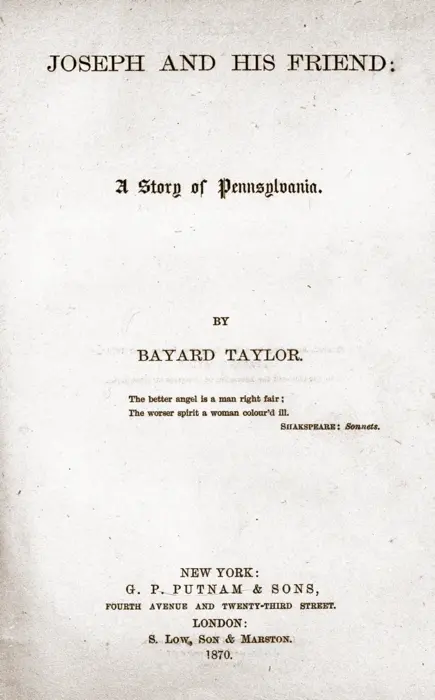
Bayard Taylor
Bayard Taylor
Bayard Taylor
BEHIND THE BOOK
This eBook is for the use of anyone anywhere in the United States and most other parts of the world at no cost and with almost no restrictions whatsoever. You may copy it, give it away or re-use it under the terms of the Project Gutenberg License included with this eBook or online at www.gutenberg.org. If you are not located in the United States, you will have to check the laws of the country where you are located before using this eBook. Read the source licence.
The original source file, including credits and licence, is retained by this library. Request an original-format copy at no charge. Please include the book title and Project Gutenberg identifier #8680.
KEEP YOUR CURIOSITY GOING
Coulson Kernahan

Maurice Baring
Frances Wright
Cécile Tormay

Frederic Jesup Stimson

W. H. P. (William Henry Pope) Jarvis