THE CLASSIC COLLECTION✦A journey to Central AfricaCLASSIC FREE BOOKS
A journey to Central Africa
Bayard Taylor
THE CLASSIC COLLECTION · 1866
"The Story of Kennett" by Bayard Taylor is a novel written during the late 19th century. The narrative unfolds in a rural community in Pennsylvania, capturing the everyday life and characters within this close-knit village. The plot centers on Gilbert Potter, a young man navigating the complexities of rural society, as well as his relationships with other residents, including the spirited Martha Deane and the enigmatic stranger named Fortune. At the start of the novel, the scene is set on a March day in 1796, where a gathering of local hunters is underway at the Barton farmhouse, signaling an upcoming fox hunt. Characters like Mr. Alfred Barton, the host with mixed intentions, and Gilbert Potter, eager for participation, introduce the social dynamics of the community. The atmosphere is lively, filled with camaraderie and competition as the potential for adventure amalgamates with local traditions. As the hunters prepare for the chase, the foundational tones of class, rivalry, and the nuances of personality emerge, establishing the complex interplay of relationships that will unfold as the story progresses.
Introduction adapted from the source catalogue; source summaries may be automatically generated.
Free to read · English · 131,091 words · No account needed
MAKE TIME FOR A GOOD BOOK
On by default. Untick to stop anonymous reading totals. Each page counts after 10 seconds in view. How this works.
Anonymous counting is on unless you have switched it off.
“Miss Lavender is one of the witnesses to the will,” Mr. Stacy answered, “and her presence is necessary, moreover, as an important testimony in regard to some of its provisions.”
Alfred Barton and Gilbert both started at these words, but from very different feelings. The former, released from public scrutiny, already experienced a comparative degree of comfort, and held up his head with an air of courage; yet now the lawyer's announcement threw him into an agitation which it was not possible to conceal. Miss Lavender looked around the circle, coolly nodded her head to Elisha Barton, and said nothing.
Mr. Stacy arose, unlocked a small niche let into the wall of the house, and produced the heavy oaken casket in which the old man kept the documents relating to his property. This he placed upon a small table beside his chair, opened it, and took out the topmost paper. He was completely master of the situation, and the deliberation with which he surveyed the circle of excited faces around him seemed to indicate that he enjoyed the fact.
“The last will and testament of Abiah Barton, made the day before his death,” he said, “revokes all former wills, which were destroyed by his order, in the presence of myself and Miss Elizabeth Lavender.”
All eyes were turned upon the spinster, who again nodded, with a face of preternatural solemnity.
“In order that you, his children and grandchildren,” Mr. Stacy continued, “may rightly understand the deceased's intention in making this last will, when the time comes for me to read it, I must first inform you that he was acquainted with the fact of his son Alfred's marriage with Mary Potter.”
Alfred Barton half sprang from his seat, and then fell back with the same startled, livid face, which Gilbert already knew. The others held their breath in suspense,--except Mary, who sat near the lawyer, firm, cold, and unmoved.
“The marriage of Alfred Barton and Mary Potter must therefore be established, to your satisfaction,” Mr. Stacy resumed, turning towards Elisha. “Alfred Barton, I ask you to declare whether this woman is your lawfully wedded wife?”
A sound almost like a groan came from his throat, but it formed the
syllable,--“Yes.”
“Further, I ask you to declare whether Gilbert Barton, who has until this day borne his mother's name of Potter, is your lawfully begotten son?”
“Yes.”
“To complete the evidence,” said the lawyer, “Mary Barton, give me the paper in your hands.”
Your reading position is saved on this browser. Take it to another device with a library code. Reading pages adapt to text, rather than matching a printed edition.
Bayard Taylor
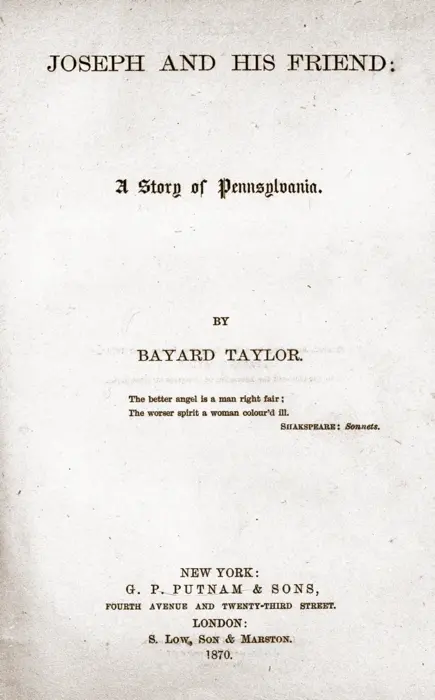
Bayard Taylor
Bayard Taylor
Bayard Taylor
BEHIND THE BOOK
This eBook is for the use of anyone anywhere in the United States and most other parts of the world at no cost and with almost no restrictions whatsoever. You may copy it, give it away or re-use it under the terms of the Project Gutenberg License included with this eBook or online at www.gutenberg.org. If you are not located in the United States, you will have to check the laws of the country where you are located before using this eBook. Read the source licence.
The original source file, including credits and licence, is retained by this library. Request an original-format copy at no charge. Please include the book title and Project Gutenberg identifier #8680.
KEEP YOUR CURIOSITY GOING
Coulson Kernahan

Maurice Baring
Frances Wright
Cécile Tormay

Frederic Jesup Stimson

W. H. P. (William Henry Pope) Jarvis