THE CLASSIC COLLECTION✦A journey to Central AfricaCLASSIC FREE BOOKS
A journey to Central Africa
Bayard Taylor
THE CLASSIC COLLECTION · 1866
"The Story of Kennett" by Bayard Taylor is a novel written during the late 19th century. The narrative unfolds in a rural community in Pennsylvania, capturing the everyday life and characters within this close-knit village. The plot centers on Gilbert Potter, a young man navigating the complexities of rural society, as well as his relationships with other residents, including the spirited Martha Deane and the enigmatic stranger named Fortune. At the start of the novel, the scene is set on a March day in 1796, where a gathering of local hunters is underway at the Barton farmhouse, signaling an upcoming fox hunt. Characters like Mr. Alfred Barton, the host with mixed intentions, and Gilbert Potter, eager for participation, introduce the social dynamics of the community. The atmosphere is lively, filled with camaraderie and competition as the potential for adventure amalgamates with local traditions. As the hunters prepare for the chase, the foundational tones of class, rivalry, and the nuances of personality emerge, establishing the complex interplay of relationships that will unfold as the story progresses.
Introduction adapted from the source catalogue; source summaries may be automatically generated.
Free to read · English · 131,091 words · No account needed
MAKE TIME FOR A GOOD BOOK
On by default. Untick to stop anonymous reading totals. Each page counts after 10 seconds in view. How this works.
Anonymous counting is on unless you have switched it off.
“This way, Gilbert. It's a strong p'int o' law, I've heerd tell, not that I know much o' law, Goodness knows, nor ever want to, but never mind, it's a strong p'int when there's two witnesses to a thing,--one to clinch what the t'other drives in; and you must have a show o' law to work on Alf. Barton, or I'm much mistaken!”
Gilbert reflected a moment. “It can do no harm,” he then said; “can you go with me, now?”
“Now's the time! If we only git the light of a farden-candle out o' him, it'll do me a mortal heap o' good; for with all this rakin' and scrapin' for nothin', I'm like a heart pantin' after the water-brooks, though a mouth would be more like it, to my thinkin', when a body's so awful dry as that comes to!”
The two thereupon took the foot-path down through the frozen fields and the dreary timber of the creek-side, to the Barton farm-house. As they approached the barn, they saw Alfred Barton sitting on a pile of straw and watching Giles, who was threshing wheat. He seemed a little surprised at their appearance; but as Gilbert and he had not met since their interview in the corn-field before the former's departure for Chester, he had no special cause for embarrassment.
“Come into the house,” he said, leading the way.
“No,” Gilbert answered, “I came here to speak with you privately. Will you walk down the lane?”
“No objection, of course,” said Barton, looking from Gilbert to Miss Lavender, with a mixture of curiosity and uneasiness. “Good news, I hope; got hold of Sandy's tracks, at last?”
“One of them.”
“Ah, you don't say so! Where?”
“Here!”
Gilbert stopped and faced Barton. They were below the barn, and out of
Giles's hearing.
“Barton,” he resumed, “you know what interest I have in the arrest of that man, and you won't deny my right to demand of you an account of your dealings with him. When did you first make his acquaintance?”
“I've told you that, already; the matter has been fully talked over between us,” Barton answered, in a petulant tone.
“It has not been fully talked over. I require to know, first of all, precisely when, and under what circumstances, you and Sandy Flash came together. There is more to come, so let us begin at the beginning.”
“Damme, Gilbert, you were there, and saw as much as I did. How could I know who the cursed black-whiskered fellow was?”
“But you found it out,” Gilbert persisted, “and the manner of your finding it out must be explained.”
Your reading position is saved on this browser. Take it to another device with a library code. Reading pages adapt to text, rather than matching a printed edition.
Bayard Taylor
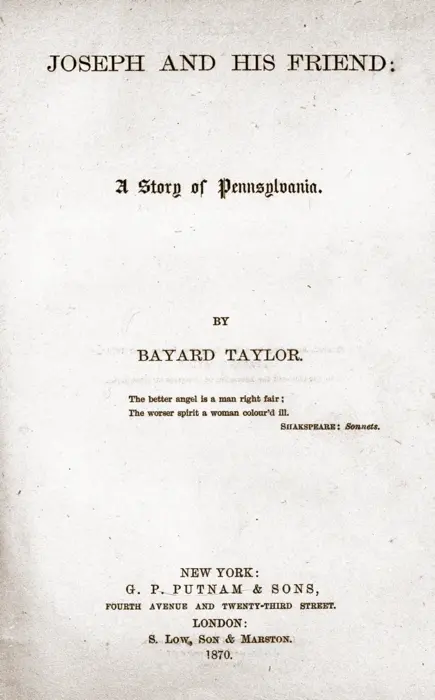
Bayard Taylor
Bayard Taylor
Bayard Taylor
BEHIND THE BOOK
This eBook is for the use of anyone anywhere in the United States and most other parts of the world at no cost and with almost no restrictions whatsoever. You may copy it, give it away or re-use it under the terms of the Project Gutenberg License included with this eBook or online at www.gutenberg.org. If you are not located in the United States, you will have to check the laws of the country where you are located before using this eBook. Read the source licence.
The original source file, including credits and licence, is retained by this library. Request an original-format copy at no charge. Please include the book title and Project Gutenberg identifier #8680.
KEEP YOUR CURIOSITY GOING
Coulson Kernahan

Maurice Baring
Frances Wright
Cécile Tormay

Frederic Jesup Stimson

W. H. P. (William Henry Pope) Jarvis