THE CLASSIC COLLECTION✦A journey to Central AfricaCLASSIC FREE BOOKS
A journey to Central Africa
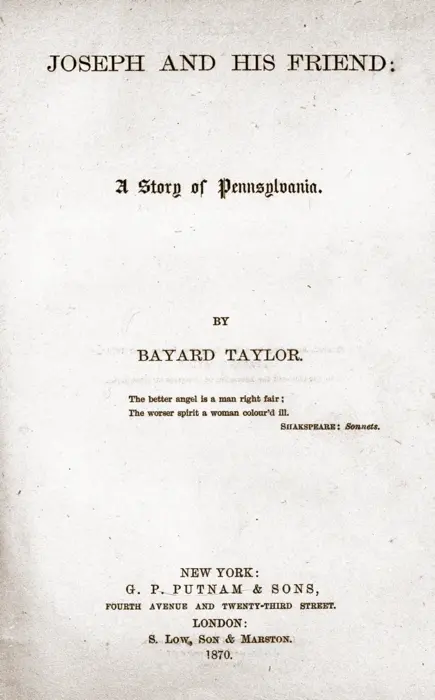
Bayard Taylor
THE CLASSIC COLLECTION · 1866
"The Story of Kennett" by Bayard Taylor is a novel written during the late 19th century. The narrative unfolds in a rural community in Pennsylvania, capturing the everyday life and characters within this close-knit village. The plot centers on Gilbert Potter, a young man navigating the complexities of rural society, as well as his relationships with other residents, including the spirited Martha Deane and the enigmatic stranger named Fortune. At the start of the novel, the scene is set on a March day in 1796, where a gathering of local hunters is underway at the Barton farmhouse, signaling an upcoming fox hunt. Characters like Mr. Alfred Barton, the host with mixed intentions, and Gilbert Potter, eager for participation, introduce the social dynamics of the community. The atmosphere is lively, filled with camaraderie and competition as the potential for adventure amalgamates with local traditions. As the hunters prepare for the chase, the foundational tones of class, rivalry, and the nuances of personality emerge, establishing the complex interplay of relationships that will unfold as the story progresses.
Introduction adapted from the source catalogue; source summaries may be automatically generated.
Free to read · English · 131,091 words · No account needed
MAKE TIME FOR A GOOD BOOK
On by default. Untick to stop anonymous reading totals. Each page counts after 10 seconds in view. How this works.
Anonymous counting is on unless you have switched it off.
Just then Joe and Jake Fairthorn, who had been dodging back and forth through the village, watching the roads, made their appearance with the announcement,--
“Hurray--there's another--comin' up from below, but it a'n't Gilbert. He's stuck full o' pistols, but he's a-foot, and you must git him a horse. I tell you, he looks like a real buster!”
“Who can it be?” asked Barton.
“We'll see, in a minute,” said the nearest volunteers, taking up their
muskets.
“There he is,--there he is!” cried Joe.
All eyes, turned towards the crossing of the roads, beheld, just rounding the corner-house, fifty paces distant, a short, broad-shouldered, determined figure, making directly for the tavern. His face was red and freckled, his thin lips half-parted with a grin which showed the flash of white teeth between them, and his eyes sparkled with the light of a cold, fierce courage. He had a double-barrelled musket on his shoulder, and there were four pistols in the tight leathern belt about his waist.
Barton turned deadly pale as he beheld this man. An astonished silence fell upon the group, but, the next moment, some voice exclaimed, in an undertone, which, nevertheless, every one heard,--
“By the living Lord! Sandy Flash himself!”
There was a general confused movement, of which Alfred Barton took advantage to partly cover his heavy body by one of the porch-pillars. Some of the volunteers started back, others pressed closer together. The pert youth, alone, who was to form the third party, brought his musket to his shoulder.
Quick as lightning Sandy Flash drew a pistol from his belt and levelled it at the young man's breast.
“Ground arms!” he cried, “or you are a dead man.”
He was obeyed, although slowly and with grinding teeth.
“Stand aside!” he then commanded. “You have pluck, and I should hate to shoot you. Make way, the rest o' ye! I've saved ye the trouble o' ridin' far to find me. Whoever puts finger to trigger, falls. Back, back, I say, and open the door for me!”
Still advancing as he spoke, and shifting his pistol so as to cover now one, now another of the group, he reached the tavern-porch. Some one opened the door of the barroom, which swung inwards. The highwayman strode directly to the bar, and there stood, facing the open door, while he cried to the trembling bar-keeper,--
“A glass o' Rye, good and strong!”
It was set before him. Holding the musket in his arm, he took the glass, drank, wiped his mouth with the back of his hand, and then, spinning a silver dollar into the air, said, as it rang upon the floor,--
Your reading position is saved on this browser. Take it to another device with a library code. Reading pages adapt to text, rather than matching a printed edition.
Bayard Taylor
Bayard Taylor
Bayard Taylor
Bayard Taylor
BEHIND THE BOOK
This eBook is for the use of anyone anywhere in the United States and most other parts of the world at no cost and with almost no restrictions whatsoever. You may copy it, give it away or re-use it under the terms of the Project Gutenberg License included with this eBook or online at www.gutenberg.org. If you are not located in the United States, you will have to check the laws of the country where you are located before using this eBook. Read the source licence.
The original source file, including credits and licence, is retained by this library. Request an original-format copy at no charge. Please include the book title and Project Gutenberg identifier #8680.
KEEP YOUR CURIOSITY GOING
Coulson Kernahan

Maurice Baring
Frances Wright
Cécile Tormay

Frederic Jesup Stimson

W. H. P. (William Henry Pope) Jarvis