THE CLASSIC COLLECTION✦A journey to Central AfricaCLASSIC FREE BOOKS
A journey to Central Africa
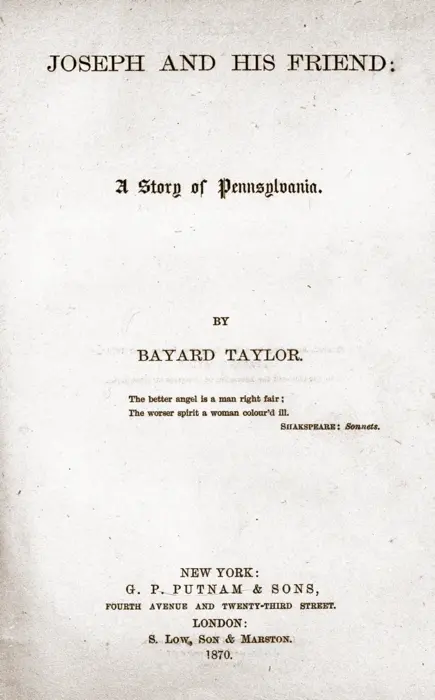
Bayard Taylor
THE CLASSIC COLLECTION · 1866
"The Story of Kennett" by Bayard Taylor is a novel written during the late 19th century. The narrative unfolds in a rural community in Pennsylvania, capturing the everyday life and characters within this close-knit village. The plot centers on Gilbert Potter, a young man navigating the complexities of rural society, as well as his relationships with other residents, including the spirited Martha Deane and the enigmatic stranger named Fortune. At the start of the novel, the scene is set on a March day in 1796, where a gathering of local hunters is underway at the Barton farmhouse, signaling an upcoming fox hunt. Characters like Mr. Alfred Barton, the host with mixed intentions, and Gilbert Potter, eager for participation, introduce the social dynamics of the community. The atmosphere is lively, filled with camaraderie and competition as the potential for adventure amalgamates with local traditions. As the hunters prepare for the chase, the foundational tones of class, rivalry, and the nuances of personality emerge, establishing the complex interplay of relationships that will unfold as the story progresses.
Introduction adapted from the source catalogue; source summaries may be automatically generated.
Free to read · English · 131,091 words · No account needed
MAKE TIME FOR A GOOD BOOK
On by default. Untick to stop anonymous reading totals. Each page counts after 10 seconds in view. How this works.
Anonymous counting is on unless you have switched it off.
Thereupon he took a chair, placed it in front of the old man, and sat down upon it, with his legs spread wide apart, and his ivory-headed cane (which he also used as a riding-whip) bolt upright between them. He was very careful not to seem to see that a short quilt, which the old man usually wore over his knees, now lay in a somewhat angular heap upon the table.
“Better, I should say,--yes, decidedly better,” he remarked, nodding his head gravely. “I had nothing to do this afternoon,--the neighborhood is very healthy,--and thought I would ride down and see how thee's getting on. Only a friendly visit, thee knows.”
The old man had laid one shaking arm and crooked hand upon the edge of the quilt, while with the other he grasped his hickory staff. His face had a strange, ashy color, through which the dark, corded veins on his temples showed with singular distinctness. But his eye was unusually bright and keen, and its cunning, suspicious expression did not escape the Doctor's notice.
“A friendly visit--ay!” he growled--“not like Doctors' visits generally, eh? Better?--of course I'm better. It's no harm to tap one of a full-blooded breed. At our age, Doctor, a little blood goes a great way.”
“No doubt, no doubt!” the Doctor assented. “Especially in thy case. I often speak of thy wonderful constitution.”
“Neighborly, you say, Doctor--only neighborly?” asked the old man. The Doctor smiled, nodded, and seemed to exhale a more powerful herbaceous odor.
“Mayhap, then, you'll take a bit of a dram?--a thimble-full won't come amiss. You know the shelf where it's kep'--reach to, and help yourself, and then help me to a drop.”
Dr. Deane rose and took down the square black bottle and the diminutive wine-glass beside it. Half-filling the latter,--a thimble-full in verity,--he drank it in two or three delicate little sips, puckering his large under-lip to receive them.
“It's right to have the best, Friend Barton,” he said, “there's more life in it!” as he filled the glass to the brim and held it to the slit in the old man's face.
The latter eagerly drew off the top fulness, and then seized the glass in his shaky hand. “Can help myself,” he croaked--“don't need waitin' on; not so bad as that!”
His color presently grew, and his neck assumed a partial steadiness. “What news, what news?” he asked. “You gather up a plenty in your goin's-around. It's little I get, except the bones, after they've been gnawed over by the whole neighborhood.”
“There is not much now, I believe,” Dr. Deane observed.
Your reading position is saved on this browser. Take it to another device with a library code. Reading pages adapt to text, rather than matching a printed edition.
Bayard Taylor
Bayard Taylor
Bayard Taylor
Bayard Taylor
BEHIND THE BOOK
This eBook is for the use of anyone anywhere in the United States and most other parts of the world at no cost and with almost no restrictions whatsoever. You may copy it, give it away or re-use it under the terms of the Project Gutenberg License included with this eBook or online at www.gutenberg.org. If you are not located in the United States, you will have to check the laws of the country where you are located before using this eBook. Read the source licence.
The original source file, including credits and licence, is retained by this library. Request an original-format copy at no charge. Please include the book title and Project Gutenberg identifier #8680.
KEEP YOUR CURIOSITY GOING
Coulson Kernahan

Maurice Baring
Frances Wright
Cécile Tormay

Frederic Jesup Stimson

W. H. P. (William Henry Pope) Jarvis