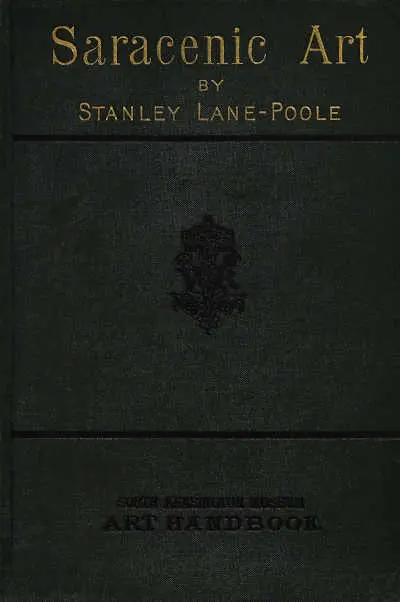
The art of the Saracens in Egypt
Stanley Lane-Poole
THE CLASSIC COLLECTION · 1906
The story of Cairo by Stanley Lane-Poole is a historical account written in the early 20th century. It traces Cairo’s making as a resolutely medieval Islamic city, interweaving urban growth, monuments, and daily life with art and architectural analysis. The focus moves from Fustat through Fatimid and Mamluk Cairo, contrasting the enduring “native” city with its newer European veneer.
The opening of the work presents Cairo as medieval in spirit despite modern reforms, voices the Cairene’s nostalgia for Mamluk days, and states the aim: to surround surviving buildings with the history and lives that gave them meaning rather than write a general history. It lists key Arabic sources, notes transliteration and illustration choices, and praises efforts to preserve Arab monuments. Chapter I contrasts European and Egyptian Cairo through street vignettes, wedding and circumcision processions, and bazars that evoke the Arabian Nights; it lingers on the conservative tradesman—his stall, bargaining rituals, and courtyard house with mashrabiyya screens, mandara, and segregated harim—then sketches men’s routines, women’s seclusion and visits, and festival life, especially the dazzling Molid of the Hasaneyn; a final panorama from the Citadel surveys domes, minarets, and the desert-pyramid horizon. At the start of Chapter II, the narrative outlines the city’s successive foundations (Fustat, al-‘Askar, al-Katai‘, al-Qahira), Saladin’s enclosing plan, and the Arab conquest eased by Coptic-Greek schism; it recounts Fustat’s “tent” legend, describes the austere origins and many rebuildings of the Mosque of ‘Amr, and notes that while Fustat lies in ruins, the Roman fortress of Babylon endures.
Introduction adapted from the source catalogue; source summaries may be automatically generated.
Free to read · English · 91,102 words · No account needed
MAKE TIME FOR A GOOD BOOK
On by default. Untick to stop anonymous reading totals. Each page counts after 10 seconds in view. How this works.
Anonymous counting is on unless you have switched it off.
The traveller tells how people came to the Ikhshíd and begged to be allowed to dig for treasure, the clue to which they said they had found in ancient manuscripts; but when permission was given the treasure- seekers found only caves full of statues of bone and dust—in short, they had opened some mummy-pits. Mas‘údy mentions the two Nilometers on the island of Roda, which he calls “the island of the shipbuilders;” the first built by Osáma and still in general use; the second made, or rather restored, by Ibn-Tulún, being used only for very high Niles; and he saw the bridges connecting Misr with the island and the island with Gíza on the west bank. He met merchants from Constantinople at Misr, but of the city itself he tells us nothing. From Ibn-Sa‘íd and others, however, we learn that the Ikhshíd built a new dockyard at Misr, which took the place of the inconvenient docks on the island of Roda, where a garden and pleasure-house were laid out instead; and it was characteristic of his parsimony that when the estimate was laid before him he exclaimed, “What? Thirty thousand dinárs for a pleasure-garden!” and immediately cut the cost down to five thousand. As the dockyard of Roda was superseded by that of Misr, so was the latter replaced by the port of Maks, a mile lower down the river, in the next generation. The Ikhshíd’s economical pleasure-house on the island has left no traces; but Roda was a favourite resort of successive rulers, and his building was doubtless pulled down to make way for the Hawdag or “litter- pavilion” of el-Amir and the more elaborate constructions of the Ayyúbids.
The great business of men of learning in those days was the interpretation of the sacred law as laid down in the Korán, in the traditions of the Prophet, and in the decisions of the canonical theologians. A Mohammedan lawyer was necessarily a divine, since the law depended on revelation, and the earliest scholars of Misr were chiefly theological jurisconsults. Of the four recognized schools of orthodoxy—the Hánafy, Máliky, Sháfi‘y and Hánbaly—the Málikis and the Sháfi‘is each had fifteen porticoes in the mosque of ‘Amr, to only three for the Hánafis, and the great court rang with their disputes. To us their distinctions may seem trivial, but to the Muslims of that age they were quite as vital as the filioque was to the Orthodox Eastern Church or the difference between ἐκ and ἐν to the Copts. The divines waxed so furious in their arguments in the Old Mosque that the Ikhshíd was obliged for a season to take away their rush mats and cushions and close the mosque except at prayer time. Mosques were then, as some are still, the academies of Islam, and not merely divinity schools. In the old days before Mohammad the Arabian poets used to recite their verses at the great fairs before critical audiences of their countrymen. In Mohammedan times the criticism of authors was equally public but in a different fashion. “When a man had produced something he thought particularly good, he hastened to the mosque to share it with his critics. He was sure to find them there, doctors learned in the law, poets, commentators, seated cross-legged on their carpets in the arched porticos round the court, expounding the refinements of style to a circle of squatting students. To this audience he would recite his latest achievement, proud but tremulous. It must have been a searching ordeal, for the listeners were some of them rivals and all of them keen critics, on the alert for the least flaw, the slightest halt in the rhythm, the smallest lapse from the purity of the classical idiom. They had, too, a way of expressing their opinions which was more forcible than kind. There was a hot debate, much citing of precedents and quoting of the Masters, exploring of memory, and examination of texts. The new comer defended his diction and produced his authorities; the rest cut him up in remorseless verbal vivisection.”[27]
Your reading position is saved on this browser. Take it to another device with a library code. Reading pages adapt to text, rather than matching a printed edition.
Stanley Lane-Poole

Stanley Lane-Poole

Stanley Lane-Poole & J. D. Jerrold (James Douglas Jerrold) Kelley
BEHIND THE BOOK
This eBook is for the use of anyone anywhere in the United States and most other parts of the world at no cost and with almost no restrictions whatsoever. You may copy it, give it away or re-use it under the terms of the Project Gutenberg License included with this eBook or online at www.gutenberg.org. If you are not located in the United States, you will have to check the laws of the country where you are located before using this eBook. Read the source licence.
The original source file, including credits and licence, is retained by this library. Request an original-format copy at no charge. Please include the book title and Project Gutenberg identifier #78916.
KEEP YOUR CURIOSITY GOING

Charles G. (Charles Griffith) Ross
Hannah Webster Foster

Emily Lawless
Edwin Hamlin Carr

Charles De Lano Hine
Andrew Ure