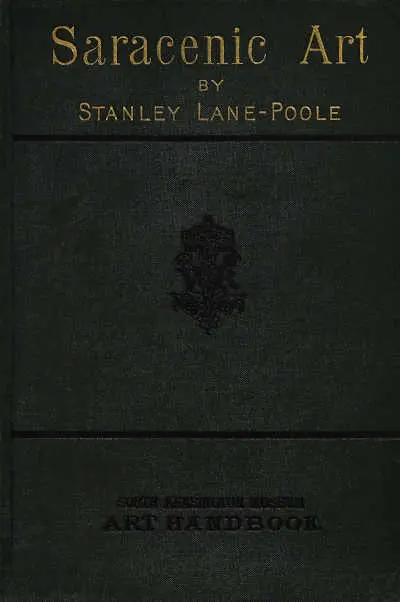
The art of the Saracens in Egypt
Stanley Lane-Poole
THE CLASSIC COLLECTION · 1906
The story of Cairo by Stanley Lane-Poole is a historical account written in the early 20th century. It traces Cairo’s making as a resolutely medieval Islamic city, interweaving urban growth, monuments, and daily life with art and architectural analysis. The focus moves from Fustat through Fatimid and Mamluk Cairo, contrasting the enduring “native” city with its newer European veneer.
The opening of the work presents Cairo as medieval in spirit despite modern reforms, voices the Cairene’s nostalgia for Mamluk days, and states the aim: to surround surviving buildings with the history and lives that gave them meaning rather than write a general history. It lists key Arabic sources, notes transliteration and illustration choices, and praises efforts to preserve Arab monuments. Chapter I contrasts European and Egyptian Cairo through street vignettes, wedding and circumcision processions, and bazars that evoke the Arabian Nights; it lingers on the conservative tradesman—his stall, bargaining rituals, and courtyard house with mashrabiyya screens, mandara, and segregated harim—then sketches men’s routines, women’s seclusion and visits, and festival life, especially the dazzling Molid of the Hasaneyn; a final panorama from the Citadel surveys domes, minarets, and the desert-pyramid horizon. At the start of Chapter II, the narrative outlines the city’s successive foundations (Fustat, al-‘Askar, al-Katai‘, al-Qahira), Saladin’s enclosing plan, and the Arab conquest eased by Coptic-Greek schism; it recounts Fustat’s “tent” legend, describes the austere origins and many rebuildings of the Mosque of ‘Amr, and notes that while Fustat lies in ruins, the Roman fortress of Babylon endures.
Introduction adapted from the source catalogue; source summaries may be automatically generated.
Free to read · English · 91,102 words · No account needed
MAKE TIME FOR A GOOD BOOK
On by default. Untick to stop anonymous reading totals. Each page counts after 10 seconds in view. How this works.
Anonymous counting is on unless you have switched it off.
[Footnote 65: Makrízy describes only nineteen mesgids (apart from those in the Karáfa cemetery), as compared with eighty-seven gámi‘s; and all the nineteen seem to have been unimportant. They were chiefly of Fátimid or Ayyúbid foundation, and situate outside the Zuweyla, Nasr, Kantara, and Sa‘áda Gates, or in the garden of Kafúr, though three were in or near Beyn-el-Kasreyn. None of them is standing now. Makrízy enumerates twenty-five Záwiyas, all but one being Mamlúk foundations, of which seven were outside the Bab-en-Nasr or B. el-Futúh, four outside other gates, five at or near Maks. In short, mesgid would appear to be applied in the Topographer’s time chiefly to the earlier suburban chapels, and záwiya to outlying chapels of the Mamlúk period.]
[Footnote 66: Saladin, 20.]
[Footnote 67: The only coin known of Sheger-ed-durr is in the British Museum (see my Catalogue of Oriental Coins, iv. p. 136). Her surname was ‘Asmat-ed-din, “Defender of the Faith,” and her title Sultán. “Sultana” is not an Arabic title.]
[Footnote 68: The extinction of the Crusaders was completed by the conquest of Margat and Tripolis by Kalaún, and the storming of ‘Akka by Khalíl in 1292: the few remaining cities fell immediately, and the work of the Crusaders was wiped out.]
[Footnote 69: The tombs of two of the ‘Abbásid caliphs of Egypt and some of their relations were discovered by E. T. Rogers Bey in 1883, close to the mosque of Sitta Nefísa at the southern side of Cairo.]
[Footnote 70: Ibn-Batúta, ed. Defremery, i. 71-4.]
[Footnote 71: See plan, p. 190. Compare the elaborate work of Herz Bey, La Mosquée du Sultan Hasan, full of admirable photographs, drawings, reconstructions, and plans.]
[Footnote 72: History of Egypt in the Middle Ages, 344.]
[Footnote 73: Marble was not commonly used before the thirteenth century, when it began to be veneered on portals. It is best seen in tessellated pavements and mural mosaics. The latter, composed of pieces of various coloured marbles, were either set in mortar or let into a solid marble slab.]
[Footnote 74: When I was in Cairo in 1883 I made paper squeezes (strengthened by layers of plaster of Paris mixed with glue) of the whole of the ornament of this wekála, and plaster casts made from these squeezes may now be examined in one of the galleries of the Museum at South Kensington.]
[Footnote 75: See M. van Berchem, Corpus Inscr. Arabic., 533 ff., for an exhaustive discussion of the development of the plan cruciforme déformé.]
[Footnote 76: Makrízy, ii. 130, 131.]
[Footnote 77: Cairo Fifty Years Ago, 34, 35.]
[Footnote 78: D. A. Cameron, Egypt in the Nineteenth Century, 14, 15.]
[Footnote 79: Makrízy, ii. 91 ff.]
[Footnote 80: Khitat, ii. 105.]
Your reading position is saved on this browser. Take it to another device with a library code. Reading pages adapt to text, rather than matching a printed edition.
Stanley Lane-Poole
Stanley Lane-Poole
Stanley Lane-Poole & J. D. Jerrold (James Douglas Jerrold) Kelley
BEHIND THE BOOK
This eBook is for the use of anyone anywhere in the United States and most other parts of the world at no cost and with almost no restrictions whatsoever. You may copy it, give it away or re-use it under the terms of the Project Gutenberg License included with this eBook or online at www.gutenberg.org. If you are not located in the United States, you will have to check the laws of the country where you are located before using this eBook. Read the source licence.
The original source file, including credits and licence, is retained by this library. Request an original-format copy at no charge. Please include the book title and Project Gutenberg identifier #78916.
KEEP YOUR CURIOSITY GOING

Charles G. (Charles Griffith) Ross
Hannah Webster Foster

Emily Lawless
Edwin Hamlin Carr

Charles De Lano Hine
Andrew Ure