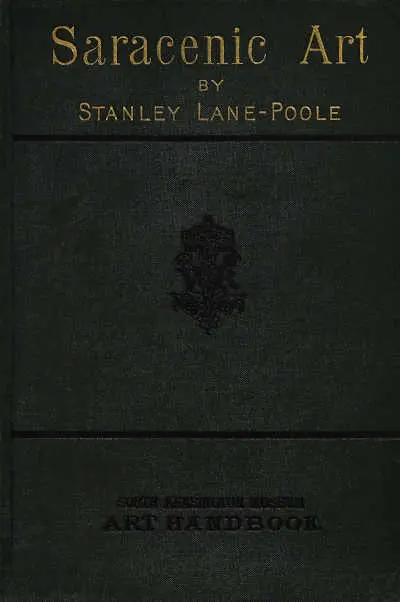
The art of the Saracens in Egypt
Stanley Lane-Poole
THE CLASSIC COLLECTION · 1906
The story of Cairo by Stanley Lane-Poole is a historical account written in the early 20th century. It traces Cairo’s making as a resolutely medieval Islamic city, interweaving urban growth, monuments, and daily life with art and architectural analysis. The focus moves from Fustat through Fatimid and Mamluk Cairo, contrasting the enduring “native” city with its newer European veneer.
The opening of the work presents Cairo as medieval in spirit despite modern reforms, voices the Cairene’s nostalgia for Mamluk days, and states the aim: to surround surviving buildings with the history and lives that gave them meaning rather than write a general history. It lists key Arabic sources, notes transliteration and illustration choices, and praises efforts to preserve Arab monuments. Chapter I contrasts European and Egyptian Cairo through street vignettes, wedding and circumcision processions, and bazars that evoke the Arabian Nights; it lingers on the conservative tradesman—his stall, bargaining rituals, and courtyard house with mashrabiyya screens, mandara, and segregated harim—then sketches men’s routines, women’s seclusion and visits, and festival life, especially the dazzling Molid of the Hasaneyn; a final panorama from the Citadel surveys domes, minarets, and the desert-pyramid horizon. At the start of Chapter II, the narrative outlines the city’s successive foundations (Fustat, al-‘Askar, al-Katai‘, al-Qahira), Saladin’s enclosing plan, and the Arab conquest eased by Coptic-Greek schism; it recounts Fustat’s “tent” legend, describes the austere origins and many rebuildings of the Mosque of ‘Amr, and notes that while Fustat lies in ruins, the Roman fortress of Babylon endures.
Introduction adapted from the source catalogue; source summaries may be automatically generated.
Free to read · English · 91,102 words · No account needed
MAKE TIME FOR A GOOD BOOK
On by default. Untick to stop anonymous reading totals. Each page counts after 10 seconds in view. How this works.
Anonymous counting is on unless you have switched it off.
Beybars was the true founder of the mamlúk power and the organizer of the mamlúk system. Since the day when he led the charge of the Bahry guard against Louis of France at the battle of Mansúra, he had sedulously watched over the army, stimulated recruiting from fresh blood, and encouraged good service by liberal distribution of fiefs. His was the foreign policy maintained in Egypt for many years, and his court formed the pattern for succeeding kings. A very magnificent and ceremonious court it was, where the sultan sat surrounded by the great officers of state and of the household,—Viceroy, Commander-in-chief, Major domo, Captain of the Guard, Armour-bearer, Master of the Horse, Cup-bearer, Taster, Master of the Wardrobe, Grand Huntsman, Polo-bearer, Slipper-holder, Lord of the Seat; the Master of the Halberds with his Gentlemen at Arms; the Adjutant-General with his thirty Lords of the Drums, each followed by forty troopers and a band of ceremony of ten drums, four trumpets, and two hautbois; the eunuch guards, equerries and chamberlains, secretaries and court physicians, judges and divines. All these functionaries had their allowances, fiefs, or appanages; a lord of the drums, for instance, would draw an income of about £16,000 a year; and the expenses of the royal household may be judged by the estimate that 20,000 lbs. of food were daily prepared in the larder, and that the daily cost in meat and vegetables in the time of en-Násir was from £800 to £1200.
The great officers of the court and of the army were of course the most powerful men next to the sultan, and each deemed himself a fit successor to the throne. On their loyalty, and especially on that of the bodyguard, a brigade of several thousand picked men who held in fief a large part of Egypt, rested the safety and power of the sultan, who stood more or less at their mercy. Each of the great lords, were he an officer of the guard, or a court official, or merely a private nobleman, was a mamlúk sultan in miniature. He, too, had his guard of slaves, who waited at his door to escort him in his rides abroad, were ready at his behest to attack the public baths and carry off the women, defended him when a rival lord besieged his palace, and followed him valiantly as he led the charge of his division on the field of battle. These great lords, with their retainers, were a constant menace to the reigning sultan. A coalition would be formed among a certain number of disaffected nobles, with the support of some of the officers of the household or of the guard, and their retainers would mass in the approaches to the royal presence, while a trusted cupbearer or other officer, whose duties permitted him access to the king’s person, would strike the fatal blow or administer the insidious cup; and the conspirators would forthwith elect one of their number to succeed to the vacant throne. This was not effected without a struggle; the royal guard was not always to be bribed or overcome, and there were generally other nobles whose interests attached them to the reigning sovereign rather than to any possible successor, except themselves, and who would be sure to oppose the plot. Then there would be a street fight; the terrified people would close their shops, run to their houses, and shut the great gates which isolated the various quarters and markets of the city; and the rival factions of mamlúks would ride through the streets that remained open, pillaging the houses of their adversaries, carrying off women and children, holding pitched battles in the road, or discharging arrows and spears from the windows upon the enemy in the street below. These things were of constant occurrence, and the life of the merchant classes of Cairo must have been exciting. We read how the great bazar, called the Khan-el-Khalíly, was sometimes shut up for a week while these contests were going on in the streets without, and the rich merchants of Cairo huddled trembling behind the stout gates.
Your reading position is saved on this browser. Take it to another device with a library code. Reading pages adapt to text, rather than matching a printed edition.
Stanley Lane-Poole
Stanley Lane-Poole
Stanley Lane-Poole & J. D. Jerrold (James Douglas Jerrold) Kelley
BEHIND THE BOOK
This eBook is for the use of anyone anywhere in the United States and most other parts of the world at no cost and with almost no restrictions whatsoever. You may copy it, give it away or re-use it under the terms of the Project Gutenberg License included with this eBook or online at www.gutenberg.org. If you are not located in the United States, you will have to check the laws of the country where you are located before using this eBook. Read the source licence.
The original source file, including credits and licence, is retained by this library. Request an original-format copy at no charge. Please include the book title and Project Gutenberg identifier #78916.
KEEP YOUR CURIOSITY GOING

Charles G. (Charles Griffith) Ross
Hannah Webster Foster

Emily Lawless
Edwin Hamlin Carr

Charles De Lano Hine
Andrew Ure