THE CLASSIC COLLECTION✦An outlaw’s diary: the CommuneCLASSIC FREE BOOKS
An outlaw’s diary: the Commune
Cécile Tormay
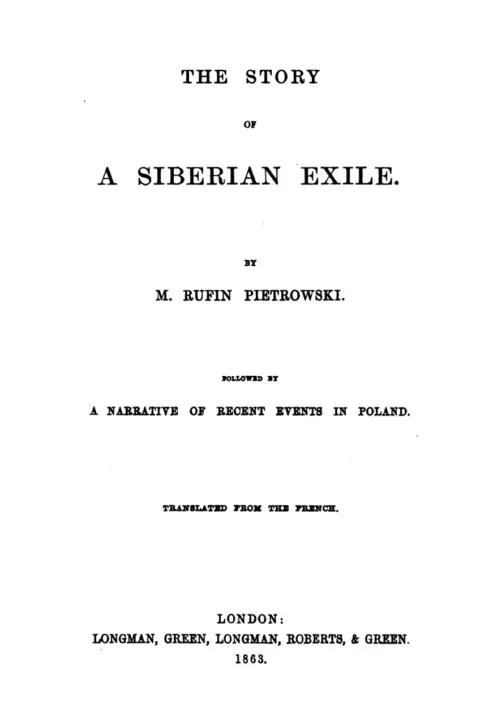
THE CLASSIC COLLECTION · 1863
"The Story of a Siberian Exile" by M. Rufin Pietrowski is a historical account written in the mid-19th century. The narrative details the experiences of a Polish exile, who faces the brutalities of imprisonment and deportation to Siberia during a tumultuous period for Poland. As a political dissident under Russian rule, the author explores themes of national identity, resistance, and suffering through his personal journey and observations of fellow prisoners. The opening of the book introduces us to the context of political persecution faced by Poles in Russia, particularly focusing on the profound despair experienced by exiles. The narrator, who takes on the alias of “Joseph Catharo,” describes his covert return to Poland, the precariousness of his situation, and the mounting suspicions from Russian authorities. As he navigates his new life in Kaminieç, he grapples with the tension between his identity as a Pole and his disguise as a British subject, all while witnessing the oppressive climate of fear and surveillance. The sections set the stage for a harrowing exploration of captivity and the scars forged by systemic repression.
Introduction adapted from the source catalogue; source summaries may be automatically generated.
Free to read · English · 81,323 words · No account needed
MAKE TIME FOR A GOOD BOOK
On by default. Untick to stop anonymous reading totals. Each page counts after 10 seconds in view. How this works.
Anonymous counting is on unless you have switched it off.
The occupations of a fervent bohomolets did not, however, prevent my wandering about the town. Archangel has a population of not much more than twenty thousand; but its port and commercial business give it an air of great animation. The town proper is joined by a wooden bridge over the Dvina with the island of Solonbal--a sort of suburb, in which has arisen the palace of the Governor. Many churches and some good houses in brick decorate this city, which is mainly constructed of wood. One single wide street, which extends through the whole length of Archangel, is paved: all its other streets and lanes are excessively dirty and muddy, for the toundra, or marshy clay upon which, like St. Petersburg, this city has been built, crops up in all directions. In one of the squares rises a colossal statue of Lomonossov. To this rhetorician and celebrated grammarian is traced the origin of a national literature in Russia, under the reign of the Tzarina Elizabeth, the daughter of Peter the Great.
The chief, and indeed, the only object which I had in view in this town may easily be guessed. Although the season had only begun, about twenty vessels were already in the bay; but among the different flags which waved from their masts, I was not able to discover one with the tri-coloured emblem. The absence of this ensign was in itself of bad augury to me. The ships were, for the most part, English; there were also some from Holland, Sweden and Hamburg, but not one French. I very soon perceived also that on the deck of every vessel walked a Russian soldier, a vigilant witness, whose eye it was impossible to elude, for this watch was not taken off even at night; while sentries posted at short distances from one another formed an unconquerable barricade along the quays of the harbour, and obliged all who came and all who went to give an account of themselves. How, then, with these sentries on the alert, could I make a signal to any captain or seaman! A crowd of idlers and foot passengers crossed the quays, and added to the difficulty of any such attempt. How then could I, if any sea-faring man should pass, accost him in French or in German--I, in my bohomolet’s dress, and surrounded by any number of people! Must I not surely draw all eyes upon myself, and bring about an immediate arrest! I continued, nevertheless, to wander up and down the quays, in the hope that some favourable opportunity would present itself; but, alas! none such came. And thus I was obliged again to turn my steps to the dvorets, where, by this time, I was expected to join in the pious exercises of the rest. On the second day, all those who had reached Archangel with me embarked for the Holy Island; but I, pretending excessive fatigue, did not accompany them, and again betook myself to the harbour. I sauntered up and down by the edge of the water which I had hoped was to have set me free; I even saw some ships that had finished taking their cargo on board, a sign that they would soon set sail and depart. My heart beat violently; my breast heaved, and I could hardly repress the cry, ‘Save me! Do not abandon me thus!’ At last I accosted some seamen, busy with tie hawsers which still fastened a ship to the pier. In spite of the extreme danger thus incurred, I ventured a few words in French; they only raised their heads and stared at me with amazement. I tried German, but with as little success; till, finally, they burst into a loud laugh, and I had to slip away as quietly as I might, for a crowd had already collected round me. On the following day my efforts had no better result, and I shall not describe either the torment of those three days, or the different attempts I made to reach any of the outward bound vessels. In spite of the severity of the season, I did not hesitate even to bathe in the harbour, hoping thus to approach some one of the ships; but nothing came of it, and no chance of escape offered itself to me. Late on the third day I returned to the dvorets, and there turned over in my mind all the circumstances of my present state, and I finished by arriving at the heart-breaking conviction that I could no longer reckon upon the port of Archangel. Already some surprise was excited that, as a bohomolets, I had so strangely delayed my departure for the Holy Isle, and to remain any longer in the town, to await the arrival of some French trader, would have been to order my own arrest. Had I not assumed the character of a pilgrim, I might perhaps have ventured into some café of public resort, and I might have flattered myself with the hope of making the acquaintance of some foreign captain; but in my peasant’s dress how could I present myself in any such place? Ah! that last night passed in the caravanserai of the pilgrims, how dark, and how sad it was! It was the thought, it had been the hope, of Archangel which had given me strength to meet the greatest dangers, and to endure the most terrible privations. And now, having reached the object of all my efforts, I was to find that they had been all in vain, and that I must fly from the city which I had so long persisted in greeting as the place of my final deliverance.
Your reading position is saved on this browser. Take it to another device with a library code. Reading pages adapt to text, rather than matching a printed edition.
BEHIND THE BOOK
This eBook is for the use of anyone anywhere in the United States and most other parts of the world at no cost and with almost no restrictions whatsoever. You may copy it, give it away or re-use it under the terms of the Project Gutenberg License included with this eBook or online at www.gutenberg.org. If you are not located in the United States, you will have to check the laws of the country where you are located before using this eBook. Read the source licence.
The original source file, including credits and licence, is retained by this library. Request an original-format copy at no charge. Please include the book title and Project Gutenberg identifier #67749.
KEEP YOUR CURIOSITY GOING
Cécile Tormay

Moritz Busch
John L. Ransom
Frances Wright
Cécile Tormay

Mabel Potter Daggett