THE CLASSIC COLLECTION✦An outlaw’s diary: the CommuneCLASSIC FREE BOOKS
An outlaw’s diary: the Commune
Cécile Tormay
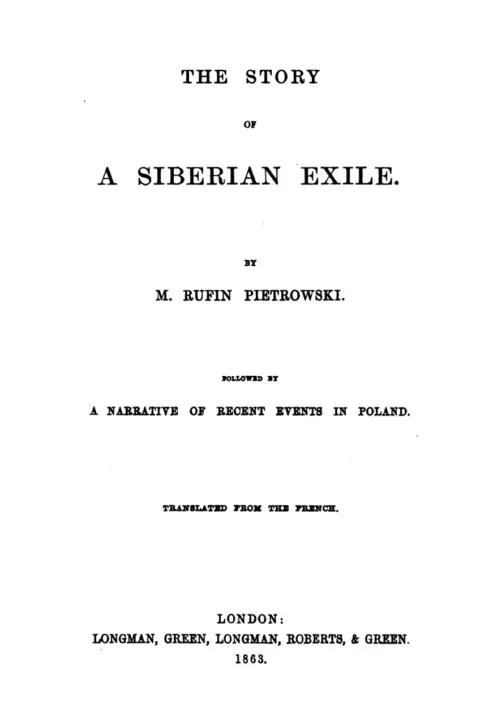
THE CLASSIC COLLECTION · 1863
"The Story of a Siberian Exile" by M. Rufin Pietrowski is a historical account written in the mid-19th century. The narrative details the experiences of a Polish exile, who faces the brutalities of imprisonment and deportation to Siberia during a tumultuous period for Poland. As a political dissident under Russian rule, the author explores themes of national identity, resistance, and suffering through his personal journey and observations of fellow prisoners. The opening of the book introduces us to the context of political persecution faced by Poles in Russia, particularly focusing on the profound despair experienced by exiles. The narrator, who takes on the alias of “Joseph Catharo,” describes his covert return to Poland, the precariousness of his situation, and the mounting suspicions from Russian authorities. As he navigates his new life in Kaminieç, he grapples with the tension between his identity as a Pole and his disguise as a British subject, all while witnessing the oppressive climate of fear and surveillance. The sections set the stage for a harrowing exploration of captivity and the scars forged by systemic repression.
Introduction adapted from the source catalogue; source summaries may be automatically generated.
Free to read · English · 81,323 words · No account needed
MAKE TIME FOR A GOOD BOOK
On by default. Untick to stop anonymous reading totals. Each page counts after 10 seconds in view. How this works.
Anonymous counting is on unless you have switched it off.
One of the most recent and remarkable publications in this the literature of the deported (for so it is called in Poland to distinguish it from the literature of the emigrated) is that which has just been given to us by M. Rufin Piotrowski.[2] His book recommends itself not only by the richness of its detail and the breadth with which it is composed, but also, and chiefly, because the author of it is an escaped ‘Siberian.’ In him, since the case of Beniowski, we have the only example of a deported person who has attempted such an enterprise, and who has also succeeded in it. It is the more extraordinary because M. Piotrowski was also condemned to hard labour in the public works. Beniowski, as we have seen, had much assistance and many accomplices. A comparatively narrow tract alone separated him from the land of freedom, whereas our contemporary had no one to rely on but himself, and without map or succours, almost without money, he had to traverse Siberia in its entire length, and a great part of Russia in Europe in addition. On foot he made the long and perilous journey from beyond Omsk in Western Siberia, penetrating the Oural mountains to Archangel, Petersburg, Riga, even into Prussia, never imparting to a living soul his fatal secret, in order not to involve any one in his own probable and terrible fate. If the narrative of M. Piotrowski has not all that romantic brilliancy which the story of the confederate of Bar can afford, it reveals to us greater dangers and a perseverance of will far superior in every way. Nor is the marvellous element wanting to this strange Odyssey, albeit its hero is no mythological being; he exists, nay, he lives among us, and we rub shoulders with him every day. This escaped convict and exile from the banks of Irtiche, this former unhappy one (for thus do the natives of Siberia call the deported Poles), is now a modest professor in that excellent Polish school of the Batignolles, for which the emigrated sons of Poland are partly indebted to the generosity of France. M. Rufin Piotrowski was one of those heroic emissaries who, from the extreme limits of Polish emigration, sought to carry back and impart to an oppressed country the hopes, the ideas, and the dreams of exile; and his narrative begins precisely at the point when he started from Paris, on the journey which he undertook to Kaminiec in Podolia. These emissaries brought with them, generally speaking, impossible plans, and calls which could not be answered, because sufficient reflection had not been bestowed upon them. Sometimes, too, they imported ideas which were positively dangerous, and if they almost always half atoned for their errors by a constancy which braved both death and danger; they did not the less draw along with them in their own unhappy fate some generous and innocent victims. M. Piotrowski has at least this consolation, that he never made himself the apostle of perverse doctrines, and that he never sowed the seeds of hatred. His actions as an emissary were always enlightened by sentiments of that religious charity to which mob law in all its meanings is utterly repugnant. The same profoundly religious spirit characterises his book--a book which was written now many years ago, but which, for reasons obvious in a case of Polish publication, it was impracticable to publish before 1861. We have thought that the recollections of M. Piotrowski were likely to find favour with the French public. At a time when nothing else is heard of in Poland but sentences to Siberia pronounced upon the most respectable of her citizens, upon canons, rabbins, provosts, merchants, professors, students, and artisans, it surely cannot be useless or amiss to explain by one striking example all that is contained for Poland and the Poles in the single word ‘deportation.’ Is it necessary now to add that what we are about to read in these pages is in every particular strict matter of fact? The narrative of M. Piotrowski bears the stamp of truth, and of a good faith which pleads for itself, and removes every suspicion of exaggeration. For the rest, as we shall see, the author hardly, if ever, blames persons; as often as not, he expresses himself with regard to them in words marked by a lively sense of gratitude. It is the system only which he accuses; and, shall we confess it, the countrymen of M. Piotrowski, and above all his companions in misfortune, while unanimous as to the perfect authenticity of his tale, have rather reproached him with an excessive indulgence in speaking of the Russian officials. How many Poles, for example, have been surprised to see the portraits which he has sketched of Prince Bibikov and of M. Pissarev, men whose names are so painfully distinguished in the annals of the Poland of to-day? As we do not think it necessary to anticipate or preach a conviction which will soon make itself felt, it remains for us only to point out the method which we have followed in borrowing here from the Polish original of the book. A mere analysis would have effaced its character of individuality, while it spoilt the originality of the book. What is presented here is a faithful abridgement of a more detailed and lengthy narrative--an abridgement of an abyss, if one may borrow Pascal’s energetic phrase--for the ‘Recollections of a Siberian Exile’ reveal to us a perfect abyss of suffering and of misery.
Your reading position is saved on this browser. Take it to another device with a library code. Reading pages adapt to text, rather than matching a printed edition.
BEHIND THE BOOK
This eBook is for the use of anyone anywhere in the United States and most other parts of the world at no cost and with almost no restrictions whatsoever. You may copy it, give it away or re-use it under the terms of the Project Gutenberg License included with this eBook or online at www.gutenberg.org. If you are not located in the United States, you will have to check the laws of the country where you are located before using this eBook. Read the source licence.
The original source file, including credits and licence, is retained by this library. Request an original-format copy at no charge. Please include the book title and Project Gutenberg identifier #67749.
KEEP YOUR CURIOSITY GOING
Cécile Tormay

Moritz Busch
John L. Ransom
Frances Wright
Cécile Tormay

Mabel Potter Daggett