THE CLASSIC COLLECTION✦A dead man’s diaryCLASSIC FREE BOOKS
A dead man’s diary
Coulson Kernahan
THE CLASSIC COLLECTION · 1912
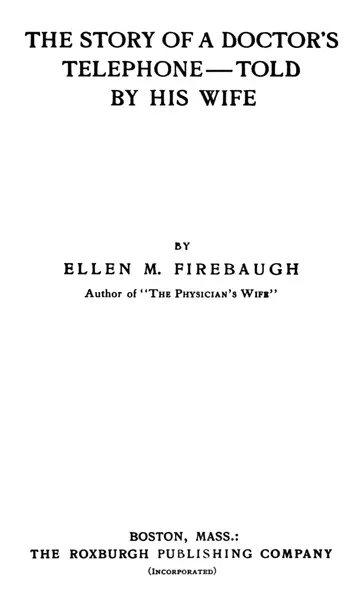
"The Story of a Doctor's Telephone—Told by His Wife" by Ellen M. Firebaugh is a fictional narrative written in the early 20th century. The book offers a glimpse into the life of a doctor and his wife, exploring the impact of the telephone on their daily lives and the peculiar challenges they face, especially during medical emergencies. The story focuses on Mary, the doctor’s wife, as she navigates the complexities and interruptions that come with being married to a physician in an era when the telephone was a relatively new but essential tool for communication and help. The opening of the narrative paints a vivid picture of the dynamics within the doctor’s household, highlighting the profound effect the telephone has on their lives. It portrays Mary’s humorous frustrations with the constant ringing intervening in her daily routines, the confusion of multiple phone lines, and the peculiarities of medical calls that disrupt their peace. Through Mary’s soliloquy and her interactions with her husband, the reader is introduced to their relationship and the nuances of managing their domestic life alongside the demands of the doctor’s profession. The tone blends humor with a touch of poignant realism, promising an exploration of family life, societal expectations, and the challenges that arise when personal and professional lives collide.
Introduction adapted from the source catalogue; source summaries may be automatically generated.
Free to read · English · 50,522 words · No account needed
MAKE TIME FOR A GOOD BOOK
On by default. Untick to stop anonymous reading totals. Each page counts after 10 seconds in view. How this works.
Anonymous counting is on unless you have switched it off.
When he came back, he said, "This time I had to help the dead."
"To help the dead!" exclaimed Mary.
"Yes. To help a dead woman into her coffin. Everybody was afraid to
touch her."
"Why?"
"The report got out that she died of smallpox. I only saw her once and could not be sure, but to be on the safe side I insisted that every precaution be taken--hence the scare."
"But how could you lift the body without help?"
"Oh, I managed it somehow. Just the same I'd rather minister to the living," said John, to which Mary gave vigorous assent.
"Old Mr. Vintner has just been 'phoning for you in a most imperious way," announced Mary as the doctor came in at the door.
"Yes, old skinflint! The maid at his house is very sick and he's so afraid they'll have to take care of her that he's determined to send her home when she can't go. She has pneumonia. She lives miles out in the country--"
Ting-a-ling-ling-ling-ling.
"Yes."
"Now see here, Vintner. Listen to me."
"Yes, I know. But a man's got to be human. I tell you you can't send her out in this cold. It's outrageous to--"
"Yes, I know all that, too. But it won't be long--the crisis will come in a day or two now and--"
"Damn it! Listen. Now stop that and listen. Don't you attempt it! That girl will be to drag off if you do, I tell you--"
"All right then. That sounds more like it," and he hung up the receiver.
Mary looked up. "You are not very elegant in your discourse at times, John, but I'm glad you beat," she said.
One evening the doctor came in and walked hurriedly into the dining-room. As he was passing the telephone it rang sharply in his ear.
"What is it?" he asked, hastily putting up the receiver.
An agitated voice said, "Oh, Doctor, I've just given my little girl a teaspoonful of carbolic acid! Quick! What must I do!"
"Give her some whiskey at once; then a teaspoonful of mustard in hot water. I'll be right down," and turning he went swiftly out. When he came back an hour or two later he said: "The mother got the wrong bottle. A very few minutes would have done the work. The telephone saved the child's life. This is a glorious age in which we are living, Mary."
"And to think that some little children playing with tin cans with a string stretched between them, gave to the world its first telephone message."
"Yes, I've heard that. It may or may not be true. Now let's have
supper."
Your reading position is saved on this browser. Take it to another device with a library code. Reading pages adapt to text, rather than matching a printed edition.
BEHIND THE BOOK
This eBook is for the use of anyone anywhere in the United States and most other parts of the world at no cost and with almost no restrictions whatsoever. You may copy it, give it away or re-use it under the terms of the Project Gutenberg License included with this eBook or online at www.gutenberg.org. If you are not located in the United States, you will have to check the laws of the country where you are located before using this eBook. Read the source licence.
The original source file, including credits and licence, is retained by this library. Request an original-format copy at no charge. Please include the book title and Project Gutenberg identifier #38752.
KEEP YOUR CURIOSITY GOING
Coulson Kernahan

Maurice Baring
Frances Wright
Cécile Tormay

Frederic Jesup Stimson

W. H. P. (William Henry Pope) Jarvis