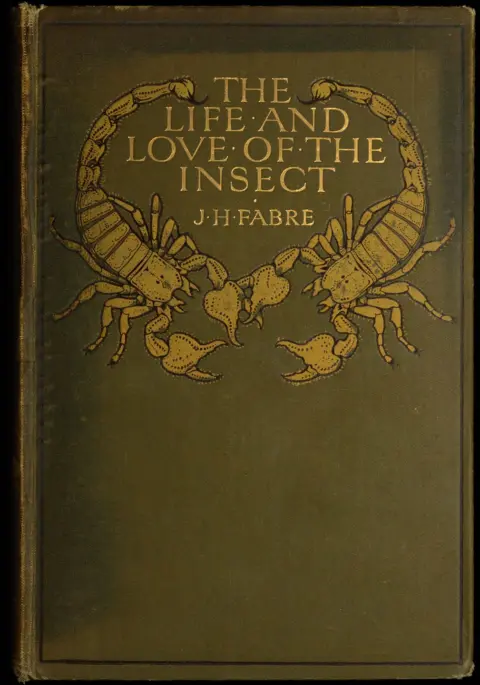
The Life and Love of the Insect
Jean-Henri Fabre
THE CLASSIC COLLECTION · 1917
"The Story-book of Science" by Jean-Henri Fabre is a collection of informative narratives aimed at young readers, written in the early 20th century. The work employs engaging storytelling to explore various scientific topics, particularly focusing on natural history and the lives of insects, plants, and animals. Fabre seeks to captivate the imagination of children while imparting knowledge about the natural world, showcasing its wonders through relatable and entertaining anecdotes. At the start of the book, we meet Uncle Paul, who reads to a group of children gathered at twilight, kindling their curiosity about the world around them. As he engages them with true stories of nature, the children express their desire for captivating tales, leading Uncle Paul to share vivid accounts about the industrious lives of ants and their relationship with "cows," specifically aphids. Through his storytelling, Uncle Paul seamlessly blends factual information with imaginative elements, illustrating the concepts of cooperation and the intricate dynamics of life in nature while emphasizing the importance of observation and inquiry in understanding science.
Introduction adapted from the source catalogue; source summaries may be automatically generated.
Free to read · English · 91,690 words · No account needed
MAKE TIME FOR A GOOD BOOK
On by default. Untick to stop anonymous reading totals. Each page counts after 10 seconds in view. How this works.
Anonymous counting is on unless you have switched it off.
“Here is another which, like the preceding, is found in the Mediterranean. It is the spiny mollusk. The creature that inhabits it produces a violet glair, from which the ancients derived, for their costly stuffs, a magnificent color called purple.”
“How are shells made?” asked Claire.
“Shells are the dwellings of creatures called mollusks, the same as the spiral snail’s shell is the house of the horny little animal that eats your young flowering plants.”
“Then the snail’s house is a shell, the same as the beautiful ones you have shown us,” Jules observed.
“Yes, my child. It is in the sea that we find, in greatest number, the largest and most beautiful shells. They are called sea-shells. To these belong the helmet-shell, cassidula, and spiny mollusk. But fresh waters, that is to say streams, rivers, ponds, lakes, have them too. The smallest ditch in our country has shells of good shape but somber, earthy in color. They are called fresh-water shells.”
“I have seen some in the water resembling large, pointed, spiral snails,” said Jules. “They have a sort of cap to close the opening.”
“They are Paludinidæ.”
“I remember another ditch shell,” said Claire. “It is round, flat, and as large as a ten or even twenty-sou piece.”
“That is one of the Planorbinæ. Finally, there are shells that are always found on land and for that reason are called land-shells. Such is the spiral snail.”
“I have seen very pretty snails,” Jules remarked, “almost as pretty as the shells in this drawer. In the woods you see yellow ones with several black bands wound round them in regular order.”
“The creature we call the spiral snail—isn’t it a slug that finds an empty shell and lives in it?” asked Emile.
“No, my friend; a slug remains always a slug without becoming a snail; that is to say, it never has a shell. The snail, on the contrary, is born with a tiny shell that grows little by little as the snail grows. The empty shells you find in the country have had their inhabitants, which are now dead and turned to dust, only their houses remaining.”
“A slug and a snail without its shell are very much alike.”
“Both are mollusks. There are mollusks that do not make shells, the slug for example; others that do make them, such as the snails, the Paludinidæ, and the cassididæ.”
“And of what does the snail make its house?”
“Of its own substance, my little friend; it sweats the materials for its
house.”
“I don’t understand.”
Your reading position is saved on this browser. Take it to another device with a library code. Reading pages adapt to text, rather than matching a printed edition.
Jean-Henri Fabre
Jean-Henri Fabre
Jean-Henri Fabre
Jean-Henri Fabre
BEHIND THE BOOK
This eBook is for the use of anyone anywhere in the United States and most other parts of the world at no cost and with almost no restrictions whatsoever. You may copy it, give it away or re-use it under the terms of the Project Gutenberg License included with this eBook or online at www.gutenberg.org. If you are not located in the United States, you will have to check the laws of the country where you are located before using this eBook. Read the source licence.
The original source file, including credits and licence, is retained by this library. Request an original-format copy at no charge. Please include the book title and Project Gutenberg identifier #56795.
KEEP YOUR CURIOSITY GOING

John Muir

Asa Gray
Asa Gray

Florence Nightingale
Elizabeth Robins Pennell
Denison Olmsted