THE CLASSIC COLLECTION✦The story of Keedon BluffsCLASSIC FREE BOOKS
The story of Keedon Bluffs
Charles Egbert Craddock
THE CLASSIC COLLECTION · 1905
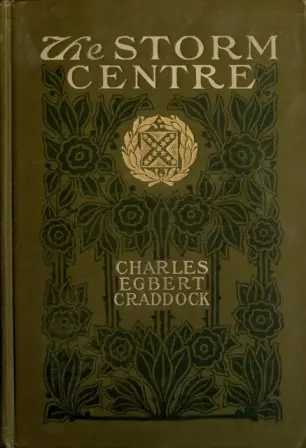
"The Storm Centre: A Novel" by Charles Egbert Craddock is a work of fiction written in the early 20th century. The story is set against the backdrop of the American Civil War and explores themes of conflict, isolation, and human relationships. The main character, Captain Fluellen Baynell, finds himself navigating not only the turmoil of war but also the complexities of his social interactions with the Roscoe household, particularly Mrs. Leonora Gwynn, whose reputation and past are shrouded in both mystery and sorrow. At the start of the novel, we are introduced to Captain Baynell as he finds himself in the calm of the Roscoe home, a stark contrast to the chaotic world outside where the Civil War rages on. He is waiting to meet the household, especially Mrs. Gwynn, the widow of a man known for his tumultuous marriage. The opening scenes depict intimate interactions with the household's old servant, Uncle Ephraim, who shares both gossip and insights about the family's dynamics. As Baynell grapples with the impending introduction to the ladies of the family, a sense of expectation builds, only to be interrupted by the playful presence of the young girls, referred to as "the ladies," and culminating in a poignant and unexpected encounter with Mrs. Gwynn, who captivates him despite her seemingly indifferent demeanor.
Introduction adapted from the source catalogue; source summaries may be automatically generated.
Free to read · English · 82,450 words · No account needed
MAKE TIME FOR A GOOD BOOK
On by default. Untick to stop anonymous reading totals. Each page counts after 10 seconds in view. How this works.
Anonymous counting is on unless you have switched it off.
Every red head on the floor had lifted at the sound, and every hand had
clutched a weapon.
"What's the matter, Sister?"
"I--I--believe there must be a flying squirrel or--or--something in the wall. Don't they build in old walls? I've seen that in some book."
Jim and Hugh arose and investigated the wall of the inner room by means of a torch of light-wood.
"Why, Sister, it is as solid as a rock!" Jim asseverated. "There's no
flying squirrel here."
He extinguished the flaming torch in the ashes banked in the chimney-place in the larger room, and again the two brothers laid themselves down to rest, with their feet on the hearth.
Once more the silence of the night, the vague crumbling of the ash, the measured sound of the sentry's tread. There was no echo of the passing of time--but how leaden-footed! How slowly fared the night! How motionless lay those cloaked figures, each with his head on his saddle!
"Watt," her voice came plaintively out of the gloom. "I'm scared!"
This time, though all stirred, they did not rise.
"Pshaw! Scared of what?"
She did not answer. Only after a time she queried irrelevantly, "Can
mice climb?"
"Did you see that in a book, too?" asked Watt.
"They can only climb under certain conditions," opined Hugh, sleepily.
"But they'd scorn to intrude on a lady in a hammock, Sister," declared
George.
"Oh, hush, George!" said Jim, authoritatively. "No mouse can get up there, Sister. Why don't you go to sleep?"
"I can't," said Millie Fisher, plaintively. "I saw so many awful things
to-day!"
"You had better think about mice," said Watt, quickly, to effect a diversion. "They are minute, but monstrous. Just imagine how one could scale the wall, and taking its tail under its left arm spring across to your hammock, and run along, say, the nape of your neck! Oh-h-h! wouldn't that be just aw-w-wful!"
"Oh, hush, Watt!" said Jim. "Just compose your mind, Sister. Shut your eyes and think about nothing."
"Think how nearly you scared a gallant captain of artillery out of his seven senses to-day," suggested Watt, anew. "I thought Jim would get run over by the gun-carriages and the caissons, whether or no. He was so scatter-brained, and white, and wild-eyed, and blundering--nearly under the horses' feet."
Millie Fisher gave a pleased little laugh.
"Was he? Was he, truly?"
"He was, for a fact. Few captains of artillery have the opportunity to make their own sister a target in a regular knock-down-and-drag-out fight. I thought I was going to have to support the gentleman off the field of battle. He couldn't stand up for a while."
Your reading position is saved on this browser. Take it to another device with a library code. Reading pages adapt to text, rather than matching a printed edition.
Charles Egbert Craddock
Charles Egbert Craddock
Charles Egbert Craddock
Charles Egbert Craddock
BEHIND THE BOOK
This eBook is for the use of anyone anywhere in the United States and most other parts of the world at no cost and with almost no restrictions whatsoever. You may copy it, give it away or re-use it under the terms of the Project Gutenberg License included with this eBook or online at www.gutenberg.org. If you are not located in the United States, you will have to check the laws of the country where you are located before using this eBook. Read the source licence.
The original source file, including credits and licence, is retained by this library. Request an original-format copy at no charge. Please include the book title and Project Gutenberg identifier #35423.
KEEP YOUR CURIOSITY GOING
Cécile Tormay

Moritz Busch
Coulson Kernahan
John L. Ransom

Maurice Baring
Frances Wright