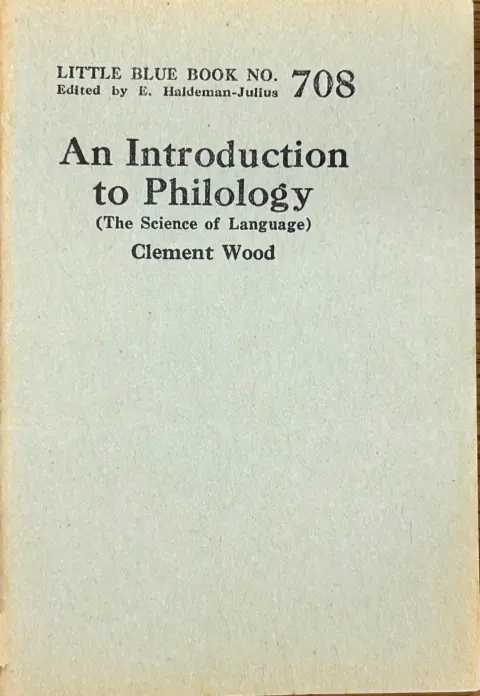
An introduction to philology
Clement Wood
THE CLASSIC COLLECTION · 1923
The Stone Age by Clement Wood. Explore this classic work in a free online edition. Subjects include Stone age. Read the locally hosted text below, adjust the reading display, and continue where you left off.
Introduction adapted from the source catalogue; source summaries may be automatically generated.
Free to read · English · 13,491 words · No account needed
MAKE TIME FOR A GOOD BOOK
On by default. Untick to stop anonymous reading totals. Each page counts after 10 seconds in view. How this works.
Anonymous counting is on unless you have switched it off.
We do not know how old the earth is, or even how old the earliest rocks are. Estimates by geologists and astronomers, based upon painstaking study, vary between 3,000,000,000 and 25,000,000 years. Carroll Lane Fenton, in “The Building of the Earth” (No. 275) in this series of books, has chosen the conservative figure of 800,000,000 years. In any case, the time occupied by man and his immediate ancestors, the apemen, hardly exceeded one sixteen-hundredth of this, or 500,000 years. A table may make this clearer:
Years Ago Era Period Life
25,000 Recent Man
475,000 Pleistocene Rise of man
(Ice Age)
Cenozoic Pliocene Rise of ape-man
(Recent Life)
40,000,000 Miocene Development of mammals, Oligocene grass, land forests, etc. Eocene
140,000,000 Mesozoic Great reptiles
(Middle Life)
360,000,000 Paleozoic Early marine life, fishes, (Ancient Life) amphibia, swamp forests
600,000,000 Proterozoic No visible trace of life. (Primordial Life) Primitive forms, jelly fish, etc.
800,000,000 Azoic (Lifeless) or No life, or one-celled life Archeozoic (First Life)
Man’s immediate ancestors emerge from the vast geologic history of the earth at the end of the Pliocene and the beginning of the Pleistocene, the Ice or Glacial Age, immediately following. In this, as in all of the tables, the order is stratigraphic, or following the strata of the rocks. Thus the most recent age is at the top, the oldest at the bottom. The Glacial Age, which reached from 475,000 to perhaps 50,000 years ago, was supposed until recently to consist of one great advance and retreat of the ice-fields from various centers. The last forty years has established that there were at least four chief glacial periods, with three interglacial periods, each with its corresponding cold and warm climates. The terraces on either bank of such European rivers as the River Inn, in Austria; the Rhine above Basle, Switzerland, and the Thames, near London, establish a different type of deposit for each glacial period, with different and advancing forms of animal life and human remains. The successive coverings of loam and earth, which washed down from the original sand and gravel terraces left by the glaciers, indicate the same series of glacial and interglacial periods. This loam was retransported in the form of dust by the winds and laid down afresh in layers of varying thickness known as “loess,” a process that still continues in certain districts; this points to the same succession of glacial and interglacial epochs. Finally, the different types of human relics and remains found in the limestone shelters and caverns of Europe point to the same succession of divisions of the Ice Age. The time since the Pliocene may thus be divided as follows:
Years Ago Period Culture Division Life
9,000-12,000 Neolithic Recent races of men (Polished Stone)
Your reading position is saved on this browser. Take it to another device with a library code. Reading pages adapt to text, rather than matching a printed edition.
Clement Wood
Clement Wood
Clement Wood
Clement Wood
BEHIND THE BOOK
This eBook is for the use of anyone anywhere in the United States and most other parts of the world at no cost and with almost no restrictions whatsoever. You may copy it, give it away or re-use it under the terms of the Project Gutenberg License included with this eBook or online at www.gutenberg.org. If you are not located in the United States, you will have to check the laws of the country where you are located before using this eBook. Read the source licence.
The original source file, including credits and licence, is retained by this library. Request an original-format copy at no charge. Please include the book title and Project Gutenberg identifier #79172.
KEEP YOUR CURIOSITY GOING

Charles G. (Charles Griffith) Ross
Hannah Webster Foster

Emily Lawless
Edwin Hamlin Carr

Charles De Lano Hine
Andrew Ure