THE CLASSIC COLLECTION✦An outlaw’s diary: the CommuneCLASSIC FREE BOOKS
An outlaw’s diary: the Commune
Cécile Tormay
THE CLASSIC COLLECTION · 1913
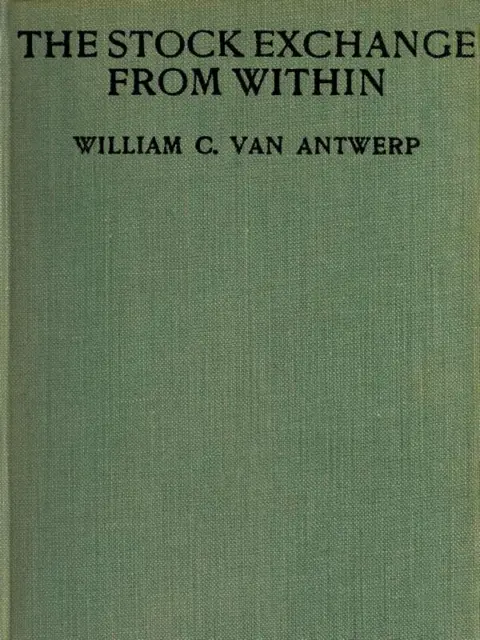
"The Stock Exchange from Within" by William C. Van Antwerp is a detailed examination of the stock exchange landscape, written in the early 20th century. This work combines elements of economic theory, practical insights, and a defense of the stock exchange as a vital institution in the American economy. The author seeks to clarify the functions, utilities, and social importance of stock exchanges, challenging the negative perceptions surrounding speculation and investment in financial markets. The opening of the book sets the stage for an in-depth exploration of the stock exchange, addressing common misconceptions regarding its purpose and value. The author begins by posing fundamental questions about the stock exchange's functions and stressing the significance of price discovery in economic transactions. He explains that the establishment of a fair market requires rigorous competition, and highlights the advantages of having a well-regulated exchange, which facilitates transparent trading and protects investors. By laying this groundwork, Van Antwerp effectively prepares the reader for a comprehensive discussion on the roles of speculation, pricing mechanisms, and the historical development of securities markets.
Introduction adapted from the source catalogue; source summaries may be automatically generated.
Free to read · English · 106,342 words · No account needed
MAKE TIME FOR A GOOD BOOK
On by default. Untick to stop anonymous reading totals. Each page counts after 10 seconds in view. How this works.
Anonymous counting is on unless you have switched it off.
“What is still more satisfactory is the wide diffusion in the ownership of industrial and railroad stocks. This is not new. The Illinois Central’s great strength for forty years was in the small stockholder, who made his voice heard to some purpose when “strike” legislation developed in his State legislature or in Congress. But the ever-widening character of the investment area, the recognition of the convenience and convertibility of Stock Exchange securities, safeguarded by sound management and full publicity, is a growth of the most hopeful character. It indicates a force of enlightened conservatism of the greatest value to the country.”--The Wall Street Journal, October 22, 1912.
[57] It is truthfully declared by Courtois, in his Traité des Opérations de Bourse et de Change, that a fictitious movement, even on the part of the most powerful operators, cannot overcome the natural tendencies of values, and that the most that can be accomplished is sometimes to hasten or retard slightly the certain effect of a foreseen event. “Wall Street and the Country,” by Charles A. Conant, p. 88, G. P. Putnam’s Sons, New York, 1904.
[58] The Wall Street Journal, December 7, 1912.
[59] The distinction between “panics,” “crises,” and “depressions,” are clearly stated in the opening chapter of “Financial Crises and Periods of Industrial and Commercial Depression,” by Theodore E. Burton, D. Appleton & Co., N. Y., 1902. In the following pages, I use the terms as they are commonly applied in Wall Street, although this application is not always governed by sound etymology. Thus in Wall Street we speak of “the panic of 1907,” meaning broadly the events of that entire year. Strictly speaking a “panic” is the brief period of a day or an hour of unreasoning fear, brought about by the “crisis” of a money scarcity which preceded it. The period of commercial and financial suffering, which continues after the panic and the crisis have passed, is the “depression.”
[60] “Des Crises Commerciales,” Clément Juglar, Paris, 1889, pp. 44–5.
[61] “Annals of the American Academy of Political and Social Science,” Vol. XXXV, No. 3, May, 1910, p. 13.
[62] “Financial Crises and Periods of Industrial and Commercial Depression,” Theodore E. Burton, New York, 1902, p. 234.
[63] The report of the New York State Superintendent of Banks for the same period emphasizes this point by showing a steady contraction of loans by State banks and trust companies of New York City during the period quoted, while all other authorities reveal a steady expansion in loans by similar institutions outside the city.
[64] “The Hughes Investigation,” by Horace White, Journal of Political Economy October, 1909, pp. 528–540. Mr. White quotes in this connection an article on “The Panic of 1907,” by Eugene Meyer, Jr., Yale Review, May, 1909, from which many facts in this chapter have been taken.
Your reading position is saved on this browser. Take it to another device with a library code. Reading pages adapt to text, rather than matching a printed edition.
BEHIND THE BOOK
This eBook is for the use of anyone anywhere in the United States and most other parts of the world at no cost and with almost no restrictions whatsoever. You may copy it, give it away or re-use it under the terms of the Project Gutenberg License included with this eBook or online at www.gutenberg.org. If you are not located in the United States, you will have to check the laws of the country where you are located before using this eBook. Read the source licence.
The original source file, including credits and licence, is retained by this library. Request an original-format copy at no charge. Please include the book title and Project Gutenberg identifier #60082.
KEEP YOUR CURIOSITY GOING
Cécile Tormay

Moritz Busch
John L. Ransom
Frances Wright
Cécile Tormay

Mabel Potter Daggett