THE CLASSIC COLLECTION✦A dead man’s diaryCLASSIC FREE BOOKS
A dead man’s diary
Coulson Kernahan
THE CLASSIC COLLECTION · 1890
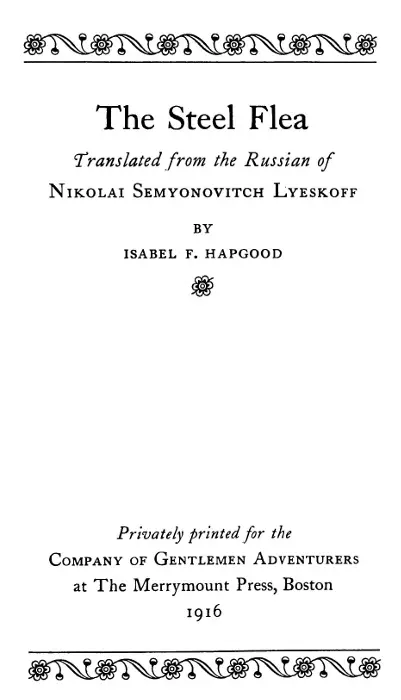
"The Steel Flea" by N. S. Leskov is a skaz written in 1881. Styled as a folk tale, it follows a left-handed craftsman from Tula who astonishes both Russian and English courts by shoeing a tiny mechanical flea created by English inventors. Through humor and distinctive language, Leskov explores Russian ingenuity and patriotism while critiquing a society that neglects its most talented people, ultimately delivering a tragic commentary on wasted genius.
Introduction adapted from the source catalogue; source summaries may be automatically generated.
Free to read · English · 13,696 words · No account needed
MAKE TIME FOR A GOOD BOOK
On by default. Untick to stop anonymous reading totals. Each page counts after 10 seconds in view. How this works.
Anonymous counting is on unless you have switched it off.
The left-handed man explained to them our position. "With us," says he, "when a man wishes to display a more particular intention with regard to a girl, he sends the confabulation-woman, and when she makes the proposal, then we go together, very politely, to the house, and we look the girl over, not in secrecy, but in the presence of all her relatives."
They understood, but answered that they had no confabulation-women, and such a custom was not in practice, but the left-handed man said: "That's all the more agreeable, because if you are going to occupy yourself with such a matter, it must be with a definite intention, and as I do not feel that towards a foreign nation, then why torment the girls?"
He pleased the Englishmen in these arguments, also, so that they again began to clap him on the shoulders and the knees, with pleasantness, and asked: "We would just like to know, out of mere curiosity: what defect have you observed in our girls, and why do you shun them?"
Thereupon the left-handed man answered them frankly: "I accuse them of no defect, but what does not please me is that their dress sort of flutters about them, and one cannot make out what they have on, and for what purpose; first there is some sort of thing or other, and underneath there's another pinned on, and on their arms are some sort of leglets or other. Their plush cloak is exactly like an ape--a sapajou."
The Englishmen burst out laughing and say: "Where's the objection in
that?"
"There's no objection," replies the left-handed man, "only I'm afraid it would make me blush to watch and wait while she is getting herself out of all that."
"Is it possible," say they, "that your fashion is better?"
"Our fashion," he replies, "in Tula is simple: every woman wears a roundabout,[32] and even the greatest ladies wear our roundabouts."
They also showed him to their ladies, and there they poured tea for him, and inquired: "Why do you frown?"
He replies: "Because," says he, "we are not used to taking it very
sweet."
Then they gave him a lump of sugar to nibble at, in Russian fashion.
They argued with him that it could not be as nice that way, but he said: "To our taste it is more tasty thus."
In no way could the English disconcert him, or make him feel attracted by their manner of life, and merely succeeded in persuading him to remain their guest for a short time, by promising that during that time they would take him about to divers factories, and show him all their art.
Your reading position is saved on this browser. Take it to another device with a library code. Reading pages adapt to text, rather than matching a printed edition.
BEHIND THE BOOK
This eBook is for the use of anyone anywhere in the United States and most other parts of the world at no cost and with almost no restrictions whatsoever. You may copy it, give it away or re-use it under the terms of the Project Gutenberg License included with this eBook or online at www.gutenberg.org. If you are not located in the United States, you will have to check the laws of the country where you are located before using this eBook. Read the source licence.
The original source file, including credits and licence, is retained by this library. Request an original-format copy at no charge. Please include the book title and Project Gutenberg identifier #61172.
KEEP YOUR CURIOSITY GOING
Coulson Kernahan

Maurice Baring
Frances Wright
Cécile Tormay
Francis Greenleaf Allinson & Anne C. E. (Anne Crosby Emery) Allinson

Frederic Jesup Stimson