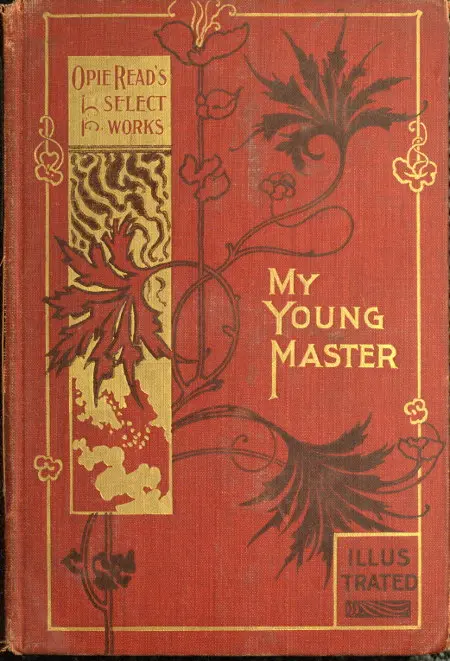
My Young Master: A Novel
Opie Percival Read
THE CLASSIC COLLECTION · 1902
"The Starbucks" by Opie Percival Read is a novel written in the early 20th century. The story is set in a rural East Tennessee community characterized by its connection to nature and traditional values. At its center is Jasper Starbuck, a man with a rich past filled with loss and resilience, and his family, including his beautiful daughter Lou and his second wife, Margaret. The narrative explores themes of love, family, and the complexities of human relationships against the backdrop of a vibrant Southern setting. The opening of the novel introduces readers to the unique lifestyle of Jasper Starbuck and his family, as well as their interactions with visitors from the city, Mrs. Mayfield and her nephew Tom Elliott. Jasper is a humorous yet deeply reflective character whose past mingles with his present household management, creating a dynamic atmosphere of warmth and tension. As the Starbuck family navigates the arrival of these outsiders, the story hints at underlying conflicts involving local rivalries, romantic interests, and the struggle to maintain a sense of home and identity amid changing circumstances. Overall, the beginning establishes a rich narrative that promises both humor and depth as it unfolds.
Introduction adapted from the source catalogue; source summaries may be automatically generated.
Free to read · English · 57,374 words · No account needed
MAKE TIME FOR A GOOD BOOK
On by default. Untick to stop anonymous reading totals. Each page counts after 10 seconds in view. How this works.
Anonymous counting is on unless you have switched it off.
"Come right in," Margaret called to Mose Blake, hesitating at the door. She led him into the room and began to introduce him to the company. "Mose, this is Miz Mayfield--" Mose shook hands with Jim. "No, this is Miz Mayfield." Mose shook hands with Lou, then with Mrs. Mayfield, and turning to Tom, to whom he was now presented, shook the stool which Tom held in his hand and upon which he was about to sit, took it from him and sat down. "All h--h--h--h--hands w--w--well, I h--h--hope."
"Well as usual," Margaret answered, sitting down in the rocker. "Why
ain't you folks been over?"
"Been a t--t--t--tryin' t--t--t--t--t--to git off. Granny sot t--t--t--the feather b--b--b--bed a--f--f--fire night afore l--l--l--last an' come mighty n--n--n--nigh b--b--b--burnin' up."
"Why, you don't say so?" Margaret exclaimed.
"Yes I d--d--d--do say so a--a--a--atter a f--f--f--fashion."
"How far do you live from here Mr. Blake?" Tom inquired.
"Oh, 'bout t--t--t--three sights and a g--g--g--good long
w--w--w--walk."
"Charmingly indefinite," said Mrs. Mayfield and Jim, his eyes set, nodded to her. Tom declared himself willing to bet that Mose was a good fellow, "and I don't want to be impertinent," he ventured to remark, "but do you know they can cure stammering now? They can."
"Y--y--y--yes, I kik--kik--kik--know. I tuck--tuck some l--l--l--lessons once a--a--a--and was kik--kik--kik--cured. Got along all r--r--r--right till I t--t--tried to talk--long as I di--d--d--din didn't say nuthin'. Lou, air you g--g--g--goin' to church Sunday?"
"I don't know."
"Lowed I'd g--g--g--go with you. Mother said I ought to go up to the m--m--m--m--m--mourner's b--b--bench, but p--p--p--p--pap he 'lowed if I did git 'ligion I couldn't s--s--s--shout. But I'm in a hurry this m--m--m--m--mornin'. Granny's sick and wants some m--m--m--med--hison."
"What's the matter with her?" Margaret inquired.
"Don't know. She didn't s--s--s--say."
"But what sort of medicine did they send you after?"
"Oh, a--a--a--any sort you ain't g--g--g--got no use fur."
"Why, that won't do," Mrs. Mayfield spoke up. "Why don't you send for a
physician?"
"Oh, that's a--a--a--all right. It never makes any d--d--dif--difference with granny what s--s--sort of medicine she t--t--t--take--takes. If you go to church Sunday, L--L--L--Lou, I may see you there. G--g--g--got somethin' to s--s--s--say to you."
"How are you going to manage to say it?" Lou asked and he began to make
signs.
"Perhaps," said Mrs. Mayfield, "what he has to say could be conveyed by
signs."
"Yes," Tom declared, "signs are very impressive. Fellow made a few at me once and when he got through I found he'd knocked me down."
"Knocked you down!" cried Lou. "Oh, how could anybody knock you down?"
Your reading position is saved on this browser. Take it to another device with a library code. Reading pages adapt to text, rather than matching a printed edition.
Opie Percival Read
Opie Percival Read

Opie Percival Read
Opie Percival Read
BEHIND THE BOOK
This eBook is for the use of anyone anywhere in the United States and most other parts of the world at no cost and with almost no restrictions whatsoever. You may copy it, give it away or re-use it under the terms of the Project Gutenberg License included with this eBook or online at www.gutenberg.org. If you are not located in the United States, you will have to check the laws of the country where you are located before using this eBook. Read the source licence.
The original source file, including credits and licence, is retained by this library. Request an original-format copy at no charge. Please include the book title and Project Gutenberg identifier #18984.
KEEP YOUR CURIOSITY GOING
Coulson Kernahan

Maurice Baring
Frances Wright
Cécile Tormay

Frederic Jesup Stimson

W. H. P. (William Henry Pope) Jarvis