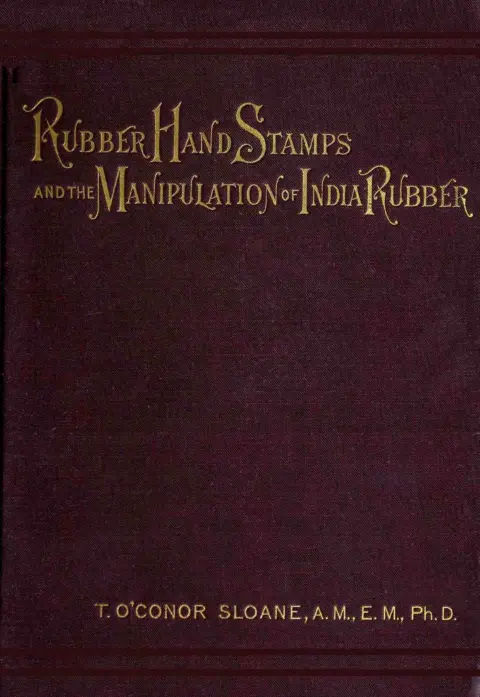
Rubber Hand Stamps and the Manipulation of Rubber A practical treatise on the manufacture of India rubber hand stamps, small articles of India rubber, the hektograph, special inks, cements, and allied subjects
T. O'Conor (Thomas O'Conor) Sloane
THE CLASSIC COLLECTION · 1892
"The Standard Electrical Dictionary" by T. O'Conor Sloane is a scientific publication written in the late 19th century. This work serves as a comprehensive reference for terminology related to electrical engineering, providing concise definitions and explanations for a multitude of concepts, terms, and inventions within the field. It reflects the advancements in electrical science, illustrating the context of its era just before significant discoveries like the electron and the development of quantum theory. The opening of this dictionary includes transcriber's notes that acknowledge the corrections of errors and the challenges of maintaining contemporary relevance given the rapidly evolving nature of electrical science. Sloane's preface outlines the purpose of the dictionary as a practical tool aimed at a growing audience interested in the intricacies of electricity, while also addressing the limitations caused by the vastness of the subject matter. The text sets a foundational tone for readers, encouraging them to utilize the indexes and synonyms to navigate through the extensive terminologies to locate and understand the complexities of electrical engineering effectively.
Introduction adapted from the source catalogue; source summaries may be automatically generated.
Free to read · English · 210,455 words · No account needed
MAKE TIME FOR A GOOD BOOK
On by default. Untick to stop anonymous reading totals. Each page counts after 10 seconds in view. How this works.
Anonymous counting is on unless you have switched it off.
The term "circuit" is also applied to portions of a true circuit, as the internal circuit, or external circuit. A certain amount of elasticity is allowed in its use. It by no means necessarily indicates a complete through circuit.
Circuit, Electrostatic.
(a) A circuit through which an electrostatic or high tension discharge
takes place. It is virtually an electric circuit.
(b) The term is applied also to the closed paths of electrostatic lines
of force.
Circuit, External.
The portion of a circuit not included within the generator.
Circuit, Grounded. A circuit, one of whose members, the return circuit, is represented by the earth, so that the earth completes the circuit. In telegraphy each end of the line is grounded or connected to an earth-plate, q. v., or to the water or gas-pipes, and the current is assumed to go through the earth on its return. It really amounts to a discharging at one end, and charging at the other end of the line. The resistance of the earth is zero, but the resistance of the grounding or connection with the earth may be considerable.
Synonyms--Ground Circuit--Earth Circuit--Single Wire Circuit.
[Transcriber's note: The resistance of the earth is high enough that large power system return currents may produce dangerous voltage gradients when a power line is shorted to the ground. Don't walk near downed lines!]
Circuit Indicator. A pocket compass, decomposition apparatus, galvanometer or other device for indicating the condition of a wire, whether carrying a current or not, and, if carrying one, its direction, and sometimes roughly indicating its strength.
Circuit, Internal.
The portion of an electric circuit included within the generator.
Circuit, Line. The portion of a circuit embracing the main line or conductor, as in a telegraph circuit the line carried on the poles; distinguished from the local circuit (see Circuit, Local,) in telegraphy.
Circuit, Local. In telegraphy, a short circuit with local generator or battery included, contained within the limits of the office or station and operated by a relay, q. v. This was the original local circuit; the term is applicable to any similar arrangement in other systems. Referring to the cut, the main line circuit includes the main battery, E, Key, P, Relay, R, ground plates, G, G1. The relay magnet opens and closes the local circuit with its local battery, L, and sounder magnet, H, with its armature, B. The minor parts, such as switches, are omitted.
Fig. 90. LOCAL CIRCUIT OF TELEGRAPH SYSTEM.
Circuit, Local Battery.
A local circuit worked by and including a local battery in its course.
Your reading position is saved on this browser. Take it to another device with a library code. Reading pages adapt to text, rather than matching a printed edition.
BEHIND THE BOOK
This eBook is for the use of anyone anywhere in the United States and most other parts of the world at no cost and with almost no restrictions whatsoever. You may copy it, give it away or re-use it under the terms of the Project Gutenberg License included with this eBook or online at www.gutenberg.org. If you are not located in the United States, you will have to check the laws of the country where you are located before using this eBook. Read the source licence.
The original source file, including credits and licence, is retained by this library. Request an original-format copy at no charge. Please include the book title and Project Gutenberg identifier #26535.
KEEP YOUR CURIOSITY GOING

Charles G. (Charles Griffith) Ross
Hannah Webster Foster

Emily Lawless
Edwin Hamlin Carr

Charles De Lano Hine
Andrew Ure