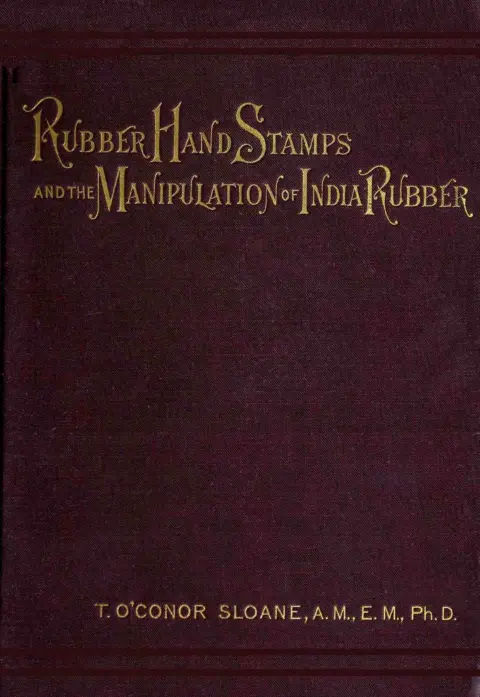
Rubber Hand Stamps and the Manipulation of Rubber A practical treatise on the manufacture of India rubber hand stamps, small articles of India rubber, the hektograph, special inks, cements, and allied subjects
T. O'Conor (Thomas O'Conor) Sloane
THE CLASSIC COLLECTION · 1892
"The Standard Electrical Dictionary" by T. O'Conor Sloane is a scientific publication written in the late 19th century. This work serves as a comprehensive reference for terminology related to electrical engineering, providing concise definitions and explanations for a multitude of concepts, terms, and inventions within the field. It reflects the advancements in electrical science, illustrating the context of its era just before significant discoveries like the electron and the development of quantum theory. The opening of this dictionary includes transcriber's notes that acknowledge the corrections of errors and the challenges of maintaining contemporary relevance given the rapidly evolving nature of electrical science. Sloane's preface outlines the purpose of the dictionary as a practical tool aimed at a growing audience interested in the intricacies of electricity, while also addressing the limitations caused by the vastness of the subject matter. The text sets a foundational tone for readers, encouraging them to utilize the indexes and synonyms to navigate through the extensive terminologies to locate and understand the complexities of electrical engineering effectively.
Introduction adapted from the source catalogue; source summaries may be automatically generated.
Free to read · English · 210,455 words · No account needed
MAKE TIME FOR A GOOD BOOK
On by default. Untick to stop anonymous reading totals. Each page counts after 10 seconds in view. How this works.
Anonymous counting is on unless you have switched it off.
Work.
When a force acts upon a body and the body moves in the direction of the
force, the force does work. Hence, work is the action of a force through
space against resistance.
It is generally expressed in compound units of length and weight, as foot-pounds, meaning a pound raised one foot.
Work, Electric, Unit of.
The volt-coulomb, q. v., or watt-second, as it is often termed.
Working, Diode.
In multiplex telegraphy the transmission of two messages,
simultaneously, over one wire. (See Telegraphy, Multiple.)
Working, Contraplex. A variety of duplex telegraphy in which the messages are sent from opposite ends of the line, simultaneously, so as to be transmitted in opposite directions. (See Working, Diplex.)
Working, Diplex.
In duplex telegraphy the sending of two independent messages from the
same end of the line in the same direction.
Working, Double Curb. A method of working telegraph lines. When a signal is sent the line is charged. This has to be got rid of, and is an element of retardation. In double curb working it is disposed of by sending a momentary current first in the reverse, and then in the same, and finally in the reverse direction. This is found to reduce the charge to a very low point.
Working, Hexode.
In multiplex telegraphy the transmission of six messages simultaneously
over one wire. (See Telegraphy, Multiplex.)
Working, Pentode.
In multiplex telegraphy the transmission of five messages simultaneously
over one wire. (See Telegraphy, Multiplex.)
Working, Reverse Current.
A method of telegraphy, in which the currents are reversed or alternated
in direction.
Working, Single Curb. A simpler form of telegraph signaling than double curb working. It consists in sending a reverse current through the line for each signal by reversing the battery connection.
Working, Tetrode.
In multiplex telegraphy the transmission of four messages simultaneously
over the same line. (See Telegraphy, Multiplex.)
Working, Triode.
In multiplex telegraphy the transmission of three messages
simultaneously over the same wire. (See Telegraphy, Multiplex.)
Work, Unit of. The erg, q. v. It is the same as the unit of energy, of which work is the corelative, being equal and opposite to the energy expended in doing it. There are many other engineering units of work, as the foot-pound and foot-ton.
Yoke.
In an electro-magnet, the piece of iron which connects the ends furthest
from the poles of the two portions of the core on which the wire is
wound.
Your reading position is saved on this browser. Take it to another device with a library code. Reading pages adapt to text, rather than matching a printed edition.
BEHIND THE BOOK
This eBook is for the use of anyone anywhere in the United States and most other parts of the world at no cost and with almost no restrictions whatsoever. You may copy it, give it away or re-use it under the terms of the Project Gutenberg License included with this eBook or online at www.gutenberg.org. If you are not located in the United States, you will have to check the laws of the country where you are located before using this eBook. Read the source licence.
The original source file, including credits and licence, is retained by this library. Request an original-format copy at no charge. Please include the book title and Project Gutenberg identifier #26535.
KEEP YOUR CURIOSITY GOING

Charles G. (Charles Griffith) Ross
Hannah Webster Foster

Emily Lawless
Edwin Hamlin Carr

Charles De Lano Hine
Andrew Ure