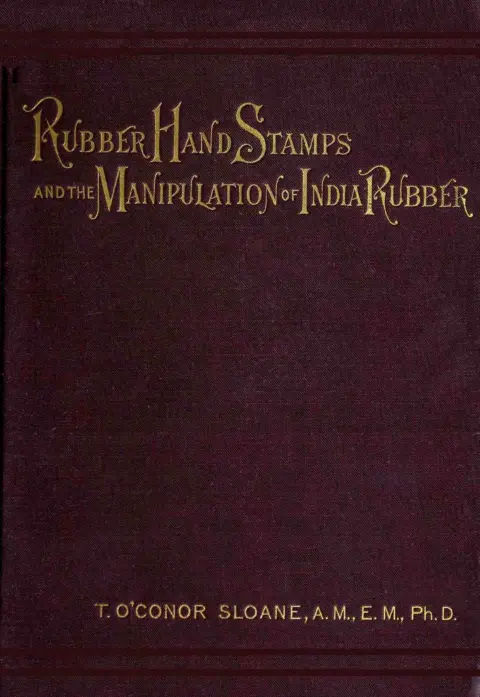
Rubber Hand Stamps and the Manipulation of Rubber A practical treatise on the manufacture of India rubber hand stamps, small articles of India rubber, the hektograph, special inks, cements, and allied subjects
T. O'Conor (Thomas O'Conor) Sloane
THE CLASSIC COLLECTION · 1892
"The Standard Electrical Dictionary" by T. O'Conor Sloane is a scientific publication written in the late 19th century. This work serves as a comprehensive reference for terminology related to electrical engineering, providing concise definitions and explanations for a multitude of concepts, terms, and inventions within the field. It reflects the advancements in electrical science, illustrating the context of its era just before significant discoveries like the electron and the development of quantum theory. The opening of this dictionary includes transcriber's notes that acknowledge the corrections of errors and the challenges of maintaining contemporary relevance given the rapidly evolving nature of electrical science. Sloane's preface outlines the purpose of the dictionary as a practical tool aimed at a growing audience interested in the intricacies of electricity, while also addressing the limitations caused by the vastness of the subject matter. The text sets a foundational tone for readers, encouraging them to utilize the indexes and synonyms to navigate through the extensive terminologies to locate and understand the complexities of electrical engineering effectively.
Introduction adapted from the source catalogue; source summaries may be automatically generated.
Free to read · English · 210,455 words · No account needed
MAKE TIME FOR A GOOD BOOK
On by default. Untick to stop anonymous reading totals. Each page counts after 10 seconds in view. How this works.
Anonymous counting is on unless you have switched it off.
Gear, Magnetic Friction. Friction gear in which the component wheels are pressed against each other by electromagnetic action. In the cut, repeated from Adherence, Electro-magnetic, the magnetizing coil makes the wheels, which are of iron, press strongly together.
Fig. 190. MAGNETIC FRICTION GEAR.
Geissler Tubes. Sealed tubes of glass containing highly rarefied gases, and provided with platinum electrodes extending through the glass tightly sealed as they pass through it, and often extending a short distance beyond its interior surface.
On passing through them the static discharge luminous effects are produced varying with the degree of exhaustion, the contents (gas), the glass itself, or solutions surrounding it. The two latter conditions involve fluorescence phenomena often of a very beautiful description.
The pressure of the gas is less than one-half of a millimeter of mercury. If a complete vacuum is produced the discharge will not pass. If too high rarefaction is produced radiant matter phenomena (see Radiant State) occur.
Geissler tubes have been used for lighting purposes as in mines, or for illuminating the interior cavities of the body in surgical or medical operations.
Generating Plate.
The positive plate in a voltaic couple, or the plate which is dissolved;
generally a plate of zinc.
Synonyms--Positive Plate--Positive Element.
Generator, Current. Any apparatus for maintaining an electric current. It may be as regards the form of energy it converts into electrical energy, mechanical, as a magneto or dynamo electric machine or generator; thermal, as a thermo-electric battery; or chemical, as a voltaic battery; all of which may be consulted.
Generator, Secondary.
A secondary or storage battery. (See Battery, Secondary.)
German Silver. An alloy of copper, 2 parts, nickel, 1 part, and zinc, 1 part. Owing to its high resistance and moderate cost and small variation in resistance with change of temperature, it is much used for resistances. From Dr. Mathiessen's experiment the following constants are deduced in legal ohms: Relative Resistance (Silver = 1), 13.92 Specific Resistance at 0° C. (32F.), 20.93 microhms. Resistance of a wire, (a) 1 foot long, weighing 1 grain, 2.622 ohms. 1 foot long, 1/1000 inch thick, 125.91 " 1 meter long, weighing 1 gram, 1.830 " 1 meter long, 1 millimeter thick, 0.2666 " Resistance of a 1 inch cube at 0°C. (32° F.), 8.240 microhms.
Approximate percentage increase of resistance per 1° C. (1.8° F.) at about 20° C. (68° F.), 0.044 per cent.
Gilding, Electro-.
The deposition of gold by an electric current, or electrolytically in
the electroplating bath.
Gilding Metal.
A special kind of brass, with a high percentage of copper, used to make
objects which are to be gilded by electrolysis.
Your reading position is saved on this browser. Take it to another device with a library code. Reading pages adapt to text, rather than matching a printed edition.
BEHIND THE BOOK
This eBook is for the use of anyone anywhere in the United States and most other parts of the world at no cost and with almost no restrictions whatsoever. You may copy it, give it away or re-use it under the terms of the Project Gutenberg License included with this eBook or online at www.gutenberg.org. If you are not located in the United States, you will have to check the laws of the country where you are located before using this eBook. Read the source licence.
The original source file, including credits and licence, is retained by this library. Request an original-format copy at no charge. Please include the book title and Project Gutenberg identifier #26535.
KEEP YOUR CURIOSITY GOING

Charles G. (Charles Griffith) Ross
Hannah Webster Foster

Emily Lawless
Edwin Hamlin Carr

Charles De Lano Hine
Andrew Ure