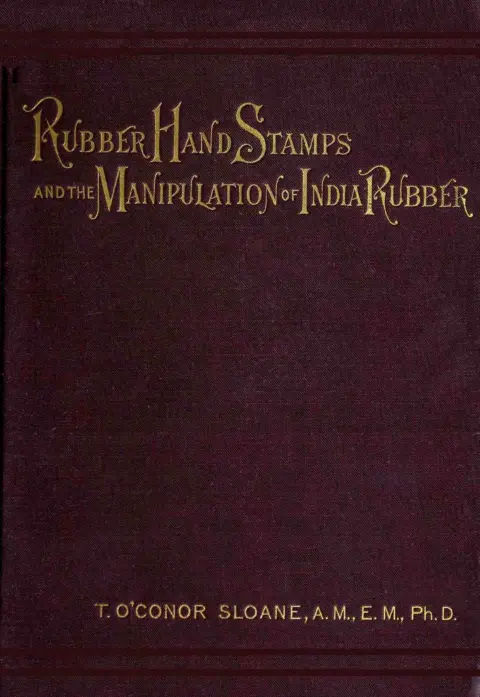
Rubber Hand Stamps and the Manipulation of Rubber A practical treatise on the manufacture of India rubber hand stamps, small articles of India rubber, the hektograph, special inks, cements, and allied subjects
T. O'Conor (Thomas O'Conor) Sloane
THE CLASSIC COLLECTION · 1892
"The Standard Electrical Dictionary" by T. O'Conor Sloane is a scientific publication written in the late 19th century. This work serves as a comprehensive reference for terminology related to electrical engineering, providing concise definitions and explanations for a multitude of concepts, terms, and inventions within the field. It reflects the advancements in electrical science, illustrating the context of its era just before significant discoveries like the electron and the development of quantum theory. The opening of this dictionary includes transcriber's notes that acknowledge the corrections of errors and the challenges of maintaining contemporary relevance given the rapidly evolving nature of electrical science. Sloane's preface outlines the purpose of the dictionary as a practical tool aimed at a growing audience interested in the intricacies of electricity, while also addressing the limitations caused by the vastness of the subject matter. The text sets a foundational tone for readers, encouraging them to utilize the indexes and synonyms to navigate through the extensive terminologies to locate and understand the complexities of electrical engineering effectively.
Introduction adapted from the source catalogue; source summaries may be automatically generated.
Free to read · English · 210,455 words · No account needed
MAKE TIME FOR A GOOD BOOK
On by default. Untick to stop anonymous reading totals. Each page counts after 10 seconds in view. How this works.
Anonymous counting is on unless you have switched it off.
Current, Circular.
A current passing through a circular conductor; a current whose path is
in the shape of a circle.
Current, Commuted.
A current changed, as regards direction or directions, by a commutator,
q. v., or its equivalent.
Current, Constant. An unvarying current. A constant current system is one maintaining such a current. In electric series, incandescent lighting, a constant current is employed, and the system is termed as above. In arc lighting systems, the constant current series arrangement is almost universal.
Current, Continuous.
A current of one direction only; the reverse of an alternating current.
(See Current, Alternating.)
Current, Critical. The current produced by a dynamo at its critical speed; at that speed when a slight difference in speed produces a great difference in electro-motive force. On the characteristic curve it corresponds to the point where the curve bends sharply, and where the electro-motive force is about two-thirds its maximum.
Current, Daniell/U.S. , Daniell/Siemens' Unit. A unit of current strength used in Germany. It is the strength of a current produced by one Daniell cell in a circuit of the resistance of one Siemens' unit. The current deposits 1.38 grams of copper per hour. It is equal to 1.16 amperes.
Current, Demarcation.
In electro-therapeutics, a current which can be taken from an injured
muscle, the injured portion acting electro-negatively toward the
uninjured portion.
Current Density. The current intensity per unit of cross-sectional area of the conductor. The expression is more generally used for electrolytic conduction, where the current-density is referred to the mean facing areas of the electrodes, or else to the facing area of the cathode only.
The quality of the deposited metal is intimately related to the current
density. (See Burning.)
Proper Current Density for Electroplating Amperes Per Square Foot of Cathode.--(Urquhart.) Copper, Acid Bath. 5.0 to 10.0 " Cyanide Bath, 3.0 " 5.0 Silver, Double Cyanide, 2.0 " 5.0 Gold, Chloride dissolved in Potassium Cyanide, 1.0 " 2.0 Nickel, Double Sulphate, 6.6 " 8.0 Brass, Cyanide, 2.0 " 3.0
Current, Diacritical.
A current, which, passing through a helix surrounding an iron core,
brings it to one-half its magnetic saturation, q. v.
Current, Diaphragm. If a liquid is forced through a diaphragm, a potential difference between the liquid on opposite sides of the diaphragm is maintained. Electrodes or terminals of platinum may be immersed in the liquid, and a continuous current, termed a diaphragm current, may be taken as long as the liquid is forced through the diaphragm. The potential difference is proportional to the pressure, and also depends on the nature of the diaphragm and on the liquid.
Current, Direct.
A current of unvarying direction, as distinguished from an alternating
current. It may be pulsatory or intermittent in character, but must be
of constant direction.
Your reading position is saved on this browser. Take it to another device with a library code. Reading pages adapt to text, rather than matching a printed edition.
BEHIND THE BOOK
This eBook is for the use of anyone anywhere in the United States and most other parts of the world at no cost and with almost no restrictions whatsoever. You may copy it, give it away or re-use it under the terms of the Project Gutenberg License included with this eBook or online at www.gutenberg.org. If you are not located in the United States, you will have to check the laws of the country where you are located before using this eBook. Read the source licence.
The original source file, including credits and licence, is retained by this library. Request an original-format copy at no charge. Please include the book title and Project Gutenberg identifier #26535.
KEEP YOUR CURIOSITY GOING

Charles G. (Charles Griffith) Ross
Hannah Webster Foster

Emily Lawless
Edwin Hamlin Carr

Charles De Lano Hine
Andrew Ure