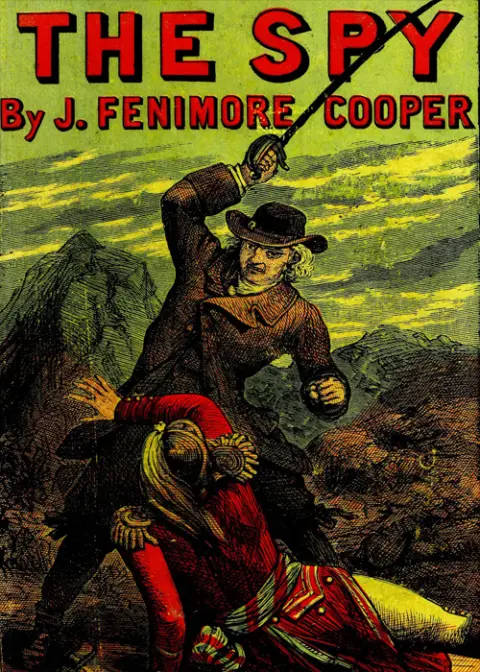
"Hey! my gentlemen, which way so fast?" he cried, "Has Washington sent
you down as spies?"
"I am an innocent peddler," returned Harvey meekly, "and am going below, to lay in a fresh stock of goods."
"And how do you expect to get below, my innocent peddler? Do you think we hold the forts at King's Bridge to cover such peddling rascals as you, in your goings in and comings out?"
"I believe I hold a pass that will carry me through," said the peddler, handing him a paper, with an air of indifference.
The officer, for such he was, read it, and cast a look of surprise and curiosity at Harvey, when he had done.
Then turning to one or two of his men, who had officiously stopped the
way, he cried,--
"Why do you detain the man? Give way, and let him pass in peace. But whom have we here? Your name is not mentioned in the pass!"
"No, sir," said the Skinner, lifting his hat with humility. "I have been a poor, deluded man, who has been serving in the rebel army; but, thank God, I've lived to see the error of my ways, and am now come to make reparation, by enlisting under the Lord's anointed."
"Umph! a deserter--a Skinner, I'll swear, wanting to turn Cowboy! In the last brush I had with the scoundrels, I could hardly tell my own men from the enemy. We are not over well supplied with coats, and as for countenances, the rascals change sides so often, that you may as well count their faces for nothing; but trudge on, we will contrive to make use of you, sooner or later."
Ungracious as was this reception, if you could judge of the Skinner's feelings from his manner, it nevertheless delighted him. He moved with alacrity towards the city, and really was so happy to escape the brutal looks and frightful manner of his interrogator, as to lose sight of all other considerations. But the man who performed the functions of orderly in the irregular troop, rode up to the side of his commander, and commenced a close and apparently a confidential discourse with his principal. They spoke in whispers, and cast frequent and searching glances at the Skinner, until the fellow began to think himself an object of more than common attention. His satisfaction at this distinction was somewhat heightened, at observing a smile on the face of the captain, which, although it might be thought grim, certainly denoted satisfaction. This pantomime occupied the time they were passing a hollow, and concluded as they rose another hill. Here the captain and his sergeant both dismounted, and ordered the party to halt. The two partisans each took a pistol from his holster, a movement that excited no suspicion or alarm, as it was a precaution always observed, and beckoned to the peddler and the Skinner to follow. A short walk brought them to a spot where the hill overhung the river, the ground falling nearly perpendicularly to the shore. On the brow of the eminence stood a deserted and dilapidated barn. Many boards of its covering were torn from their places, and its wide doors were lying, the one in front of the building, and the other halfway down the precipice, whither the wind had cast it. Entering this desolate spot, the refugee officer very coolly took from his pocket a short pipe, which, from long use, had acquired not only the hue but the gloss of ebony, a tobacco box, and a small roll of leather, that contained steel, flint, and tinder. With this apparatus, he soon furnished his mouth with a companion that habit had long rendered necessary to reflection. So soon as a large column of smoke arose from this arrangement, the captain significantly held forth a hand towards his assistant. A small cord was produced from the pocket of the sergeant, and handed to the other. The refugee threw out vast puffs of smoke, until nearly all of his head was obscured, and looked around the building with an inquisitive eye. At length he removed the pipe, and inhaling a draft of pure air, returned it to its domicile, and proceeded at once to business. A heavy piece of timber lay across the girths of the barn, but a little way from the southern door, which opened directly upon a full view of the river, as it stretched far away towards the bay of New York. Over this beam the refugee threw one end of the rope, and, regaining it, joined the two parts in his hand. A small and weak barrel, that wanted a head, the staves of which were loose, and at one end standing apart, was left on the floor, probably as useless. The sergeant, in obedience to a look from his officer, placed it beneath the beam. All of these arrangements were made with composure, and they now seemed completed to the officer's perfect satisfaction.