The Four Seasons
Carl Ewald
THE CLASSIC COLLECTION · 1907
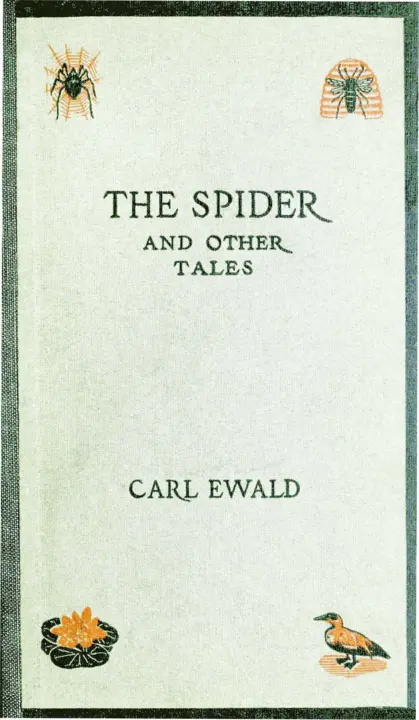
"The Spider and Other Tales" by Carl Ewald is a collection of short stories written in the early 20th century. This anthology features rich, allegorical tales with a focus on nature, animals, and humanity's interaction with them, often exploring themes of independence and societal expectations. Among the prominent characters is a strong-willed spider who challenges conventional roles and relationships, ultimately seeking her place in the world. The opening portion introduces the story of "The Spider," where a proud and independent spider seeks a home within a hedge populated by boastful but fragile weeds and a cautious mouse. The spider’s confident demeanor and rejection of traditional gender roles create an intriguing dynamic, leading to discussions about marriage and independence among the hedge's residents. As the spider begins to build her web, the tale delves into her interactions with other characters, highlighting themes of autonomy and societal pressures regarding love and relationships, setting a tone that invites the reader to contemplate the balance between personal desires and social expectations.
Introduction adapted from the source catalogue; source summaries may be automatically generated.
Free to read · English · 25,727 words · No account needed
MAKE TIME FOR A GOOD BOOK
On by default. Untick to stop anonymous reading totals. Each page counts after 10 seconds in view. How this works.
Anonymous counting is on unless you have switched it off.
So there was. And he was a very handsome bird. He had a green neck, a white throat and a white breast, with a pink sheen on it, and lovely yellow legs.
“That is the drake,” said the gull. “The other two are females and not so smart, although they don’t look bad either.”
The three eider-ducks had now come so near that the sparrow and the gull could hear what they were talking about.
“Dear lady,” said the drake, “I cannot understand why you stay on the ice. Do come to the open water and let us all enjoy ourselves.”
“I must stay with my niece,” said the elder eider-duck. “She is my
sister’s child.”
“And why should not Miss Eider-Duck come too?” said the drake. “In the summer, she was the gayest of us all in the Faroes.”
“That was then,” said Miss Eider-Duck. “But now I have begun to think of other and more serious things.”
The drake tried just a little longer to persuade them, but to no purpose. Then he flew back across the ice.
“Are there no cliffs here, auntie?” asked the young eider-duck. “I am dying to get married and to build a nest.”
“If I may venture to make a remark,” said the sparrow, “I should say that it is still a little too cold. And there are no cliffs in this country.”
“But you can brood in the sand,” said the gull.
“Thank you for the information, my good women,” said Aunt Eider-Duck. “But it is only a fancy of my niece’s. She is three years old now and marriageable.”
“Lord!” said the sparrow. “I was born last summer and, if it was only a little warmer, I could get married at once.”
“It’s easier for one than for another,” said the aunt.
“Let us fly home to the Faroes and get married, auntie,” said the young
duck.
“In a month’s time, my child,” said auntie. “But I must decline the honour for myself. I have now been married seven times and have had enough of it. Still, I will gladly chat about it with you. That is so awfully interesting.”
“The trees will not be green yet in a month,” said the sparrow. “This
is only January.”
“We have no trees in the Faroes, my girl,” said auntie, “and we don’t want them either.”
“Has the young lady a sweetheart?” asked the gull.
“Not yet,” said auntie. “But he’ll come. You can get sweethearts for the asking. She has spent her three years dancing on the sea and having a good time. One must see a little life first.”
Your reading position is saved on this browser. Take it to another device with a library code. Reading pages adapt to text, rather than matching a printed edition.
BEHIND THE BOOK
This eBook is for the use of anyone anywhere in the United States and most other parts of the world at no cost and with almost no restrictions whatsoever. You may copy it, give it away or re-use it under the terms of the Project Gutenberg License included with this eBook or online at www.gutenberg.org. If you are not located in the United States, you will have to check the laws of the country where you are located before using this eBook. Read the source licence.
The original source file, including credits and licence, is retained by this library. Request an original-format copy at no charge. Please include the book title and Project Gutenberg identifier #62910.
KEEP YOUR CURIOSITY GOING
Coulson Kernahan

Maurice Baring
Frances Wright
Cécile Tormay

Frederic Jesup Stimson

W. H. P. (William Henry Pope) Jarvis