
Polly the Pagan: Her Lost Love Letters
Isabel Anderson
THE CLASSIC COLLECTION · 1915
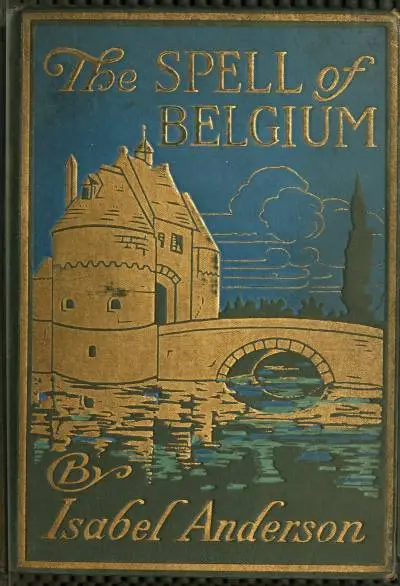
"The Spell of Belgium" by Isabel Anderson is a historical account written in the early 20th century. The book explores the rich cultural heritage, defining historical moments, and the daily lives of the Belgian people during a significant period marked by the backdrop of war. Through the personal experiences of the author and her observations, it sheds light on the unique charm of Belgium, its architecture, art, traditions, and especially the resilience of its citizens. At the start of "The Spell of Belgium," the author introduces her experience of living in Brussels as the spouse of an American minister. The narrative begins with their arrival in Belgium, focusing on the excitement and the nuances of diplomatic life. The reader is drawn into vivid descriptions of the royal audience with the Belgian king and queen and the ceremonial aspects of their roles. Through the lens of the author's observations, we also catch glimpses of significant historical figures and events that have shaped the country, as well as an appreciation for Belgian culture amid the impact of war. The beginning establishes a personal connection and a sense of deep appreciation for the history and charm of Belgium.
Introduction adapted from the source catalogue; source summaries may be automatically generated.
Free to read · English · 91,003 words · No account needed
MAKE TIME FOR A GOOD BOOK
On by default. Untick to stop anonymous reading totals. Each page counts after 10 seconds in view. How this works.
Anonymous counting is on unless you have switched it off.
Charles van Lerberghe wrote his play of the new school, "Les Flaireurs," in 1889, before Maeterlinck had published anything, but his work resembles the latter's somewhat in style. He was born in 1862, of a Flemish father and a Walloon mother, which resulted in a sort of dual personality. Van Lerberghe was "a man for whom modern life had no more existence than for a mediæval recluse," and he passed his happiest years in an old-world village in the Ardennes. He died in 1907, having published besides the play already mentioned, only three little books of poetry, "Entrevisions," "La Chanson d'Eve," and "Pan"--small but classic. Maeterlinck speaks of his verse as having a sort of "lyric silence, a quality of sound such as we have not heard in our French poetry." The early poems of Rossetti are suggested by his work.
"If poetry is music van Lerberghe is a poet. The charm of his verses is unique," writes Bithell. Are not these stanzas on "Rain" exquisite?
"The rain, my sister dear,
The summer rain, warm and clear,
Gently flees, gently flies,
Through the moist atmosphere.
"Her collar of white pearls
Has come undone in the skies.
Blackbirds, sing with all your might,
Dance, magpies!
Among the branches downward pressed,
Dance, flowers, dance, every nest,
All that comes from the skies is blest."
"Fernand Severin, who was lecturer in French literature at the University of Ghent, is a poet of great charm. His diction is apparently that of Racine, but in substance he is essentially modern." The following lines, from the translation by Bithell, will give an idea of the grace and beauty of his style:
"Her sweet voice was a music in mine ear;
And in the perfume of the atmosphere
Which, in that eve, her shadowy presence shed,
'Sister of mystery,' trembling I said,
'Too like an angel to be what you seem,
Go not away too soon, beloved dream!'"
Albert Mockel is a fine musician and an excellent critic, as well as a good poet, a combination which is very rare. He is learned, subtle and brilliant. "Chantefable un peu Naïve" and "Clartés" contain musical notations of rhythms.
I give here part of one of his poems called
"Jewels, ribbons, naked necks,
And the living bouquet that the corsage decks;
Women, undulating the soft melody
Of gestures languishing, surrendering--
And the vain, scattered patter of swift words--
Silken vestures floating, faces bright,
Furtive converse, gliding glances, futile kiss
Of eyes that flitting round alight like birds,
And flee, and come again coquettishly;
Laughter, and lying ... and all flying away
To the strains that spin the frivolous swarm around."
Your reading position is saved on this browser. Take it to another device with a library code. Reading pages adapt to text, rather than matching a printed edition.
Isabel Anderson

Isabel Anderson
Isabel Anderson
BEHIND THE BOOK
This eBook is for the use of anyone anywhere in the United States and most other parts of the world at no cost and with almost no restrictions whatsoever. You may copy it, give it away or re-use it under the terms of the Project Gutenberg License included with this eBook or online at www.gutenberg.org. If you are not located in the United States, you will have to check the laws of the country where you are located before using this eBook. Read the source licence.
The original source file, including credits and licence, is retained by this library. Request an original-format copy at no charge. Please include the book title and Project Gutenberg identifier #40713.
KEEP YOUR CURIOSITY GOING
Wilfrid Scawen Blunt
Wilfrid Scawen Blunt

E. W. (Edgar Watson) Howe
Cécile Tormay

Moritz Busch
John L. Ransom