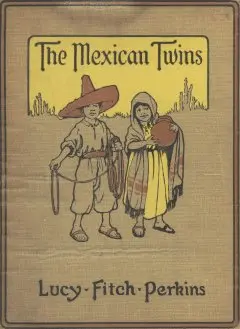
The Mexican Twins
Lucy Fitch Perkins
THE CLASSIC COLLECTION · 1918
"The Spartan Twins" by Lucy Fitch Perkins is a children's historical novel written in the early 20th century. The story centers on the lives of twin siblings, Dion and Daphne, who are children of a Spartan farmer living on the island of Salamis, just off the coast of Greece in the 5th century B.C. The narrative captures their adventures and experiences as they navigate their family life, interactions with a visiting philosopher, and ultimately their journey to Athens. The opening of the book introduces the twins and their family, focusing on a typical spring day at their farm where Lydia, the mother, is busy preparing for an unexpected guest. The children, looking remarkably alike, are depicted as playful and lively, engaging in banter about their differing abilities and aspirations. As their father, Melas, brings home a traveling philosopher, Lydia scrambles to prepare a meal for her husband and their honored guest. The chapter sets a lively scene filled with familial warmth and hints at the twins' adventurous spirits as they engage with new people and ideas, establishing a rich context for their impending journey into the heart of Athens and its accompanying challenges.
Introduction adapted from the source catalogue; source summaries may be automatically generated.
Free to read · English · 21,098 words · No account needed
MAKE TIME FOR A GOOD BOOK
On by default. Untick to stop anonymous reading totals. Each page counts after 10 seconds in view. How this works.
Anonymous counting is on unless you have switched it off.
"What are the walls for?" asked Daphne. "It seems silly to build high walls like this right out in the country."
"Not so silly when you think about it," answered Melas. "These walls were built by Pericles, so that if any enemy should make an invasion, Athens would always have a safe access to the sea. Without that she could be starved within her own walls in a very short time."
"Pericles must be almost as powerful and wise as the Gods themselves, I should think," said Daphne.
"He does all these things by the help of the Gods, without doubt," said
Melas.
When they were halfway on their journey to the city, Dion suddenly let down his side of the basket with a thump.
"Remember the eggs!" cried Daphne sharply, but Dion did not seem to hear.
"Look! Look!" he cried and pointed toward the east. There against the sky, on the top of the sacred mountain, stood a gigantic figure shining in the sun.
"What is it?" cried both children at once.
"That is the bronze statue of Athena, the Goddess who gives protection to
Athens," said Melas.
"Did Pericles make that too?" asked Daphne.
Melas laughed. "No," he said; "you must not think Pericles made everything you may see in Athens. Great as he is, he is not a sculptor."
"Oh, oh," cried Dion, "I want to see the Gorgon's head with snaky locks. Don't you remember the Stranger said it was on the breastplate of the statue?"
"Ugh," said Daphne, shuddering. "I don't believe I'd like it. It must
look just like eels."
"Come, come," said Melas. "At this rate you won't have a chance. The day will be gone before we know it."
The Twins picked up the basket, and the three marched on toward the city, and it was not long before they had entered the gate and were passing along closely built-up streets to the home of the greatest man in Athens.
"This is the place," said Melas at last, stopping at one of the houses.
"This isn't Pericles' house, is it?" cried Daphne. "Why, I thought it would be the biggest house in Athens, and it looks just like the others."
"Pericles does not put on much style," said Melas, as he lifted the knocker on the door. "He is too great to need display. He cares more about fine public buildings for the city than about making his neighbors envious by living better than they do. Just get the idea out of your head that greatness means wealth and luxury, or you are no true Spartans, nor even good Athenians."
Your reading position is saved on this browser. Take it to another device with a library code. Reading pages adapt to text, rather than matching a printed edition.
Lucy Fitch Perkins
Lucy Fitch Perkins
Lucy Fitch Perkins
Lucy Fitch Perkins
BEHIND THE BOOK
This eBook is for the use of anyone anywhere in the United States and most other parts of the world at no cost and with almost no restrictions whatsoever. You may copy it, give it away or re-use it under the terms of the Project Gutenberg License included with this eBook or online at www.gutenberg.org. If you are not located in the United States, you will have to check the laws of the country where you are located before using this eBook. Read the source licence.
The original source file, including credits and licence, is retained by this library. Request an original-format copy at no charge. Please include the book title and Project Gutenberg identifier #9966.
KEEP YOUR CURIOSITY GOING
Cécile Tormay

Moritz Busch
Coulson Kernahan
John L. Ransom

Maurice Baring
Frances Wright